Autoportrait
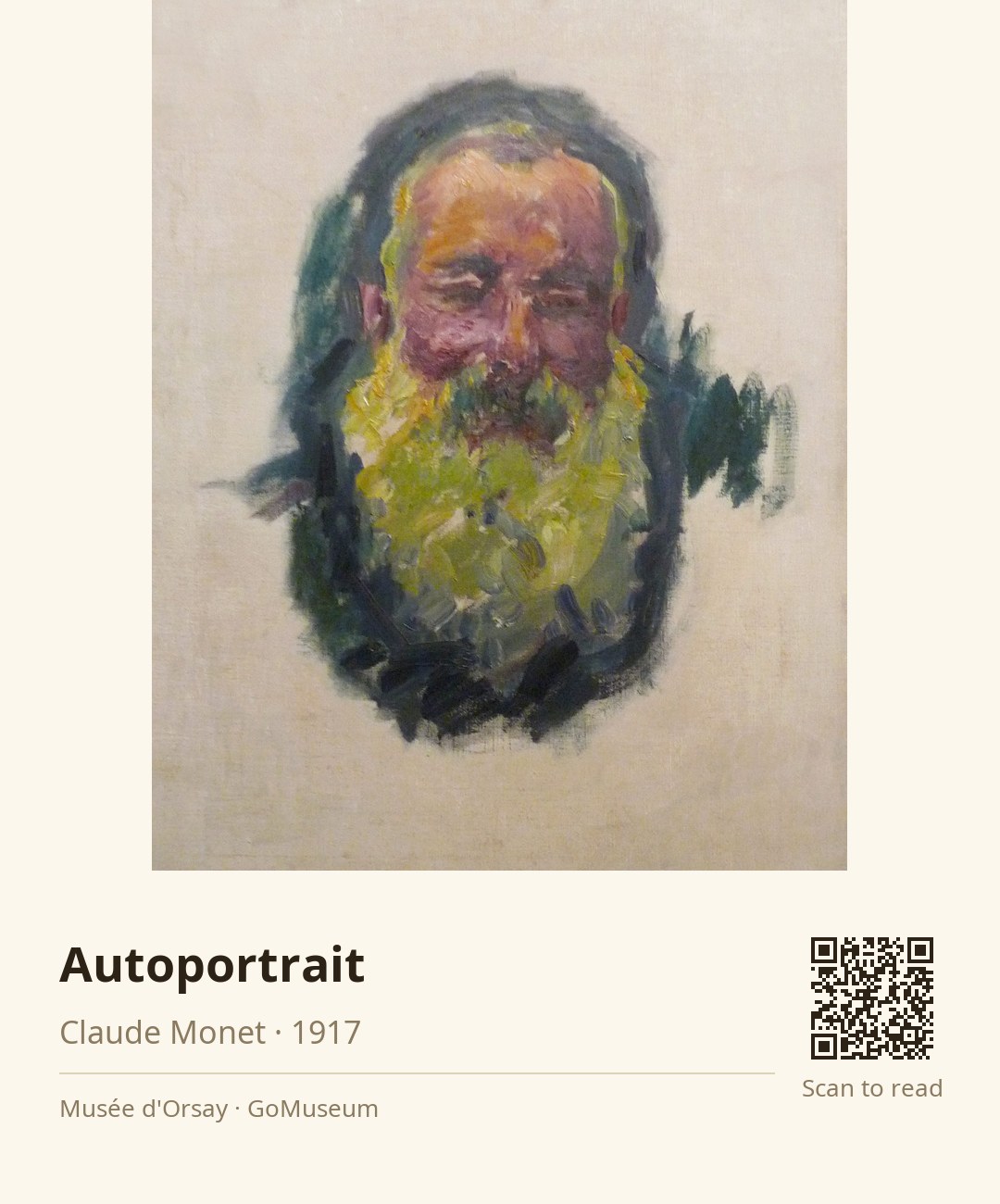
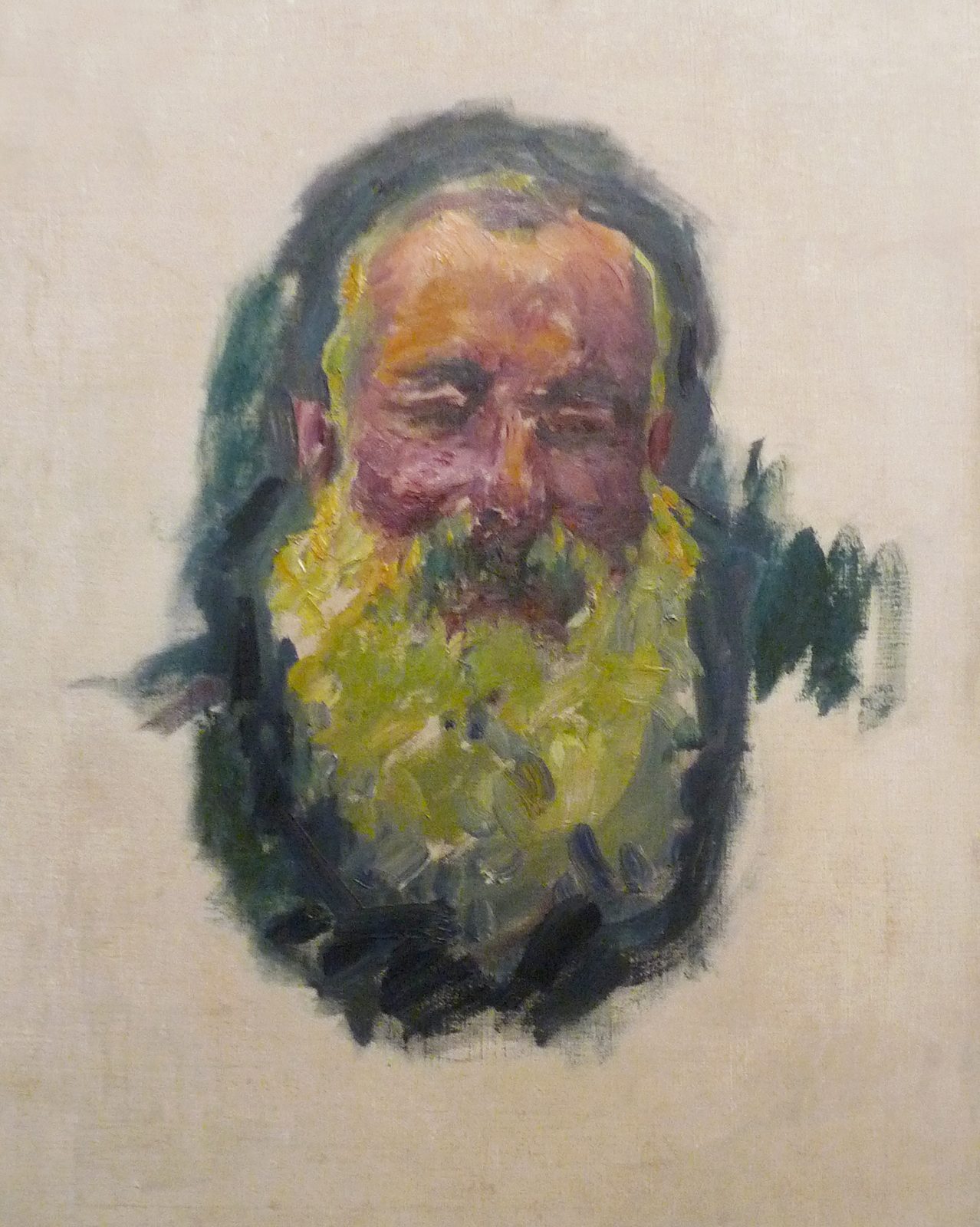
🎧 This work has audio narration — listen in the appMonet painted this head with the paint he had left on his brushes. Look at the forehead first: it is built from short, thick strokes of orange and pink, and the cheeks and nose are heaped with purple and magenta, while the beard is a tangle of yellow, lime green and grey-blue daubs. Around the edges the strokes trail into ragged dark blue-green marks, and beyond them there is nothing but bare, pale canvas. There is no body, no room, no background at all, only the head floating in raw cloth.
That emptiness is part of the story. According to the account preserved in the museum's records, Georges Clemenceau, the statesman who had commissioned those panels, came to visit the studio and noticed this unfinished head. Monet explained that he had painted it because he needed to clean his brushes, so the self-portrait began as a byproduct of simply wiping colour off his tools. It is a loose, almost careless thing, and yet it sits among the last self-portraits he ever made.
Oscar-Claude Monet, born on November 14, 1840, in Paris, was a pioneering French painter and a founder of Impressionism, a movement that transformed the art world. Raised in Le Havre, he developed a passion for nature and painting early on, encouraged by his mother, while his father hoped he would pursue a business career. After his mother's death in 1857, Monet moved in with his aunt, who supported his artistic ambitions.
Monet's career began with caricatures, but he soon sought formal training, studying under Eugène Boudin, who introduced him to plein air painting. His breakthrough came in 1866 with "La Femme à la robe verte," which garnered attention at the Salon. The term "Impressionism" originated from his work "Impression, Sunrise," exhibited in 1874, marking a shift away from traditional art.
Throughout his life, Monet focused on capturing the essence of light and color in nature, creating series of paintings that depicted the same scenes under varying conditions, such as his famous haystacks and water lilies. He settled in Giverny in 1883, where he cultivated a beautiful garden that became his muse. Despite personal hardships, including the loss of loved ones and health issues, Monet's relentless dedication to his craft solidified his place in art history as a master of modernism, influencing countless artists and leaving a lasting legacy. He died on December 5, 1926, in Giverny, celebrated as one of the most significant figures in art.
Monet made this in 1917, at Giverny, while he was busy with the water-lily canvases. The museum's material tells us the work passed through the hands of Georges Clemenceau, the man who had commissioned those big panels. Clemenceau came to the studio, saw this unfinished head, and asked about it. Monet's answer was simple: he had painted it because he needed to clean his brushes. So a sketch that began as a way of wiping paint off tools ended up in Clemenceau's possession, which is why the record lists his name as the one who held it.
The head is seen straight on and sits dead centre on canvas that is otherwise bare, pale and finely woven. Nothing else is painted: no body, no room, no background, no inscription. The forehead is bald and built from orange and pink strokes, while the nose and cheeks take on purple and magenta. The heavy dark brows lean over narrowed eyes, and the beard is a patchwork of yellow, lime green and grey-blue daubs, with a darker patch around the mouth. The outline is drawn with dark blue-green marks that break off into ragged strokes at the right and bottom edges, so the head seems to dissolve into the surrounding cloth rather than sit in a space.
Monet said he made it simply to clean his brushes, so it began as a practice wipe of leftover paint rather than a planned, finished portrait.