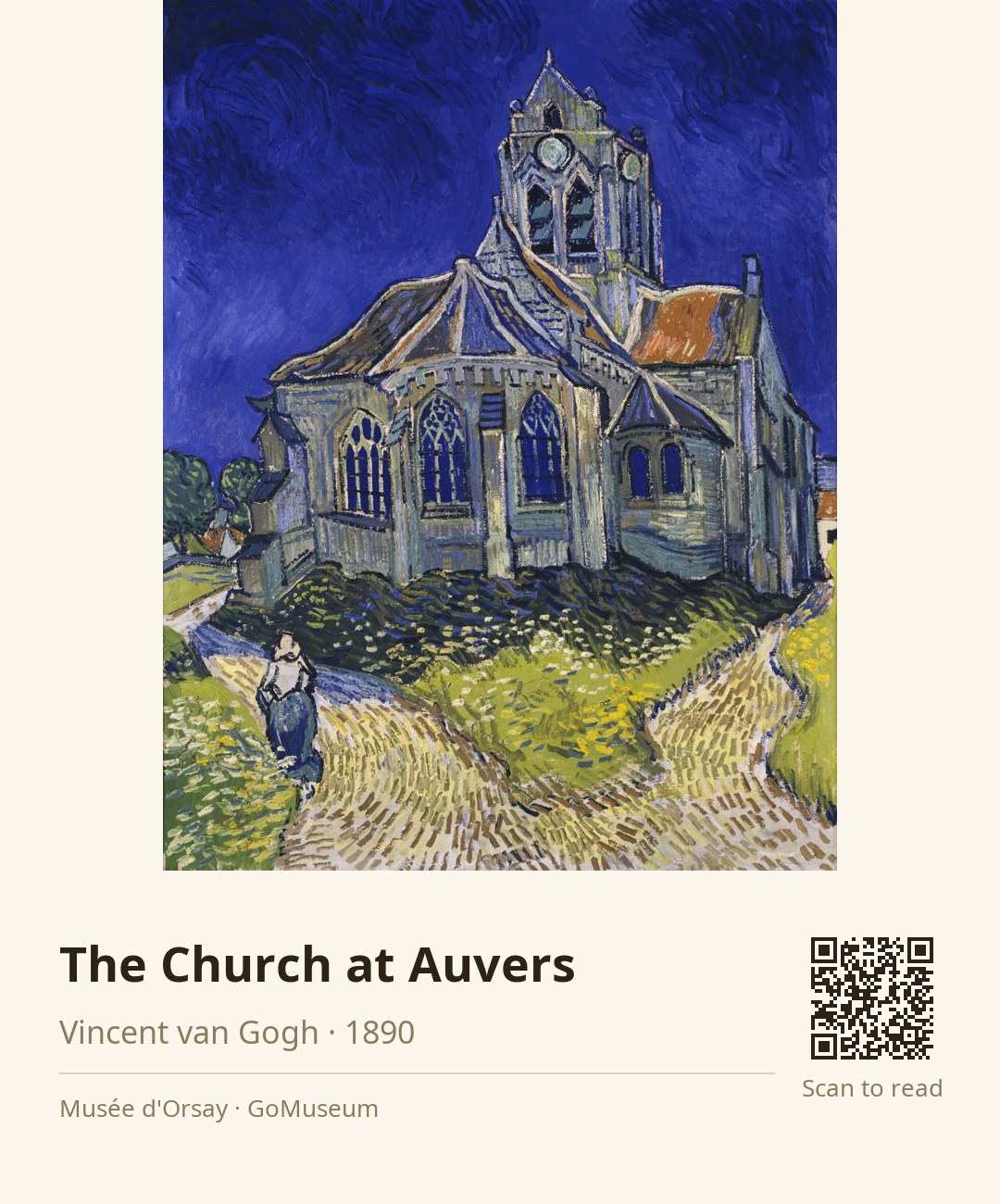
The Church at Auvers
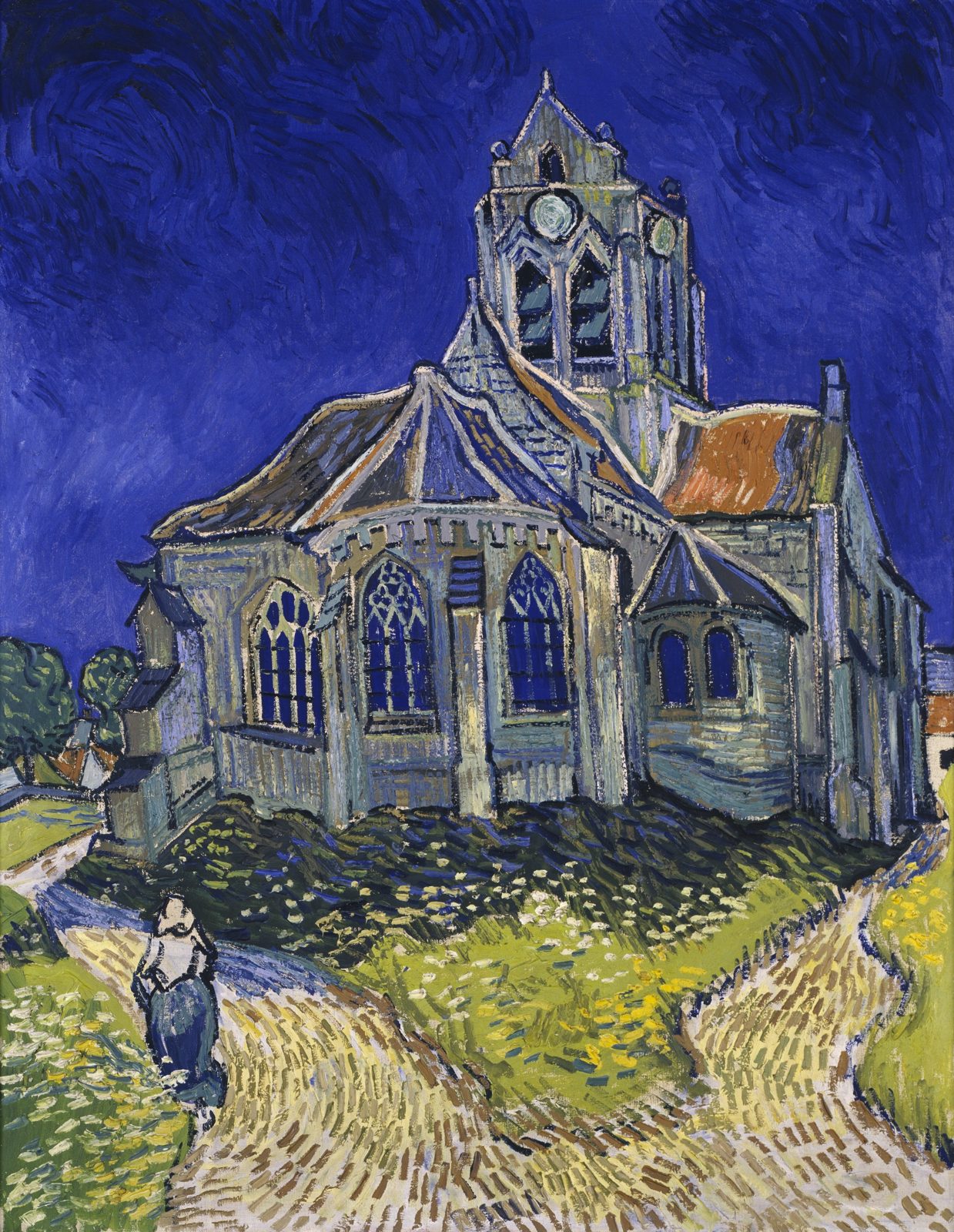
🎧 This work has audio narration — listen in the appTake a moment to really look at "The Church at Auvers." Notice how the church stands tall, almost looming, against that deep cobalt sky. The vibrant colors seem to pulse with emotion, don’t they? Look closely at the stained-glass windows; they’re not just glass—they’re splashes of ultramarine, almost like Van Gogh poured his feelings right onto the canvas. This contrast between the vibrant foreground and the shadowy church is significant. It reflects Van Gogh’s own struggles with light and darkness, both in his art and his life. The church, despite its grandeur, feels heavy and uninviting, almost as if it’s a metaphor for the emptiness he felt inside. In his letters, he spoke of the church as a place devoid of light, echoing Shakespeare’s words about the emptiness of preaching. Painted in June 1890, just weeks before his death, this piece captures a moment of nostalgia for Van Gogh. He had returned to the north of France, where he had spent his early years, and you can sense that longing in the way he depicts the church. It’s a blend of memory and emotion, a reflection of his turbulent mind. As you stand here, consider what this church represents for you. Does it evoke a sense of solace, or does it feel more like a reminder of struggles?
Vincent van Gogh was a Dutch Post-Impressionist painter born on March 30, 1853, in Zundert. He is renowned for his vibrant use of color and expressive brushwork, which laid the groundwork for modern art. Despite creating around 2,100 artworks in just over a decade, including 860 oil paintings, he struggled with mental illness and poverty throughout his life. His early career as an art dealer was marked by disillusionment, leading him to pursue painting in 1881.
Van Gogh's intense passion for art was evident in his correspondence with his brother Theo, who provided emotional and financial support. His works evolved significantly after moving to Paris in 1886, where he mingled with avant-garde artists. His time in Arles in 1888 marked a peak in his creativity, producing iconic series like sunflowers and wheat fields.
Tragically, van Gogh's life ended in suicide at 37, after years of battling his demons. Initially unrecognized, he gained fame posthumously, becoming a symbol of the tortured artist. His legacy influenced movements like Fauvism and Expressionism, securing his place as one of the most significant figures in art history.
Vincent van Gogh painted 'The Church at Auvers' in June 1890, during a tumultuous period in his life. This work was created shortly after he moved to Auvers-sur-Oise, a village north of Paris, where he sought treatment from Dr. Paul Gachet, a physician and fellow artist. Van Gogh's time in Auvers was tragically brief, lasting only about two months before his untimely death on July 29, 1890. This painting, along with others he completed during this period, reflects a deep nostalgia for his earlier years in the north of France. In a letter to his sister Wilhelmina, he described the church with vivid colors, emphasizing the contrast between the violet hues of the building and the cobalt sky. After his death, the painting passed through the hands of Dr. Gachet and his son Paul before finding its home at the Musée d'Orsay in Paris, where it remains today, a testament to Van Gogh's enduring legacy.
As you gaze at 'The Church at Auvers,' pay attention to Van Gogh's dynamic brushwork. The strokes are not merely applied; they dance across the canvas, creating a sense of movement that contrasts sharply with the static form of the church. Notice how the vibrant foreground, filled with green plants and sunlight, contrasts with the shadowy church, which seems almost to absorb light rather than reflect it. This juxtaposition heightens the emotional weight of the piece. Van Gogh's choice of color is striking; the ultramarine of the stained-glass windows and the deep cobalt sky evoke a sense of longing and melancholy. The composition is deliberately skewed, with the church looming large and dominating the scene, yet the paths diverging in the foreground suggest choices and uncertainty. This tension between light and shadow, movement and stillness, encapsulates Van Gogh's inner turmoil, making the painting not just a depiction of a building, but a window into his soul.
One surprising aspect of 'The Church at Auvers' is that it was painted during the last weeks of Van Gogh's life, yet he managed to create around 70 canvases in that short span. This intense burst of creativity showcases his relentless drive to express his emotions and experiences through art, even as he faced profound personal struggles. The painting's vibrant colors and dynamic brushwork stand in stark contrast to the darkness he felt, making it a powerful testament to his artistic genius.
During the creation of 'The Church at Auvers,' Van Gogh was experiencing profound emotional turmoil, as he was grappling with his mental health issues and a sense of impending doom, having only weeks left to live.
The painting reflects a nostalgia for Van Gogh's earlier years in the north of France, reminiscent of his work during his Nuenen period, where he explored similar themes of rural life and architecture.
Van Gogh's style in 'The Church at Auvers' showcases influences from Japanese art, particularly in his use of bold colors and dynamic brushwork, which were inspired by the woodblock prints he admired.