Olympia
🎧 Free preview: one of 5 works you can listen to here in full.
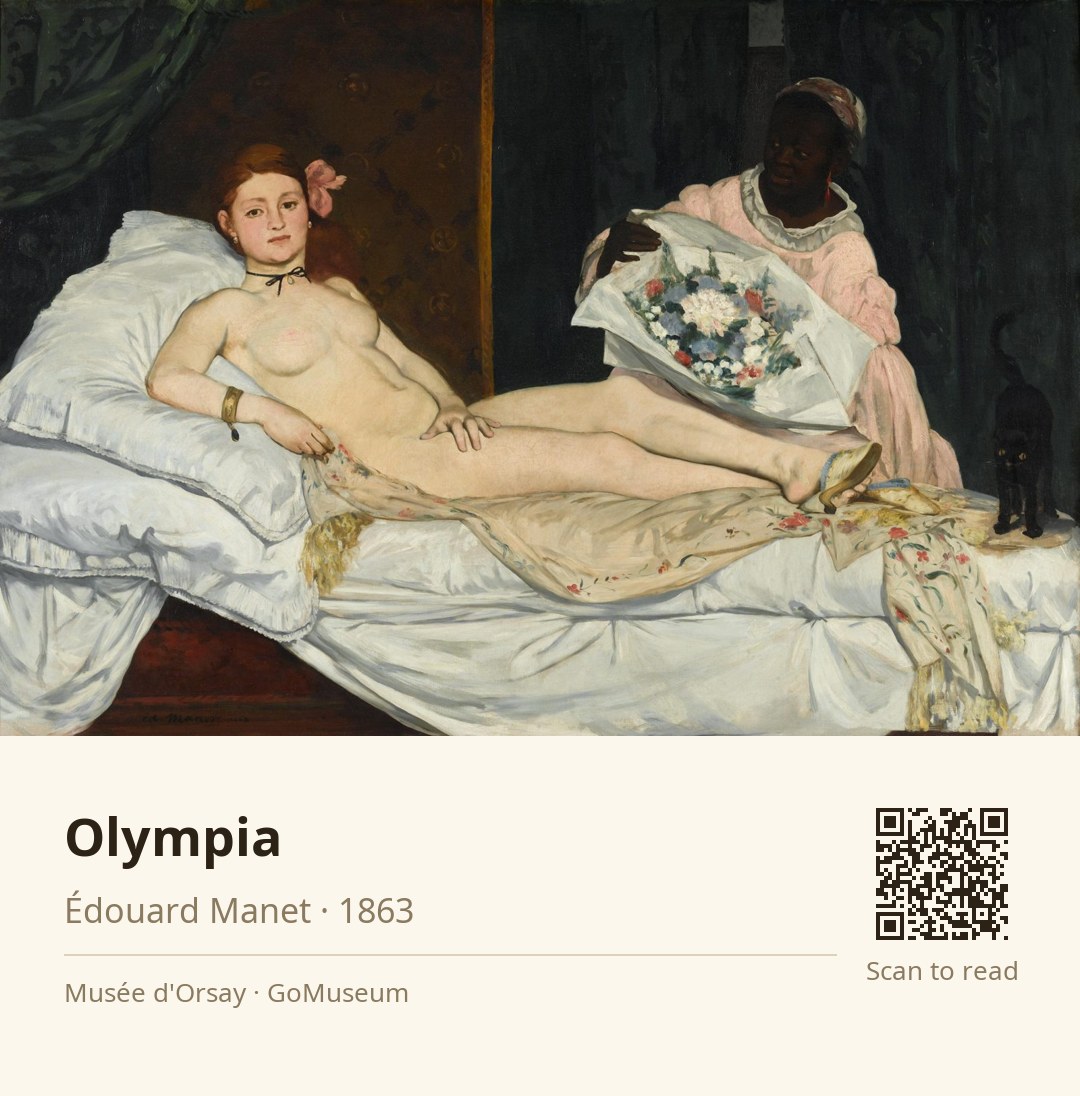
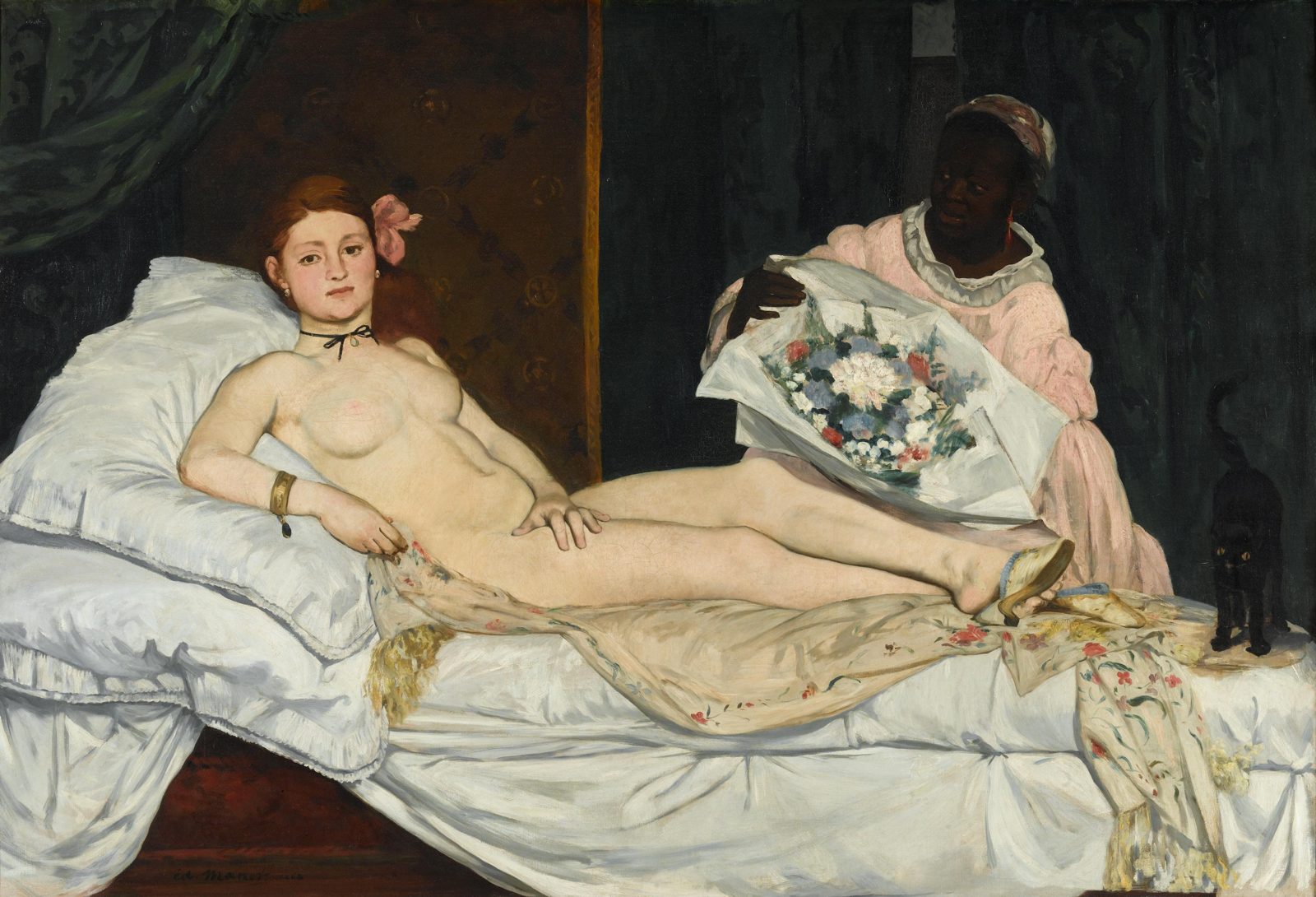
Take a moment to really look at "Olympia" by Édouard Manet. Notice how the figure of the woman, reclining on the bed, meets your gaze with a boldness that feels almost confrontational. Manet painted this in 1863, and at the time, a woman looking directly at the viewer while nude was scandalous. Now, check out the details around her: the black cat perched at the foot of the bed, its tail raised, and the cut flowers being offered by her maid. These elements are loaded with meaning. The cat, with its suggestive posture, plays on the idea of seduction and promiscuity, while the flowers symbolize fleeting beauty and the transactional nature of her existence as a courtesan. This wasn’t just a painting; it was a statement about the realities of women’s lives in Paris at that time. Manet was inspired by Titian’s "Venus of Urbino," but he flipped the script. Instead of a mythological figure, he presented a contemporary woman, one who embodies the complexities of modern life. The painting was first shown at the Salon in 1865 and caused an uproar, challenging the norms of what art—and women—should represent. As you stand here, think about how "Olympia" invites you to confront not just the subject, but your own perceptions of femininity and power. What do you see in her gaze?
Édouard Manet, born on January 23, 1832, in Paris, emerged as a pivotal figure in 19th-century art, bridging Realism and Impressionism. From an affluent family, he initially faced pressure to pursue a naval career but instead dedicated himself to painting, influenced by his uncle and the Old Masters. His early works, including "The Luncheon on the Grass" and "Olympia," sparked controversy and challenged traditional artistic norms, marking him as a revolutionary force.
Manet's style, characterized by loose brushwork and a focus on contemporary life, diverged from the meticulous techniques of his predecessors. He often depicted modern Parisian scenes, capturing the essence of leisure and social dynamics. Despite initial rejection from the art establishment, he gained recognition among progressive artists and became a mentor to the Impressionists.
Throughout his life, Manet formed connections with influential figures like Baudelaire and Zola, who defended him against critics. His later works, such as "A Bar at the Folies-Bergère," showcased his evolving style and mastery of color. Manet's contributions to art history are profound; he is celebrated not only for his innovative techniques but also for elevating still life and modern subjects to the forefront of artistic expression. He passed away on April 30, 1883, leaving behind a legacy that continues to inspire artists today.
Édouard Manet's "Olympia" was painted in 1863 and first exhibited at the Salon in 1865, where it caused a scandal that reverberated through Parisian society. Manet's choice to present a nude woman with such a direct gaze was shocking, especially in a time when women were typically idealized in art. The uproar was so intense that even the French government took notice, acquiring the painting in 1890 through a public subscription led by Claude Monet. Critics at the time labeled it as 'immoral' and 'vulgar,' and it was a focal point of heated debates about modernity and the role of women in society. The public's reaction was mixed, with some praising its boldness while others condemned it, marking a pivotal moment in the evolution of modern art.
When you look at "Olympia," pay attention to the bold brushwork and the way Manet handles light. He uses broad, quick strokes that give the painting a sense of immediacy and rawness, contrasting sharply with the smooth, idealized nudes of his contemporaries. The lighting is stark, eliminating mid-tones and creating a flatness that emphasizes Olympia's form rather than romanticizing it. Notice how the colors are applied in large, unblended patches, which was revolutionary at the time. The composition is strikingly direct; Olympia's left hand, positioned to block her body, challenges the viewer's gaze, while the black cat at her feet adds a layer of provocative symbolism. This cat, with its raised tail, hints at themes of seduction and promiscuity, while the cut flowers presented by her maid symbolize the transient nature of beauty and desire. The overall effect is one of confrontation, inviting you to grapple with the complexities of femininity and power.
One surprising detail about "Olympia" is that the model for the painting, Victorine Meurent, was not just a muse for Manet; she later became an accomplished painter herself. She exhibited her own works at the Paris Salon in the late 19th century, proving that the woman who inspired such a controversial piece was also a talented artist in her own right, challenging the norms of her time.
The name 'Olympia' was commonly associated with prostitutes during that time, which added a layer of controversy to Manet's painting, as it directly identified the subject as a courtesan rather than an idealized figure.