Luncheon on the Grass
🎧 Free preview: one of 5 works you can listen to here in full.
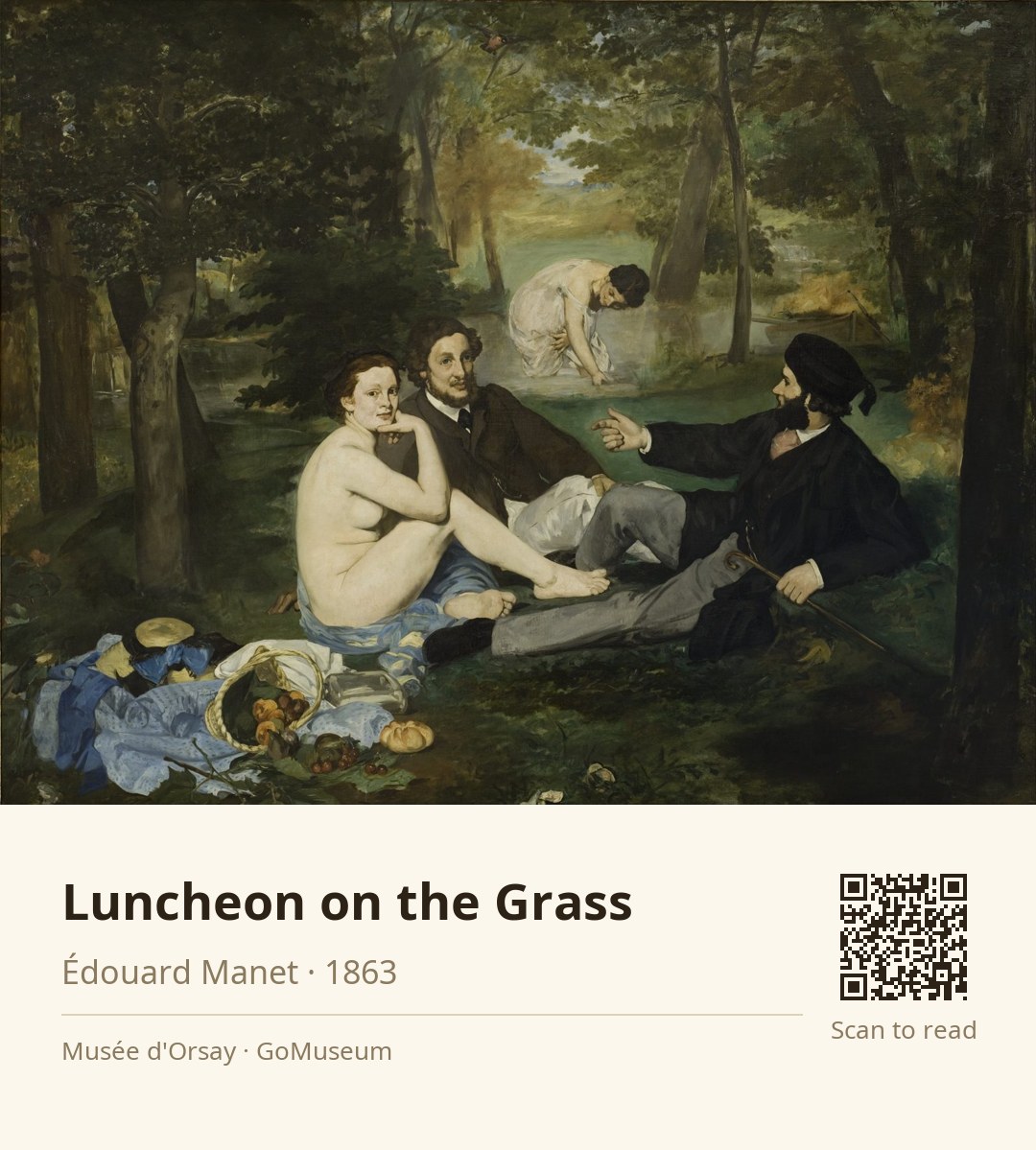
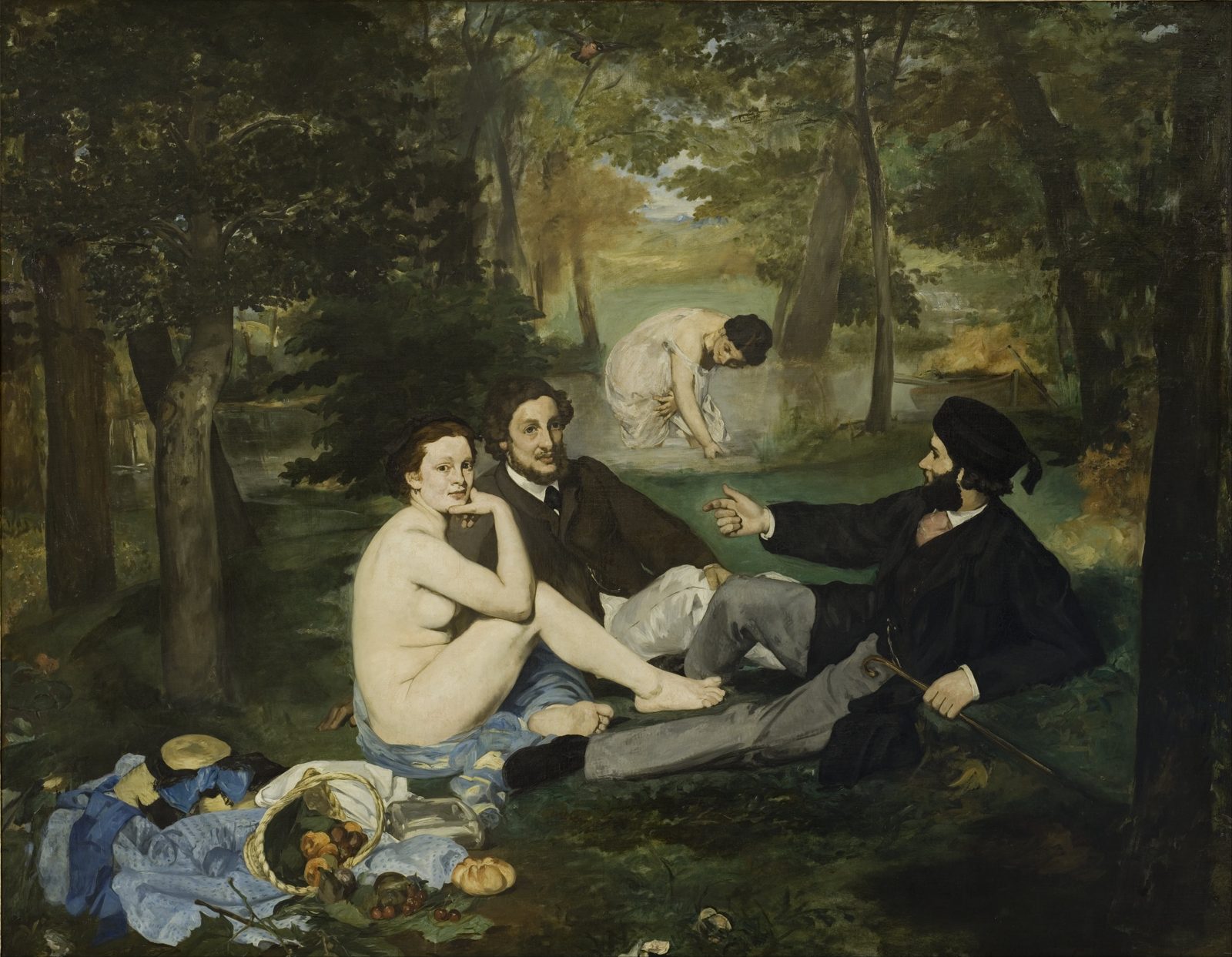
Take a moment to really look at "Luncheon on the Grass" by Édouard Manet. Notice how the nude woman in the foreground boldly stares right at you, while the two men beside her are fully dressed, seemingly oblivious to her gaze. This striking contrast isn’t just about nudity; it challenges the norms of propriety in 19th-century art. Why does this matter? Well, Manet painted this scene not just to provoke, but to question societal expectations. The casualness of the nude woman, juxtaposed with the formality of the men, forces us to confront our own perceptions of decency and the roles of gender. This was revolutionary for its time, as it broke away from the idealized nudes of classical art, presenting instead a raw and unfiltered reality. Created in 1863, "Luncheon on the Grass" was initially rejected by the Salon, leading Manet to showcase it at the Salon des Refusés, where it sparked outrage and debate. Critics saw it as scandalous, but it also marked a pivotal moment in the transition to modern art, paving the way for future movements like Impressionism. As you stand here, consider what the woman’s gaze might mean. Is she challenging you, inviting you in, or simply indifferent? What do you think Manet was trying to say about the world he lived in?
Édouard Manet, born on January 23, 1832, in Paris, emerged as a pivotal figure in 19th-century art, bridging Realism and Impressionism. From an affluent family, he initially faced pressure to pursue a naval career but instead dedicated himself to painting, influenced by his uncle and the Old Masters. His early works, including "The Luncheon on the Grass" and "Olympia," sparked controversy and challenged traditional artistic norms, marking him as a revolutionary force.
Manet's style, characterized by loose brushwork and a focus on contemporary life, diverged from the meticulous techniques of his predecessors. He often depicted modern Parisian scenes, capturing the essence of leisure and social dynamics. Despite initial rejection from the art establishment, he gained recognition among progressive artists and became a mentor to the Impressionists.
Throughout his life, Manet formed connections with influential figures like Baudelaire and Zola, who defended him against critics. His later works, such as "A Bar at the Folies-Bergère," showcased his evolving style and mastery of color. Manet's contributions to art history are profound; he is celebrated not only for his innovative techniques but also for elevating still life and modern subjects to the forefront of artistic expression. He passed away on April 30, 1883, leaving behind a legacy that continues to inspire artists today.
Édouard Manet's "Luncheon on the Grass" was completed in 1863, originally titled "Le Bain". It was first exhibited at the Salon des Refusés, a showcase for works rejected by the official Salon, where it ignited a firestorm of controversy. Critics were outraged by the audacity of a nude woman casually dining with fully dressed men, challenging the era's strict moral codes. The painting was deemed scandalous, and its reception was marked by heated debates about propriety and artistic expression. Despite its initial rejection and failure to sell, the painting significantly boosted Manet's reputation, making him a key figure in the transition to modern art. Over the years, it has been displayed in various prestigious exhibitions, including the Exposition Universelle in 1900 and a major retrospective at the Grand Palais in 1983. Its journey into public ownership began in 1906, thanks to a donation by collector Étienne Moreau-Nélaton, ensuring its place in the Musée d'Orsay, where it remains a cornerstone of modern art.
When you look closely at "Luncheon on the Grass," the technique is as striking as the subject matter. Manet chose a large canvas, typically reserved for grand historical or mythological scenes, to depict this seemingly mundane picnic. Notice how he deliberately left visible brush strokes, giving the painting a raw, unfinished quality that defies the smooth, polished finish of academic art. The figures are arranged in a triangular composition, a nod to classical traditions, yet the stark contrast between the nude woman and the dressed men creates a jarring tension. The light falls dramatically on the nude, emphasizing her form against the darker, more muted tones of the men’s clothing. This choice not only highlights her nudity but also serves to elevate her presence in the scene. The background is painted with a rougher technique, further distancing the nude from the other figures, and suggesting a world that is both familiar and unsettling. Manet's bold use of color and light, combined with his unconventional subject matter, creates a striking visual impact that invites viewers to question societal norms.
By placing a nude woman in a casual picnic scene with fully dressed men, Manet challenged societal norms and the academic standards of his time. This audacious composition not only sparked controversy but also paved the way for modern art movements, influencing artists like Claude Monet and Pierre-Auguste Renoir. Manet's bold brushwork and refusal to hide his techniques signaled a departure from realism, making him a pivotal figure in the transition to Impressionism. Remember this: Manet didn't just paint a scene; he ignited a revolution in how art could reflect and challenge society.
One surprising tidbit about 'Luncheon on the Grass' is that when it was first exhibited at the Salon des Refusés in 1863, it didn’t just shock audiences—it was outright rejected by the Salon jury! This rejection turned out to be a blessing in disguise. The painting sparked such controversy that it propelled Manet into the spotlight, making him a household name. Interestingly, despite the uproar, it failed to sell at its debut, remaining in Manet's possession until he sold it years later for a fraction of its supposed value.
Manet's decision to use a large canvas, typically reserved for grand historical or mythological themes, was a deliberate act of defiance against the academic norms of his time, allowing him to elevate a mundane picnic scene to a level of significance usually reserved for more serious subjects.
While the nudity in 'Luncheon on the Grass' was shocking to many, Émile Zola pointed out that similar depictions existed in classical art, suggesting that the outrage stemmed more from societal hypocrisy than from the act of painting nudity itself.
The nude woman in the painting is believed to be Victorine Meurent, who was not only Manet's favorite model but also a significant figure in his life, appearing in several of his works and representing a personal and artistic bond.