The women of Cervara, near Rome
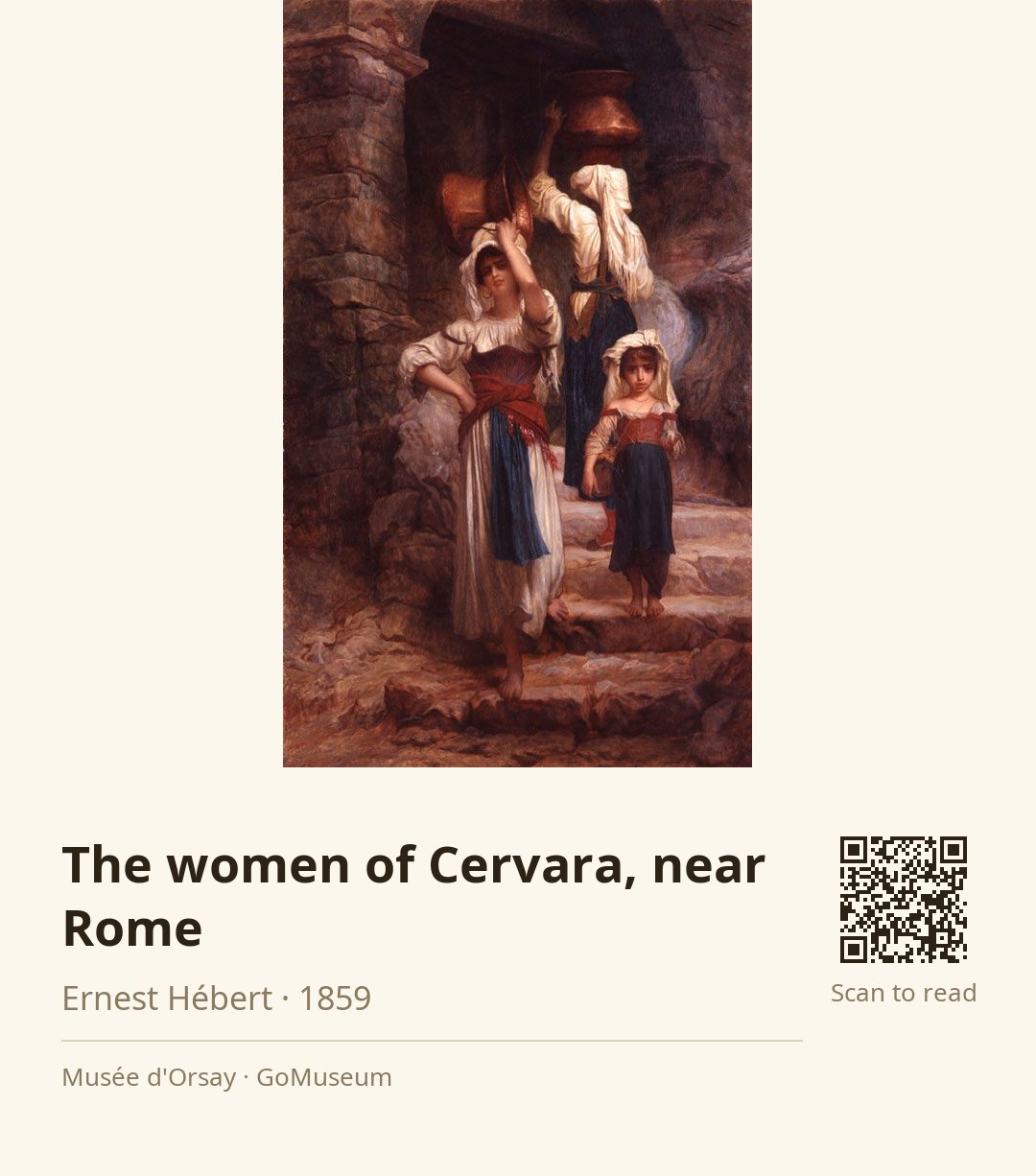
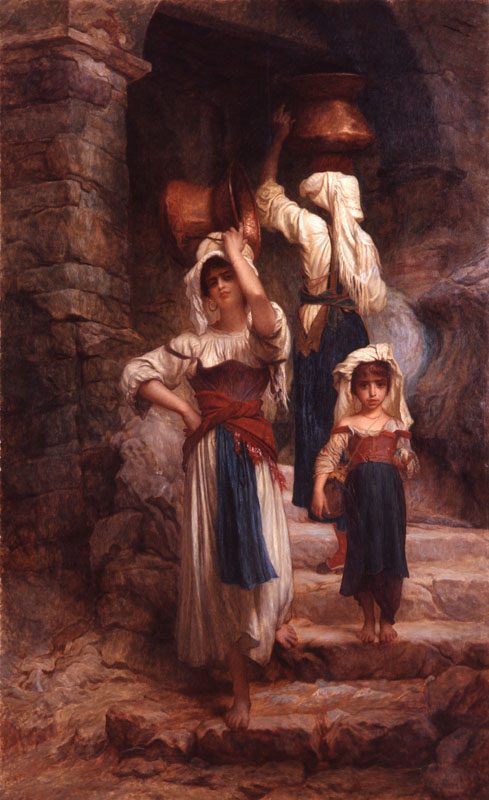
🎧 This work has audio narration — listen in the appThree figures make their way down worn stone steps beneath a dark arched opening, and the one in front has a copper vessel balanced on her white head cloth. She is barefoot, one hand raised to steady the load and the other resting on her hip, as if she has carried water up and down these stairs many times before. Behind her, another woman, seen from the back, is lifting a large copper jar onto her own head, and at the right a small barefoot girl in a white head cloth and red bodice looks out toward us, holding a little basket.
What makes the scene hold together is the way the figures step down one after another in a diagonal, so the eye travels with them rather than resting on any single face. The warm browns, ochres and coppery oranges of the stone and the copper bring the three women into one glowing mass, while the flashes of white, maroon and blue in their clothing keep each of them distinct. The painter gives the stone and the cloth the same close attention, so the rough masonry and the folded fabric seem to have equal weight in the picture.
It was shown at the Paris Salon of 1859, and the work was then exhibited again at the international exhibitions of London in 1862, Paris in 1867 and Vienna in 1873.
Ernest Hébert was a French academic painter born in Grenoble in 1817, the son of a local notary. He first went to Paris in 1835 to study law, but his interest in art soon drew him into the workshops of the sculptor David d'Angers and the history painter Paul Delaroche, though he was largely self-taught. His early success came quickly: at only twenty-two he won attention at the Paris Salon, and in 1839 the Académie des Beaux-Arts awarded him the Prix de Rome for a biblical scene, Joseph's Cup in Benjamin's Sack. That prize carried him to the Villa Medici in Rome, where he spent several years painting the Roman countryside with a notable sense of light.
His best-known work, Mal'aria, shown at the Salon of 1850, depicts Italian peasants fleeing an epidemic by raft, a scene drawn from what he had seen in Italy. Painted in a Romantic manner, it now hangs in the Musée d'Orsay. Later he returned to France and became a sought-after painter of the Second Empire, producing many portraits and drawing on memories of Italy in works that moved toward Symbolism. He directed the French Academy in Rome twice, and he received numerous honors, including the grand prize at the 1889 and 1900 world exhibitions and the highest rank of the Légion d'honneur. Among his circle was the Princess Mathilde, with whom he corresponded for decades, and he married the photographer Gabrielle d'Uckermann in 1880. His commissions also included a mosaic design for the Panthéon. Hébert died in 1908 at his home in La Tronche, near Grenoble, now a museum. He is remembered as a respected academic master whose teaching influenced artists such as Paul Trouillebert, linking Romanticism to the emerging Symbolist mood.
This canvas was shown at the Paris Salon of 1859, and then at the international exhibitions in London in 1862, Paris in 1867 and Vienna in 1873. Before entering the public collection it belonged to Napoléon III, who held it in his private domain. The catalogue lists its title as The women of Cervara, near Rome, under the French form Les Cervaroles (États-Romains).
The painting is an oil on canvas, and the surface is smoothly blended, with more detailed textures reserved for the stone and the fabric. The figures form a diagonal down the steps, and the palette runs warm, in browns, ochres and coppery oranges, with white and blue accents. The foreground woman wears a white blouse with loose sleeves, a maroon bodice, a red fringed sash, a blue apron and a long pale skirt. The woman seen from behind wears a white cloth and a dark skirt with a green sash. The small girl at right wears a white head cloth, a red bodice and a dark blue skirt, and she holds a small basket or vessel. No inscription is visible on the canvas.
The catalogue records that the painting was exhibited in the French section of the 1862 London exhibition, under the number 217 in class 38.
Yes. After winning the Prix de Rome, he lived in Rome as a resident at the Villa Medici from 1840 to 1844, and he painted much of the Roman countryside during that time.