 Image: Sailko
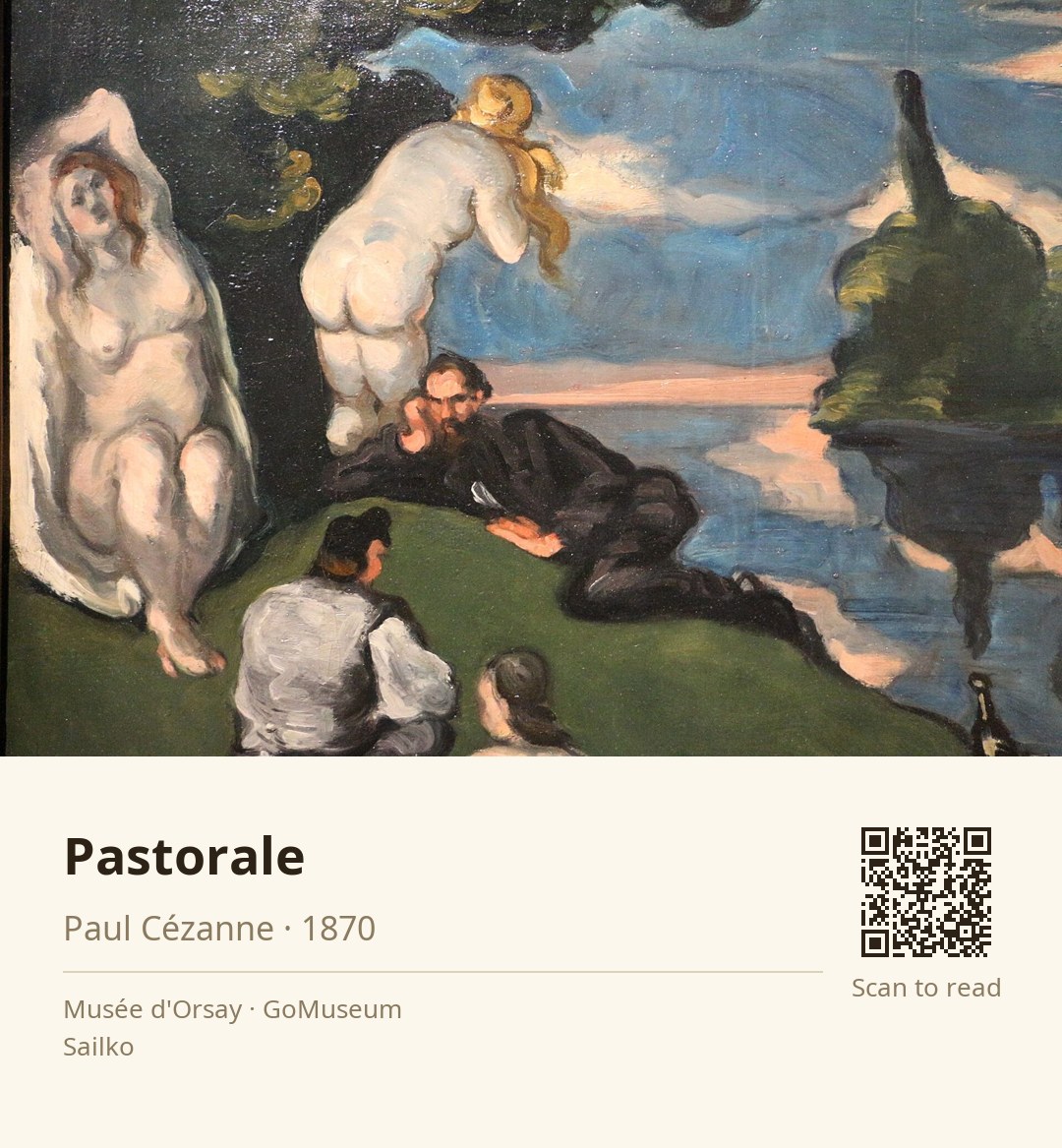
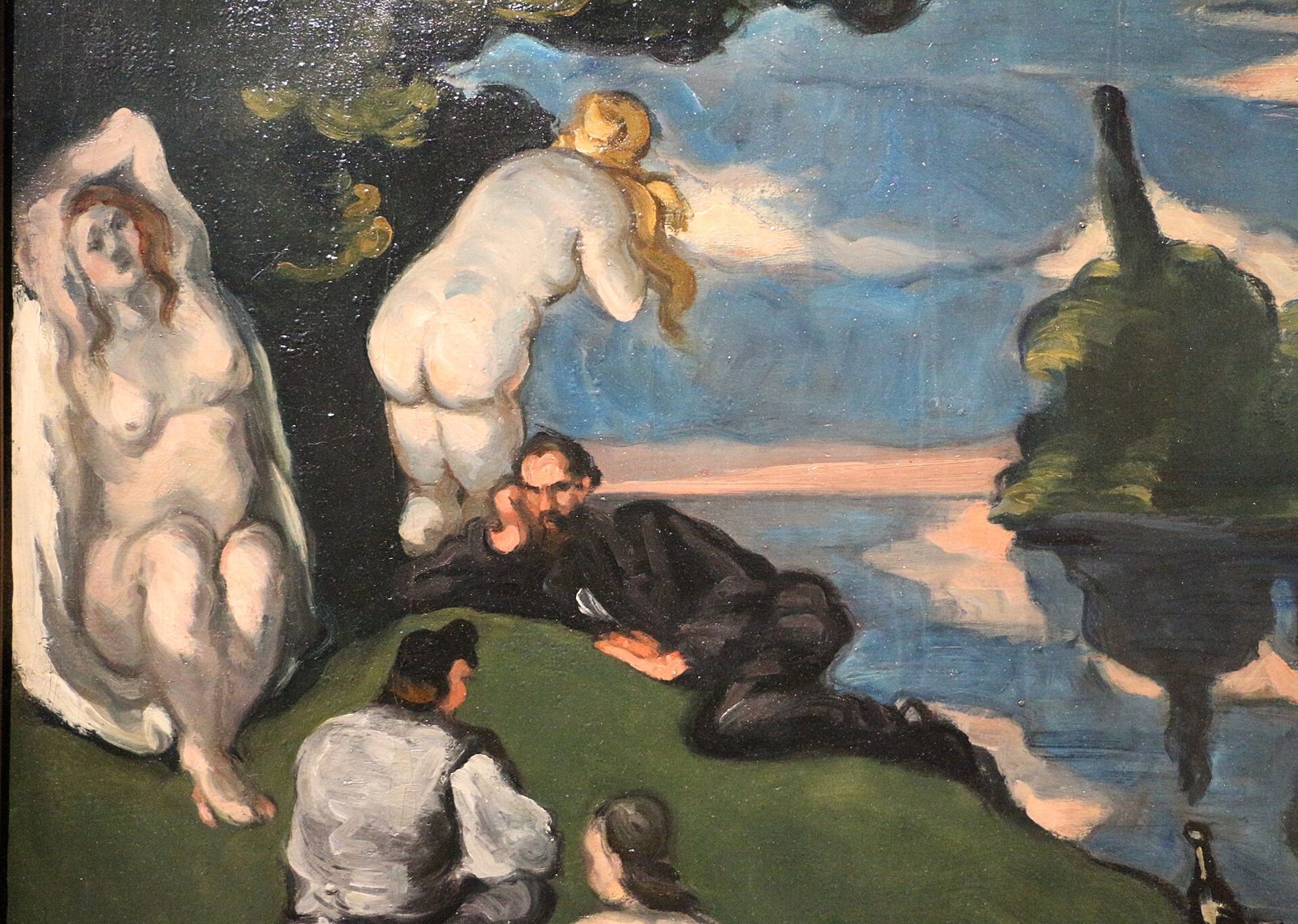
Two women, one of them nude, sit and stand in a clearing while a bearded man lies propped on his elbow beside them, and the whole scene is painted in thick, opaque strokes that never quite settle into smooth flesh or foliage. Look low on the right edge and you will find the neck of a dark bottle, a small, ordinary object pushed to the margin of an idyll.
That bottle and the rough, deliberate handling of the paint are the key to the picture. Cézanne lays colour down in broad, visible patches rather than blending it away, so the bank of grass, the dark mass of trees and the still water all read as painted surfaces first and as places second. The title, Pastorale, promises the old pastoral dream of shepherds at leisure in nature, yet the bottle and the solid, heavy bodies pull that dream back toward the real and the physical.
The work dates from 1870, when Cézanne was in his early thirties and still working out his own language, well before he became the painter later artists would call the father of modern art. It was painted in oil on canvas, and it measures about 81 by 65 centimetres. Its history can be traced through a remarkable line of owners. It first belonged to the physician Paul Gachet in Auvers-sur-Oise, the doctor who later cared for Vincent van Gogh, and then passed to the dealer Ambroise Vollard, who did more than anyone to bring Cézanne before the public. Later it went to the Bernheim-Jeune gallery and to the collector Auguste Pellerin, whose son Jean-Victor Pellerin kept it in Paris.
Paul Cézanne was a French Post-Impressionist painter born on January 19, 1839, in Aix-en-Provence. His innovative approach to color and form bridged the gap between Impressionism and the emerging Cubism of the early 20th century. Initially influenced by Romanticism and Realism, Cézanne developed a unique style that emphasized the underlying structure of objects, using repetitive brushstrokes and planes of color to create depth and complexity in his work.
Despite facing ridicule and misunderstanding from critics during his early career, Cézanne garnered support from fellow artists like Camille Pissarro and the art dealer Ambroise Vollard, who recognized his talent. His first solo exhibition in 1895 marked a turning point, leading to greater appreciation of his contributions to art. Cézanne's legacy is profound; both Henri Matisse and Pablo Picasso acknowledged him as a foundational figure in modern art, dubbing him "the father of us all." He passed away on October 22, 1906, leaving behind a transformative body of work that continues to influence artists today.
The title given in the record is Pastorale, though its French catalogue entry also lists the alternative title Idylle, which the museum's records keep alongside it.
The sources say that both Henri Matisse and Pablo Picasso are reported to have remarked that Cézanne "is the father of us all".
It was accepted by the State in 1982 as a payment in kind of inheritance taxes, and was then given to the Musée d'Orsay.