Self-portraits
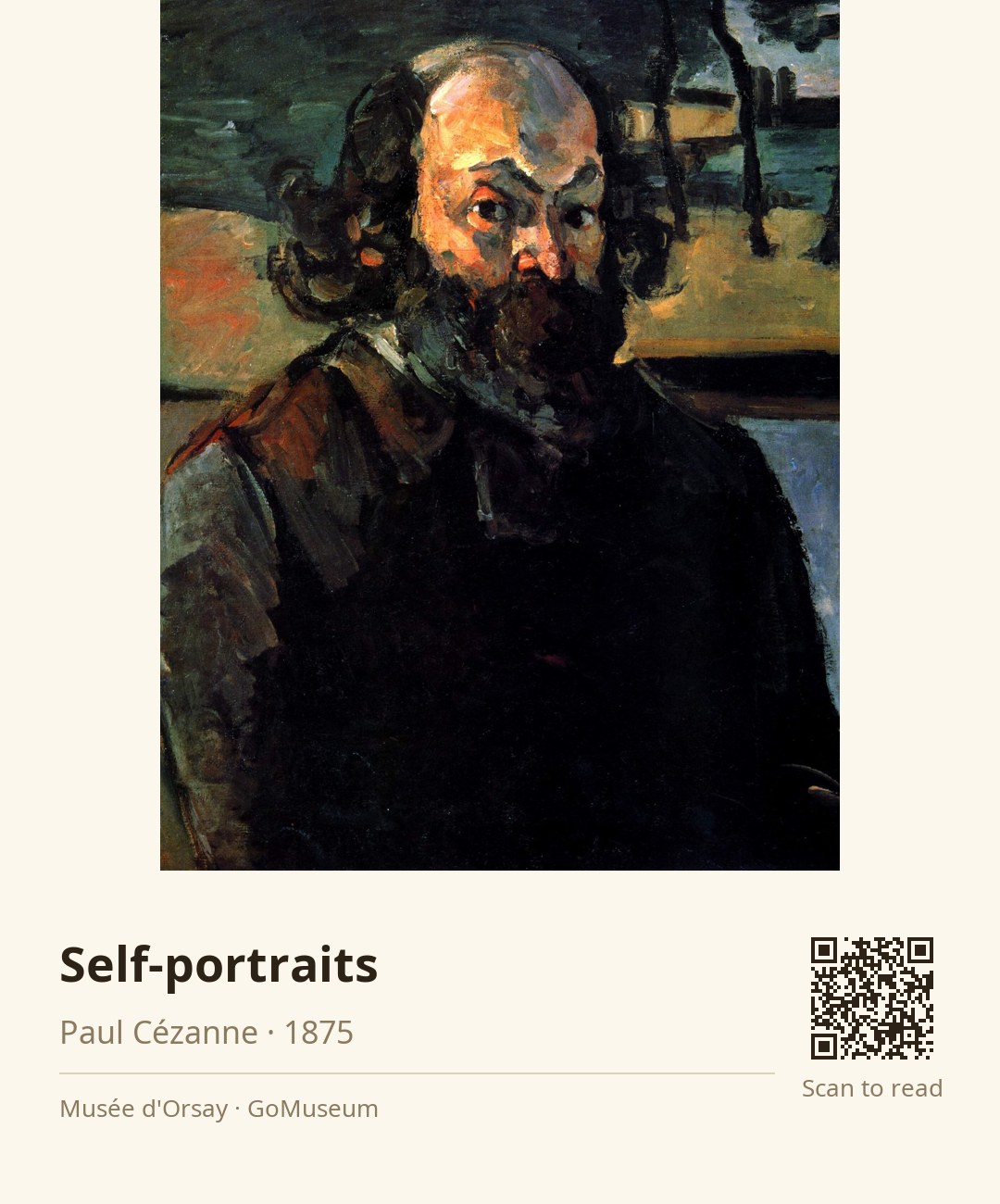
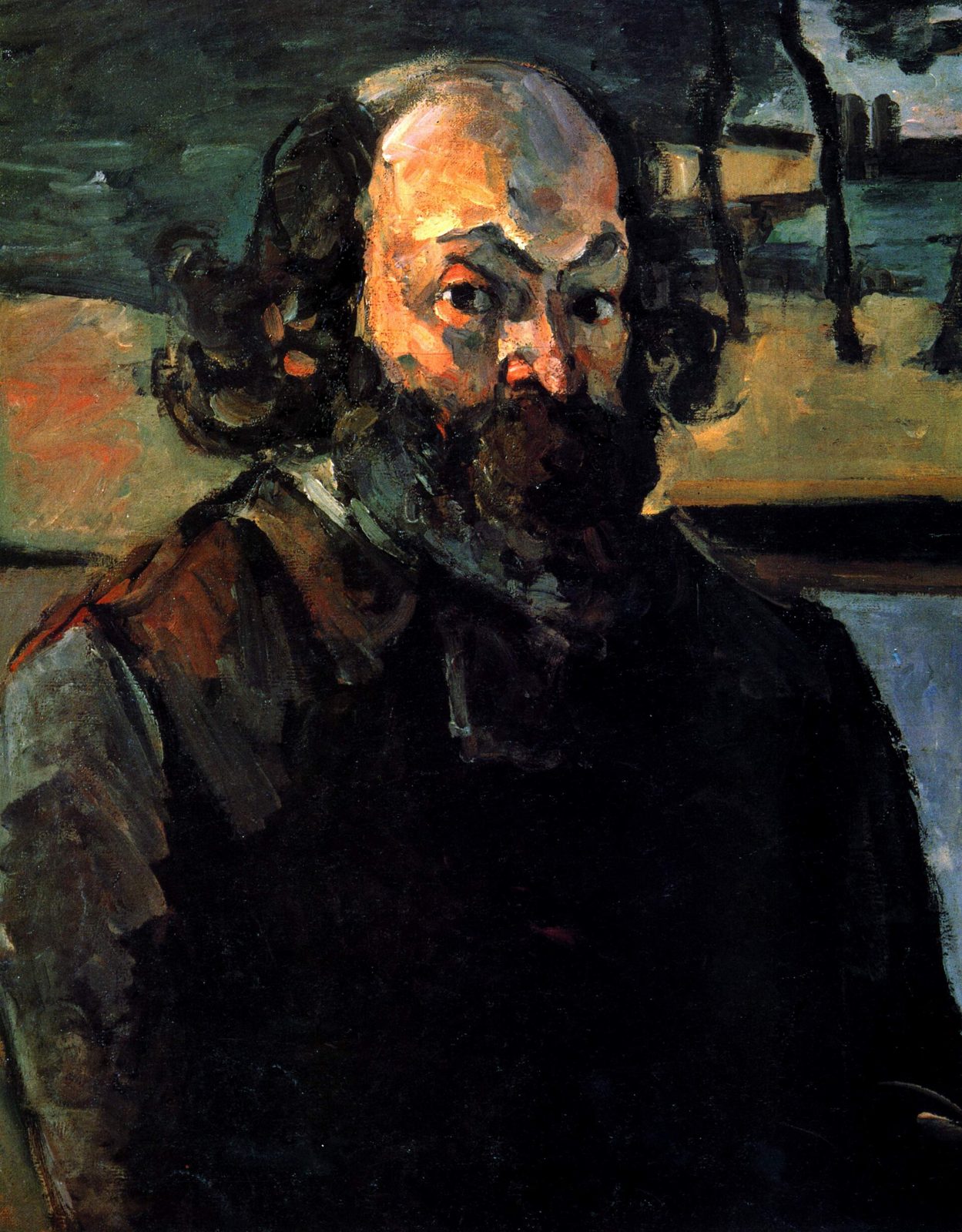
🎧 This work has audio narration — listen in the appHalf-length, bald, bearded, and staring out sideways from under heavy slanted brows: this is Cézanne looking at himself. The face is built from patches of orange, pink and pale lilac, with blue-grey shadow sliding along the cheek, and the dark coat sits against a background cut into flat, blocky bands of green, ochre and orange-red.
Look at how the paint is put on. The strokes are thick, broad and clearly visible, not blended away, so the forehead and nose seem to be assembled from separate blocks of colour rather than smoothly modelled. The same thing happens behind him, where the walls and bars read almost as planes. Cézanne was working out the solidity of things through colour and stroke, and you can see that method at work right on the canvas.
The painting is an oil on canvas, and the museum's records describe it as a self-portrait, a subject Cézanne returned to throughout his career. Its records show it passing through several hands, from a dealer in Paris to the family of Jacques Laroche, and it was shown in exhibitions in 1922, 1924, 1952 and 1988, including a major Cézanne retrospective at the Musée d'Orsay in 1988.
Paul Cézanne was a French Post-Impressionist painter born on January 19, 1839, in Aix-en-Provence. His innovative approach to color and form bridged the gap between Impressionism and the emerging Cubism of the early 20th century. Initially influenced by Romanticism and Realism, Cézanne developed a unique style that emphasized the underlying structure of objects, using repetitive brushstrokes and planes of color to create depth and complexity in his work.
Despite facing ridicule and misunderstanding from critics during his early career, Cézanne garnered support from fellow artists like Camille Pissarro and the art dealer Ambroise Vollard, who recognized his talent. His first solo exhibition in 1895 marked a turning point, leading to greater appreciation of his contributions to art. Cézanne's legacy is profound; both Henri Matisse and Pablo Picasso acknowledged him as a foundational figure in modern art, dubbing him "the father of us all." He passed away on October 22, 1906, leaving behind a transformative body of work that continues to influence artists today.
The material traces the apples back to a childhood gift: when Cézanne stood up for the young Émile Zola in a schoolyard, Zola thanked him the next day with a basket of apples. Apples became a recurring motif in his still lifes for the rest of his career.
Henri Gasquet was a classmate of Cézanne at the Saint-Joseph school in Aix. His son, the writer Joachim Gasquet, later published a book about Cézanne in 1921, which is one of the testaments to the painter's life.