The Hydrangea
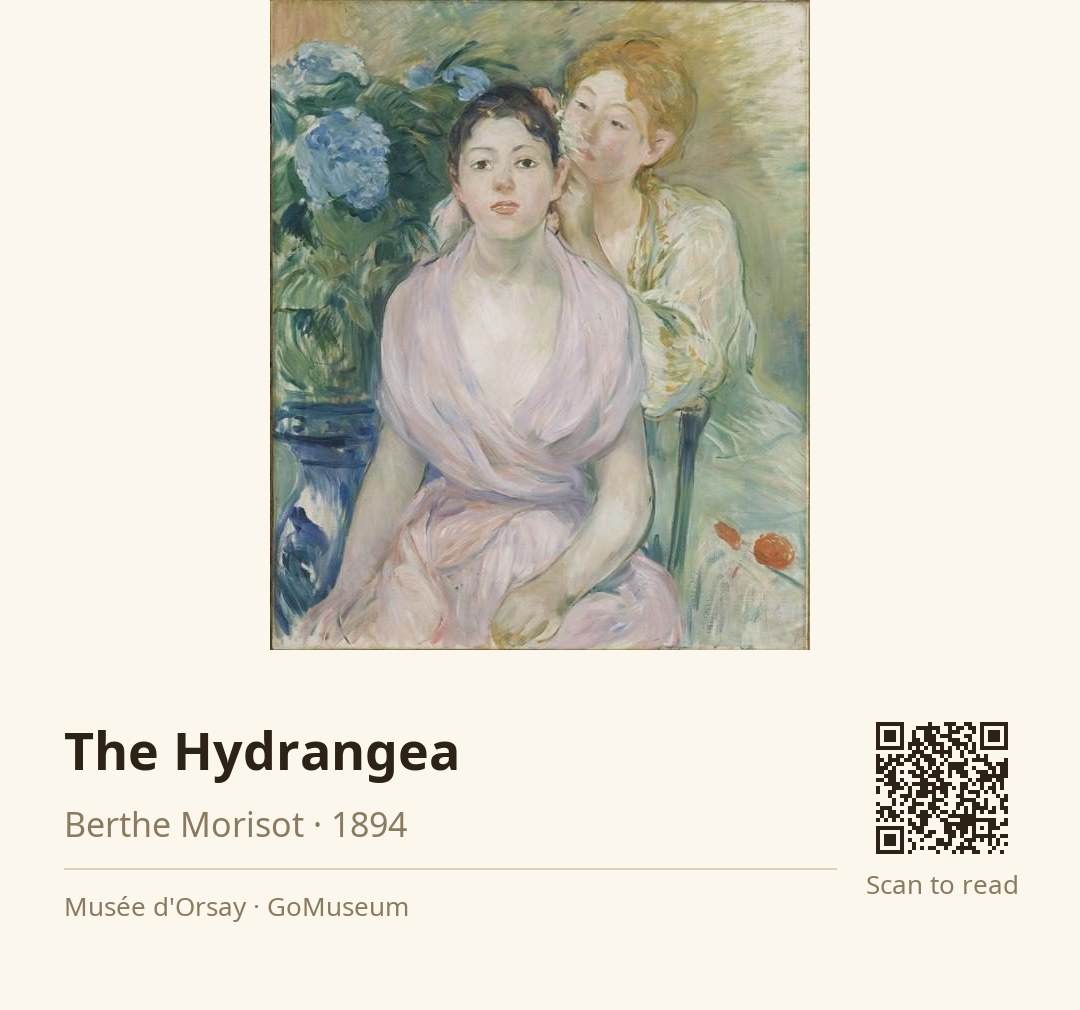
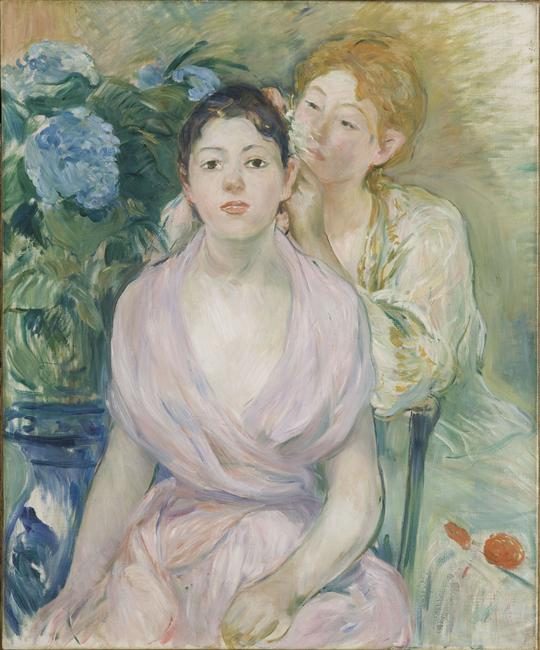
🎧 This work has audio narration — listen in the appTwo young women, one seated and facing us with direct brown eyes, the other leaning over her shoulder, and between them a great pot of blue hydrangeas that fills the left side of the canvas. Look closely at the dark-haired sitter's hands, folded quietly in her lap, and at the loose lilac-pink gown whose soft folds cross in a deep V at her chest. The paint itself is thin and feathery, with diagonal strokes and the weave of the canvas showing through in places, so the flowers and the dress seem to dissolve into the hazy green and cream of the background.
The painting is an oil on canvas from 1894, made by Berthe Morisot, one of the founding members of the Impressionist group and one of the few women to exhibit alongside them. The work is often called The Hydrangea, and its French title, L'hortensia, ou Les deux sœurs, tells you what the scene is meant to be: two sisters. The composition is upright, and the two figures are intimate yet unhurried, with nothing of the public display of a formal portrait.
The painting was exhibited at the Salon d'Automne in 1907 and entered public collections in 1920, when it was given by Julie and Ernest Rouart.
Berthe Morisot was a pioneering French painter born on January 14, 1841, in Bourges. Coming from an affluent family, she received a private art education alongside her sisters, fostering a deep passion for painting. Morisot first exhibited her work at the Paris Salon in 1864 and became a key figure in the Impressionist movement, participating in nearly all of its exhibitions from 1874 to 1886. Her innovative approach, characterized by light brushwork and a focus on domestic life and women’s experiences, distinguished her in a male-dominated art world. Married to Eugène Manet, brother of fellow artist Édouard Manet, she maintained close relationships with prominent Impressionists like Monet and Renoir. Art critic Gustave Geffroy recognized her as one of the three great ladies of Impressionism, alongside Mary Cassatt and Marie Bracquemond. Morisot's legacy endures as she broke barriers for women in art, leaving an indelible mark on the Impressionist movement before her death on March 2, 1895.
The painting is an oil on canvas made in 1894, and the material records that it passed through the artist's own collection before it reached the Rouart couple, Julie and Ernest, who gave it to the public collections. Its French title is L'hortensia, ou Les deux soeurs. It was shown at the 1912 centennial exhibition of French art in Saint Petersburg, and at a 1919 exhibition of Berthe Morisot's work in Paris. The record also notes that the work measures 73.5 by 60.5 centimetres.
A large pot of blue hydrangeas with green leaves sits in a blue-and-white vessel on the left. Small orange-red touches sit low on the right against a pale ground. The paint is thin and feathery, with visible diagonal strokes, and the weave of the canvas shows through in places.
No, the painting has been kept at the Musée d'Orsay in Paris only since 1986, after entering public collections in 1920.
Yes, the two sisters showed their work together at the Salon for the first time in 1864, though Edma stopped painting soon after her marriage in 1869.
Not as far as the record shows: despite a long-standing assumption, she had no family connection to Jean-Honoré Fragonard.