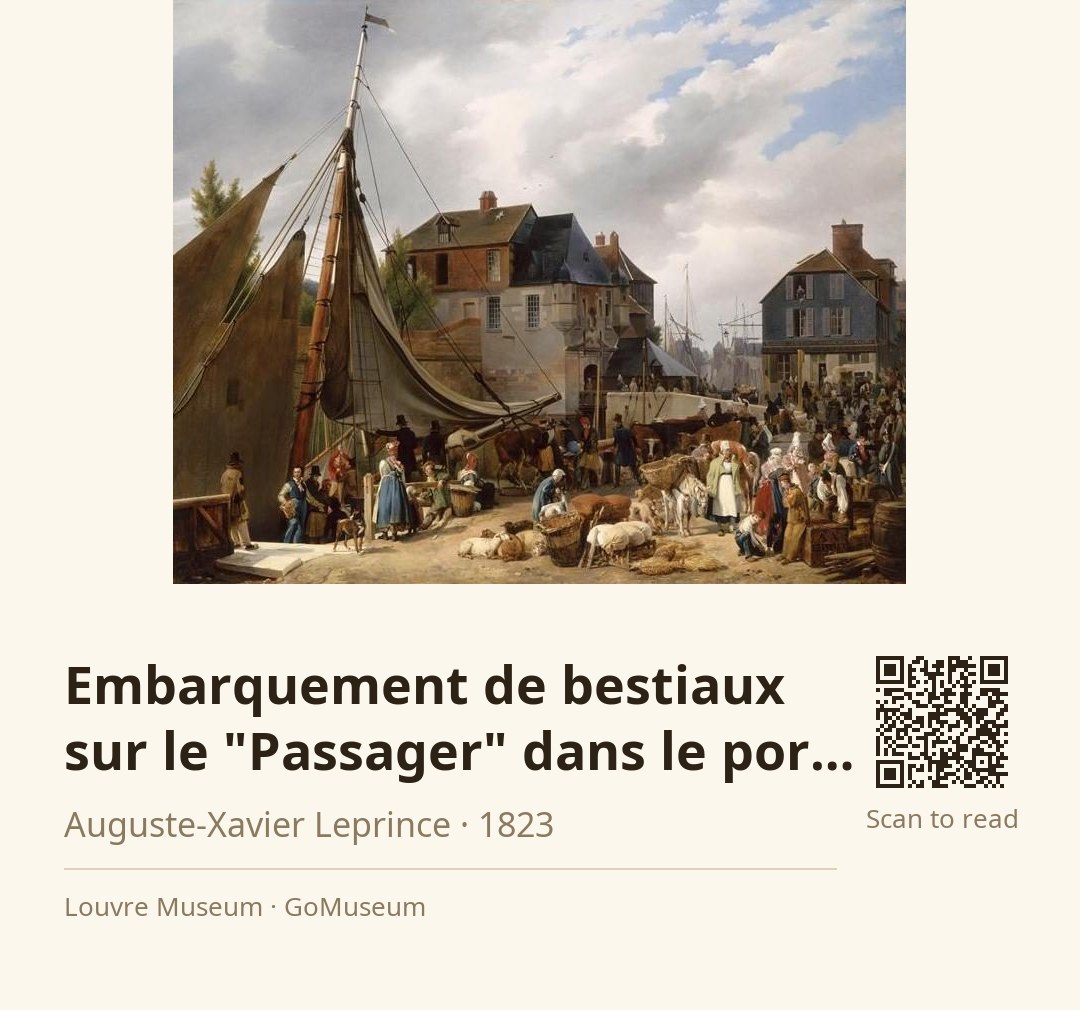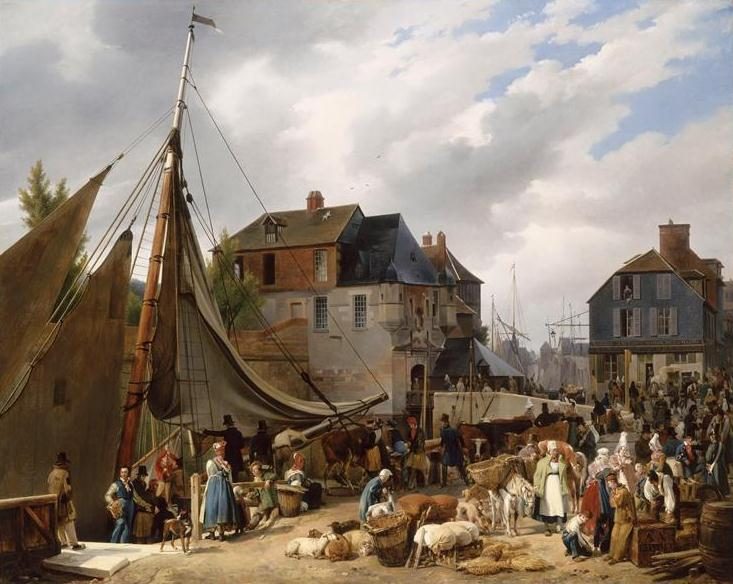
Embarquement de bestiaux sur le "Passager" dans le port de Honfleur
🎧 This work has audio narration — listen in the appPicture a white pony loaded with panniers, a dog at the edge of the crowd, and sheep lying bound on the cobbles of Honfleur's quay. Those are the first things to catch the eye in Auguste-Xavier Leprince's busy harbour scene. Look left and you find the tall mast, rigging and brownish furled sails of a sailing ship rising above the quay, while the crowd in the foreground, men and women in blue, red and ochre, clusters around baskets, barrels and bundles of straw.
What makes the scene work is how the animals and people share the same space. The sheep lie tied and still while the figures around them haggle and hoist, and the cattle and horses in the middle distance stand patiently among the bustle. The stone and brick building with its dark slate roofs, and the blue-grey timbered house beside it, anchor the crowd to a real town, so the viewer feels the working rhythm of the port rather than a posed tableau.
Auguste-Xavier Leprince was born in Paris in 1799 and died in Nice in 1826, at only twenty-seven. Though his life was brief, he became a celebrated painter while still a teenager. The sources describe him as largely self-taught, working "almost without any other guide than nature," and his early paintings of livestock, herders and rural life drew high prices from dealers even before he was twenty. His ambition and skill took him beyond the pastoral: he painted marine scenes, Parisian street life, portraits, troubadour-style subjects and views of the Forest of Fontainebleau, and he also supplied figures to a number of landscape painters who lacked confidence in drawing people or animals. One critic faulted him for this, yet praised his wit, vitality, originality and facility. His career advanced through royal and aristocratic patronage, including the Duchesse de Berry and Charles X, whose purchase of his cattle-embarkation scene at Honfleur in 1823 secured his reputation. He also founded his own studio, where he trained his younger brothers and other painters, and in 1824 he worked alongside Eugène Isabey at Honfleur. Art historians link his work to seventeenth-century Dutch painters of animals and landscapes, and the painter Corot is thought to have been influenced by his figure painting. His brilliant promise ended with his early death, but his paintings remain in major collections, including the Louvre.
The canvas is large, about 130 by 163 centimetres, and it is painted in oil on canvas. The paint surface is smooth and finely detailed, with the figures, animals and architecture rendered with close attention. A broad sky of white and grey clouds, with patches of blue, opens above the scene, and the stone and brick building behind the crowd has several gables and dark slate roofs. Beside it stands a blue-grey timbered house. At the far edge, more masts and rigging rise into the distance, so the harbour seems to extend beyond the frame. The clothing of the crowd moves through blue, red, white and ochre, and the men and women wear white caps or tall dark hats, which gives the foreground a lively mix of colour against the muted greys of the architecture.
Féréol Bonnemaison wrote that the painting "placed M. Leprince among our best genre painters. His career is now gloriously open before him." The picture is described as emblematic of the cattle paintings of its era, and as being of singular importance to Leprince's career.
The painting was bought by Charles X for 3,000 francs, which is why it is connected to the royal collection before it came to the Louvre.
Leprince shared a studio at Honfleur with the painter Eugène Isabey, a few years after he painted this harbour scene.
Leprince died at the age of twenty-seven, which cut short a career that had begun with remarkable early success as a teenager.
Yes, he regularly painted the human figures for several landscape painters, acting as a kind of contractor for artists who did not want to paint people or animals themselves.