Venus and the Three Graces Presenting Gifts to Giovanna degli Albizzi
🎧 Free preview: one of 5 works you can listen to here in full.
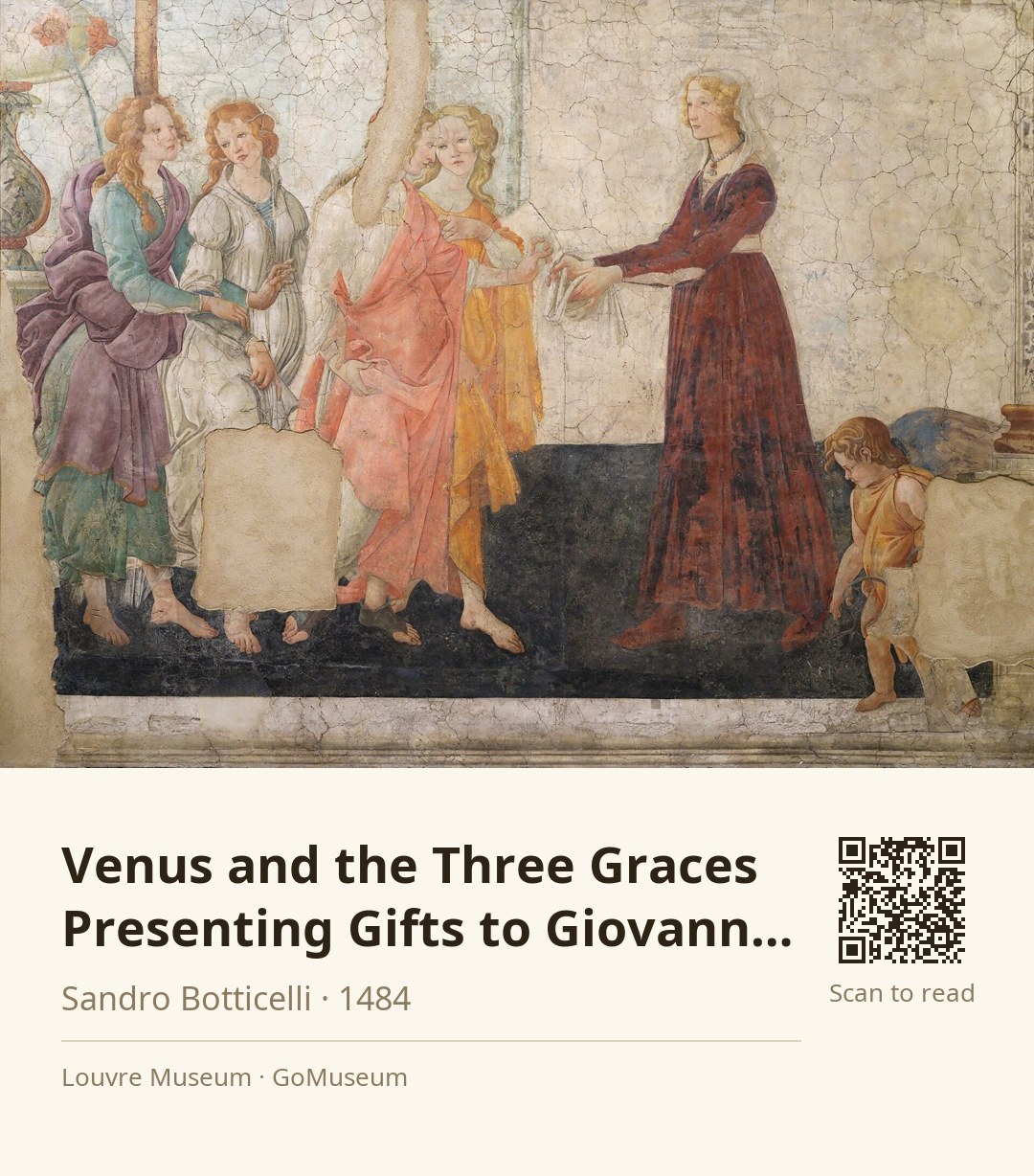
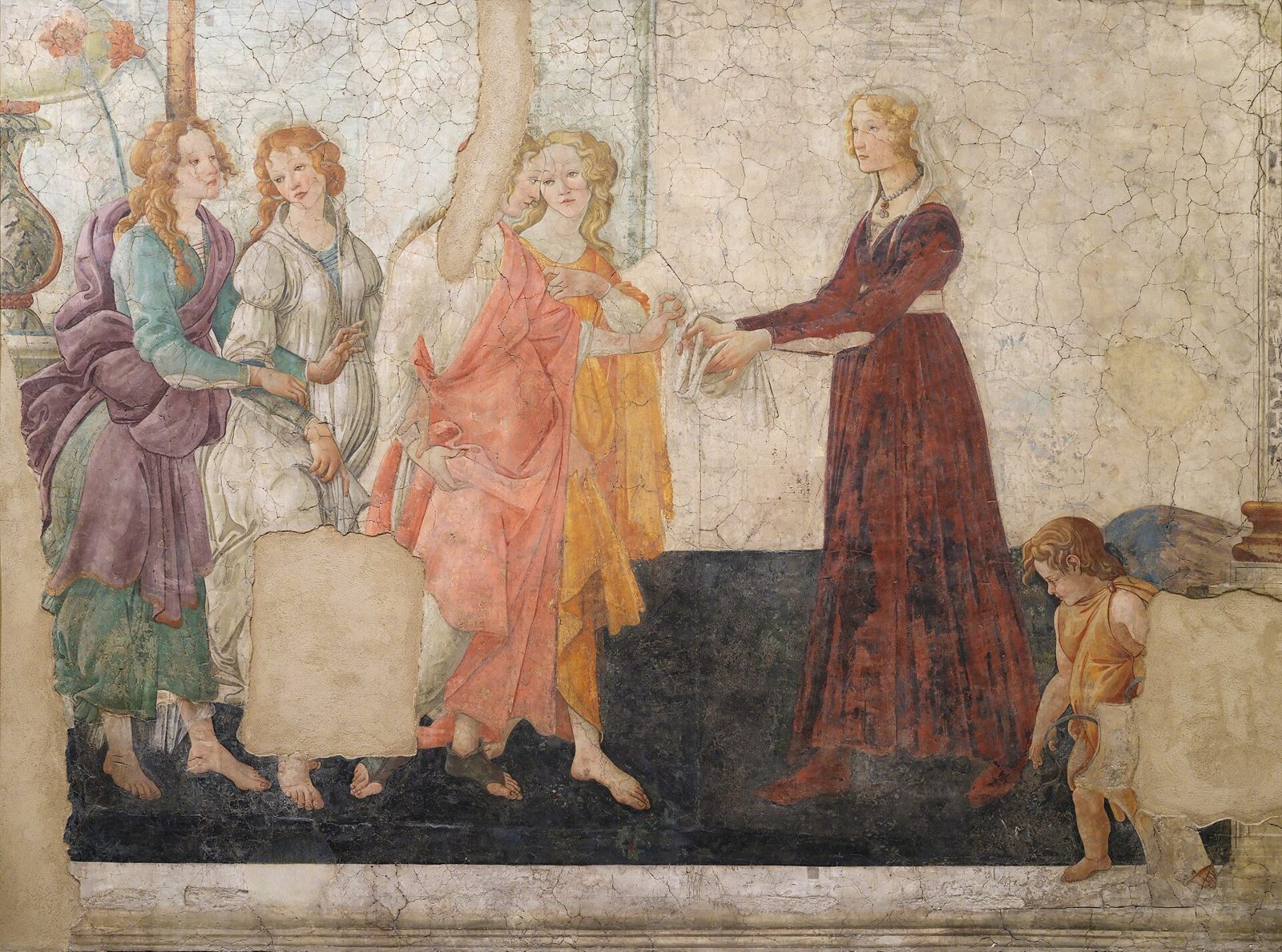
The elegant figure in a flowing pink gown at the center of this fresco is Venus, surrounded by the Three Graces, who are dressed in soft hues of purple, white, and pink. To her right, a young woman in a deep red gown holds out a white cloth to receive Venus's gift, while a winged child in the lower right corner clutches a piece of fabric, adding a playful touch to this mythological scene.
The cracked wall in the background hints at the passage of time, contrasting with the ethereal quality of the figures, which seem to transcend the mundane.
Originally painted on the walls of Villa Lemmi near Florence, this fresco was discovered under layers of whitewash in 1873 and subsequently transferred to canvas.
Filippino Lippi, born around 1457 in Prato, Tuscany, was an influential Italian Renaissance painter, the illegitimate son of the renowned artist Fra Filippo Lippi. His upbringing was marked by the artistic environment of his father's workshop, where he began his training. After his father's death, Filippino continued to hone his skills under Sandro Botticelli, contributing to a blend of styles that defined his early works.
As a painter, Filippino specialized in religious themes, often depicting elongated figures and intricate details that conveyed a sense of the surreal. His style evolved significantly after a formative period in Rome, where he absorbed classical influences and developed a unique approach characterized by vibrant, imaginative compositions. His notable works include the frescoes in the Brancacci Chapel and the altarpiece for the Strozzi Chapel, which reflect the political and religious tensions of his time.
Filippino's contributions to art history are significant; he is recognized for bridging the Early and High Renaissance styles, paving the way for the expressive tendencies that would lead to Mannerism. His innovative techniques, including visible brushwork, influenced later artists and positioned him as a pivotal figure in the evolution of Renaissance art. He passed away in Florence on April 18, 1504, leaving behind a legacy that continues to resonate in the art world.
The work was painted on the walls of Villa Lemmi, a country villa owned by Giovanni Tornabuoni, Lorenzo's uncle. After its initial display, the fresco remained hidden under layers of whitewash until its rediscovery in 1873. Following this, it was carefully transferred to canvas, preserving Botticelli's intricate details for future generations. Today, it resides in the Musée du Louvre, a testament to its enduring appeal and the rich history of the Medici family's patronage of the arts.
The figures are rendered with a soft, almost ethereal quality, achieved through smooth transitions in color and subtle gradations of tone. The composition is dynamic yet harmonious, with Venus at the center, drawing the viewer's eye. The use of contrasting colors, especially the vibrant pink of Venus's gown against the softer hues of the Graces, enhances the visual impact. The cracked wall in the background adds a layer of depth, suggesting the passage of time while framing the timeless beauty of the figures.
Interestingly, Botticelli's reputation waned after his death, and it wasn't until the 19th century that his work was rediscovered and celebrated. The Pre-Raphaelites, in particular, were instrumental in this revival, viewing Botticelli's art as a bridge between the Gothic and Renaissance styles. They admired his ability to convey emotion and beauty, which led to a renewed interest in his paintings, including this very fresco.
Villa Lemmi was significant as it was owned by Giovanni Tornabuoni, who commissioned the fresco, linking it directly to the Medici family's artistic patronage.
Botticelli's reputation declined after his death but saw a revival in the 19th century, particularly through the influence of the Pre-Raphaelites who admired his work.
Botticelli achieved the ethereal quality of the figures through smooth color transitions and subtle tonal gradations, enhancing their delicate appearance.