Mona Lisa
🎧 Free preview: one of 5 works you can listen to here in full.
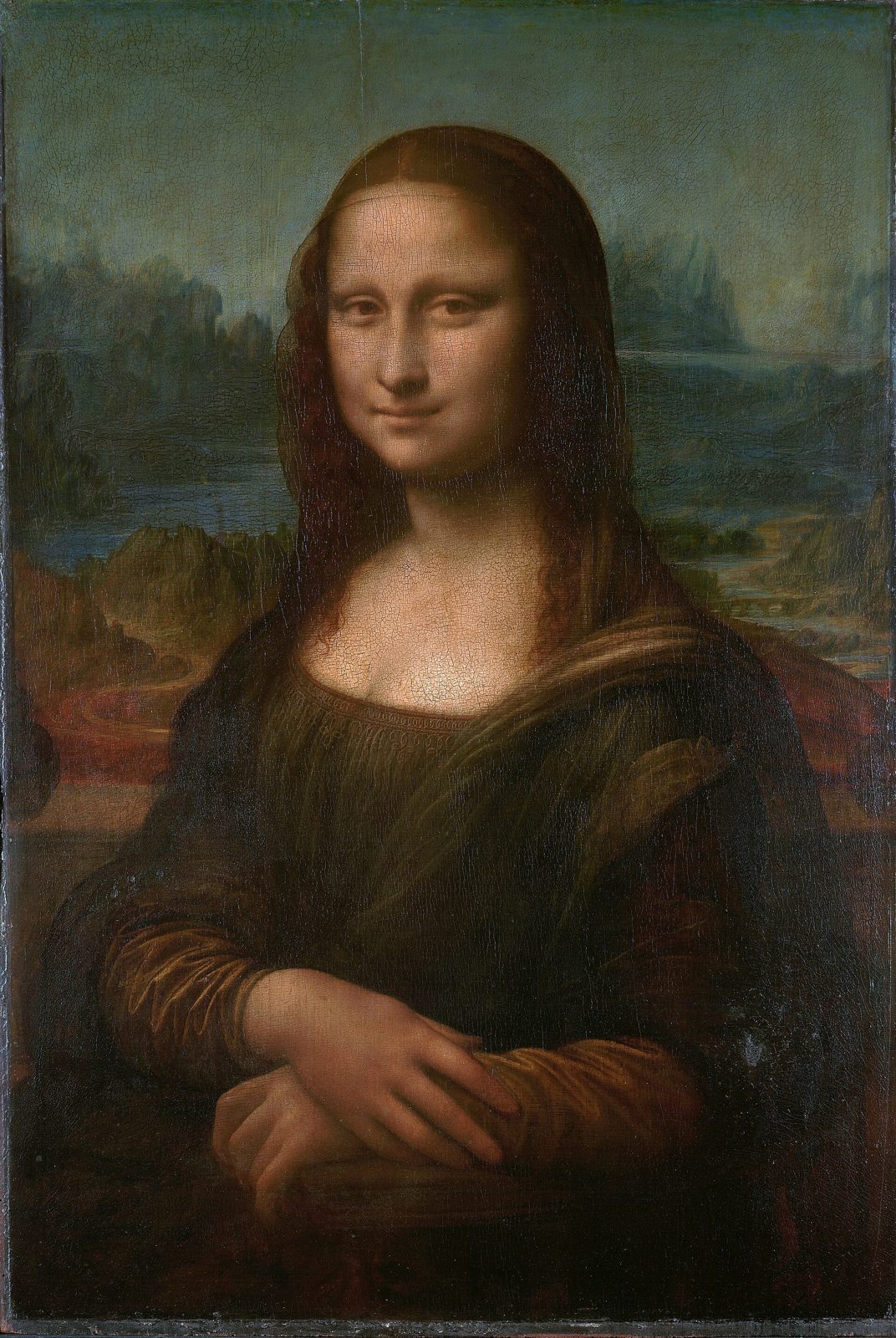
As you stand before the Mona Lisa, take a moment to really look into her eyes. Notice how they seem to follow you, no matter where you stand. This captivating gaze is part of what makes her so enigmatic and has intrigued viewers for centuries.
Now, focus on the subtle smile that plays on her lips. It’s not just a smile; it’s a window into her soul, a blend of joy and mystery that invites countless interpretations. This duality is a hallmark of Leonardo da Vinci’s genius, showcasing his ability to capture complex human emotions in a single moment.
At the time, portraits were often stiff and formal, but Leonardo infused life into his subject, breaking conventions and inviting viewers into a more intimate connection.
The Mona Lisa, believed to depict Lisa del Giocondo, was commissioned by her husband, but Leonardo never delivered it. Instead, he kept it with him until his death, which only added to its allure. After his passing, it became a prized possession of King Francis I of France, and today, it resides in the Louvre, drawing millions each year.
So, as you gaze at her, consider this: what stories do you think she could tell if she could speak? What secrets lie behind that smile?
Leonardo da Vinci, born on April 15, 1452, in Vinci, Italy, was a quintessential figure of the High Renaissance, renowned for his multifaceted genius as a painter, scientist, and inventor. Raised by his grandparents after being born out of wedlock, he received artistic training under Andrea del Verrocchio in Florence. His career flourished in Milan under Ludovico Sforza, where he produced iconic works like "The Last Supper" and began his extensive studies in anatomy and engineering.
Leonardo's notebooks reveal a relentless curiosity, encompassing subjects from botany to mechanics, showcasing his innovative spirit. Despite creating fewer than 25 major works, his influence on Western art is profound, with the "Mona Lisa" standing as a cultural icon. His visionary designs for flying machines and other inventions, though largely unfeasible in his time, reflect a forward-thinking approach that laid groundwork for future scientific exploration.
In his later years, he moved to France, where he continued to work until his death in 1519. Leonardo's legacy endures as a symbol of the Renaissance ideal, blending art and science, and inspiring generations with his empirical observations and artistic mastery. His life and work remain a testament to the boundless potential of human creativity.
Commissioned by Francesco del Giocondo, a wealthy Florentine merchant, it was meant to celebrate the birth of their second son. However, Leonardo never delivered the painting to the Giocondo family. Instead, he kept it with him, working on it for years, possibly until as late as 1517. After Leonardo's death in 1519, the painting became a prized possession of King Francis I of France. It was displayed in various royal residences before finding its permanent home at the Louvre in 1797, where it has since captivated millions. But the Mona Lisa's fame skyrocketed after a daring theft in 1911 by Vincenzo Peruggia, who believed it should be returned to Italy. This audacious act turned the painting into a global sensation, leading to its recovery and a surge in public interest that continues to this day.
When you look closely at the Mona Lisa, you can’t help but notice the masterful technique that Leonardo employed. The soft, almost ethereal quality of her skin is achieved through a technique called sfumato, where layers of translucent paint create a smoky effect, blurring the lines between light and shadow. This gives her face a lifelike quality, as if she could breathe. The composition is striking too; she sits in a three-quarter pose, breaking away from the rigid frontal portraits of the time. The background, with its winding paths and distant mountains, adds depth and a sense of mystery, inviting the viewer to wonder about the world beyond her gaze. Notice how the light falls softly from the left, illuminating her face while casting gentle shadows that enhance her enigmatic smile. The careful arrangement of her hands and the slight turn of her body create a dynamic tension, drawing you into her world. It’s this intricate balance of light, shadow, and composition that makes the Mona Lisa not just a painting, but an experience.
The Mona Lisa has left an indelible mark on the art world, influencing countless artists and movements over the centuries. Its innovative approach to portraiture paved the way for future generations, encouraging a more personal and intimate connection between the subject and the viewer. The painting's fame has inspired a plethora of parodies, adaptations, and references in popular culture, solidifying its status as an icon. Artists from the Romantic period to modern times have drawn inspiration from its complex portrayal of emotion and beauty. Today, the Mona Lisa is not just a painting; it's a cultural phenomenon, representing the pinnacle of artistic achievement and the enduring power of art to captivate the human spirit.
In fact, it is housed in a bulletproof glass case at the Louvre, a testament to its immense value and the lengths to which the museum goes to protect it. This level of security is not just for the painting's monetary worth, but also for its cultural significance, as it continues to be one of the most recognized and celebrated works of art in history.
The painting's fame surged after its theft in 1911, leading to numerous cultural references, including operas, films, and songs, such as Nat King Cole's hit 'Mona Lisa', which contributed to its status as a cultural icon.