La Belle Ferronnière
🎧 Free preview: one of 5 works you can listen to here in full.
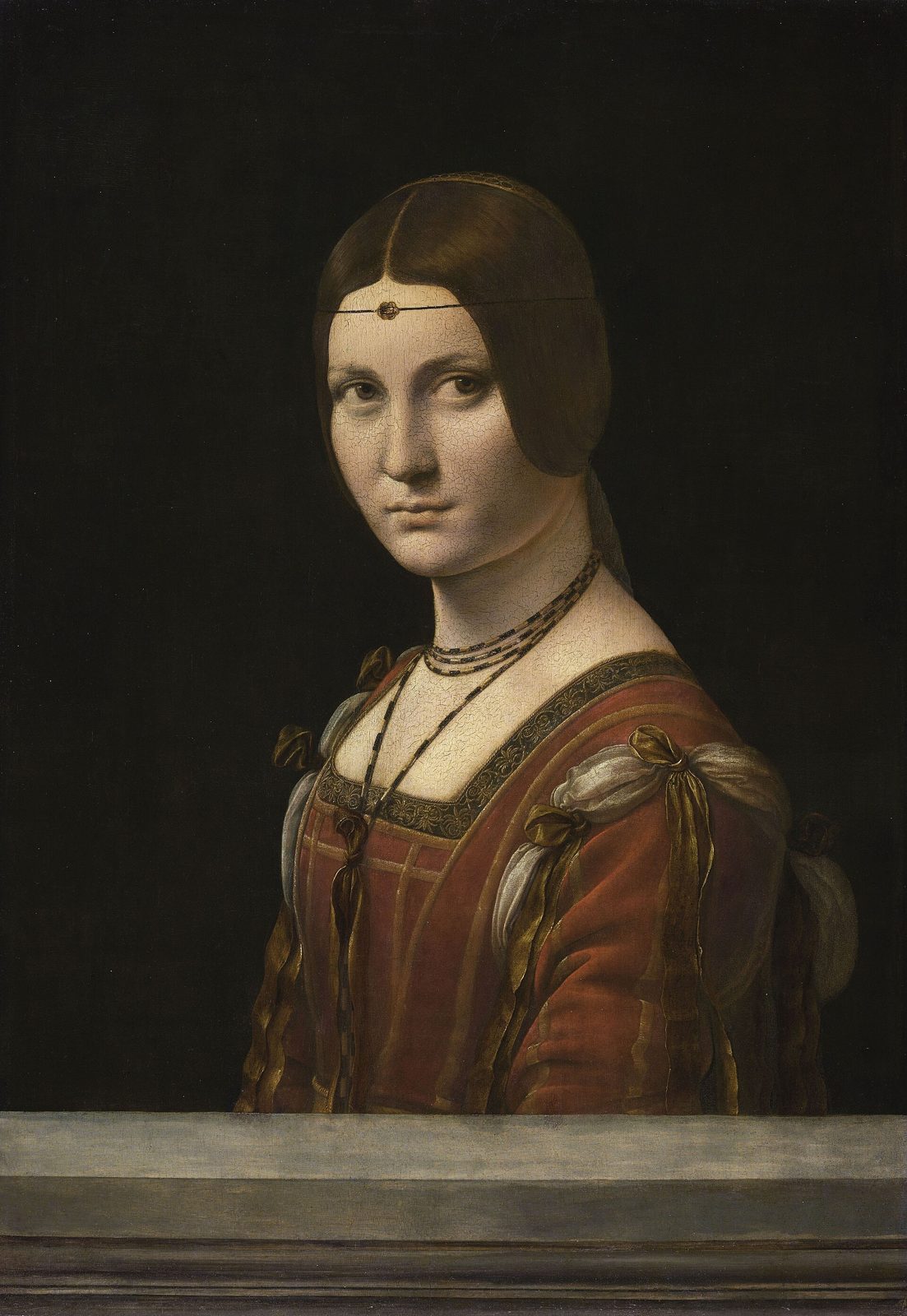
As you stand before "La Belle Ferronnière," let your gaze linger on the enigmatic expression of the woman depicted here. Notice how her eyes seem to glance away, almost as if she’s guarding a secret. This subtle detachment invites you into a world of intrigue, doesn't it?
Now, take a closer look at the delicate details of her attire, especially the intricate necklace that adorns her neck. The alternating black beads and the way they catch the light are not just decorative; they hint at deeper meanings.
Created by Leonardo da Vinci around 1495, this portrait has sparked countless theories about the identity of its subject. Some believe she could be Beatrice d'Este, a powerful figure at the court of Milan, while others suggest she might be Lucretia Crivelli, a lady-in-waiting with a scandalous past. This ambiguity adds layers to the painting, making it not just a portrait but a window into the complexities of Renaissance society.
Leonardo, known for his mastery in capturing human emotion, was at the height of his powers during this period. His ability to convey depth and character through subtle expressions was revolutionary, setting a standard for portraiture that artists would strive to achieve for centuries.
So, as you reflect on this captivating piece, consider: what secrets do you think she holds? What stories might she tell if she could speak? Let your imagination wander through the corridors of history, and perhaps you’ll uncover a narrative that resonates with your own experiences.
Leonardo da Vinci, born on April 15, 1452, in Vinci, Italy, was a quintessential figure of the High Renaissance, renowned for his multifaceted genius as a painter, scientist, and inventor. Raised by his grandparents after being born out of wedlock, he received artistic training under Andrea del Verrocchio in Florence. His career flourished in Milan under Ludovico Sforza, where he produced iconic works like "The Last Supper" and began his extensive studies in anatomy and engineering.
Leonardo's notebooks reveal a relentless curiosity, encompassing subjects from botany to mechanics, showcasing his innovative spirit. Despite creating fewer than 25 major works, his influence on Western art is profound, with the "Mona Lisa" standing as a cultural icon. His visionary designs for flying machines and other inventions, though largely unfeasible in his time, reflect a forward-thinking approach that laid groundwork for future scientific exploration.
In his later years, he moved to France, where he continued to work until his death in 1519. Leonardo's legacy endures as a symbol of the Renaissance ideal, blending art and science, and inspiring generations with his empirical observations and artistic mastery. His life and work remain a testament to the boundless potential of human creativity.
La Belle Ferronnière, painted by Leonardo da Vinci around 1495, has a rich and somewhat convoluted history. This portrait first appeared in royal collections in France in 1642, where it was referred to as a depiction of a 'Duchess of Mantua,' specifically identifying the sitter as Lucrezia Crivelli. Over the years, the painting has been linked to various figures, including Beatrice d'Este, the wife of Ludovico Sforza, Duke of Milan. The title 'La Belle Ferronnière' itself emerged in the 17th century, suggesting a connection to a mistress of King Francis I of France, hinting at a romantic intrigue that has captivated audiences for centuries. The painting has been displayed in prestigious exhibitions, including the landmark 'Leonardo Da Vinci: Painter at the Court of Milan' at the National Gallery in London in 2011, which reignited debates about the identity of the sitter. Its provenance is equally fascinating, having been part of the French royal collection before becoming a centerpiece at the Louvre, where it continues to draw admiration and speculation about its mysterious subject.
As you examine La Belle Ferronnière, pay attention to Leonardo's masterful brushwork and the way he handles light and color. The painting is executed on a walnut panel, which gives it a warm, rich tone. Notice how the soft transitions between light and shadow create a lifelike quality, almost as if the woman could step out of the frame. Leonardo's use of sfumato—a technique that allows colors and tones to blend seamlessly—contributes to the enigmatic expression on her face. The composition is carefully structured; her three-quarter pose invites the viewer in while her gaze seems to drift away, adding an air of mystery. The intricate details of her attire, especially the necklace, are rendered with precision, reflecting the opulence of her status. The alternating black beads not only catch the light beautifully but also serve to enhance the narrative of motherhood suggested by the three strands. This meticulous attention to detail and emotional depth is what sets Leonardo apart and makes this portrait a standout in the realm of Renaissance art.
This painting not only set a standard for future portrait artists but also influenced the way women were depicted in art, moving beyond mere representation to convey complex emotions and identities. The sitter's enigmatic expression invites viewers to ponder her story, a technique that would resonate through the ages, inspiring artists like Rembrandt and Vermeer. The legacy of this work lies in its ability to evoke curiosity and connection, reminding us that behind every portrait is a human experience waiting to be explored. Remember, it's not just about the brushstrokes; it's about the stories they tell and the lives they capture.
One surprising anecdote about La Belle Ferronnière involves a notorious court case in the early 20th century. A later version of the painting was mistakenly presented as the original to the Kansas City Art Institute, leading to a legal battle over its authenticity. The case drew in major art connoisseurs of the time, who inspected both paintings side by side at the Louvre. Ultimately, the court ruled in favor of the painting being a copy, resulting in a settlement of $60,000 plus expenses. This incident highlights the ongoing intrigue and confusion surrounding Leonardo's works and the lengths to which collectors and institutions will go to authenticate and protect their treasures.
The title was mistakenly applied to this painting in the 17th century, originally referring to a different work, which led to a mix-up with a portrait of a mistress of King Francis I. This confusion was compounded by the popularity of a specific accessory, the ferronnière, which was not commonly referenced until the 19th century.
A later version of La Belle Ferronnière was mistakenly presented as the original, leading to a legal battle that involved major art connoisseurs and resulted in a settlement of $60,000. This incident highlighted the ongoing intrigue and confusion surrounding Leonardo's works and their authenticity.