 Image: Shonagon · Geffroy, Gustave, 1855-1926 · Adoscam
Venus de Milo
🎧 Free preview: one of 5 works you can listen to here in full.
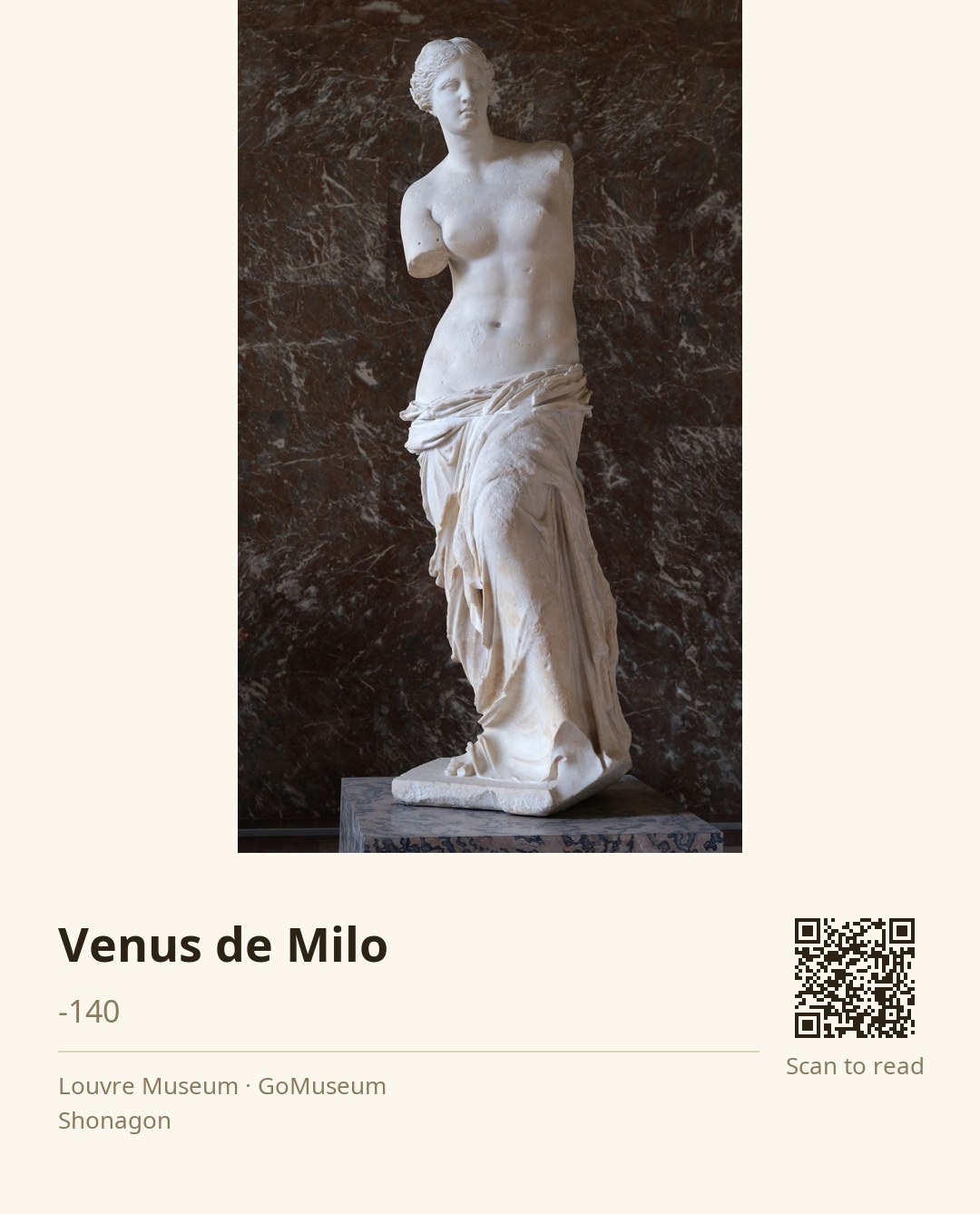
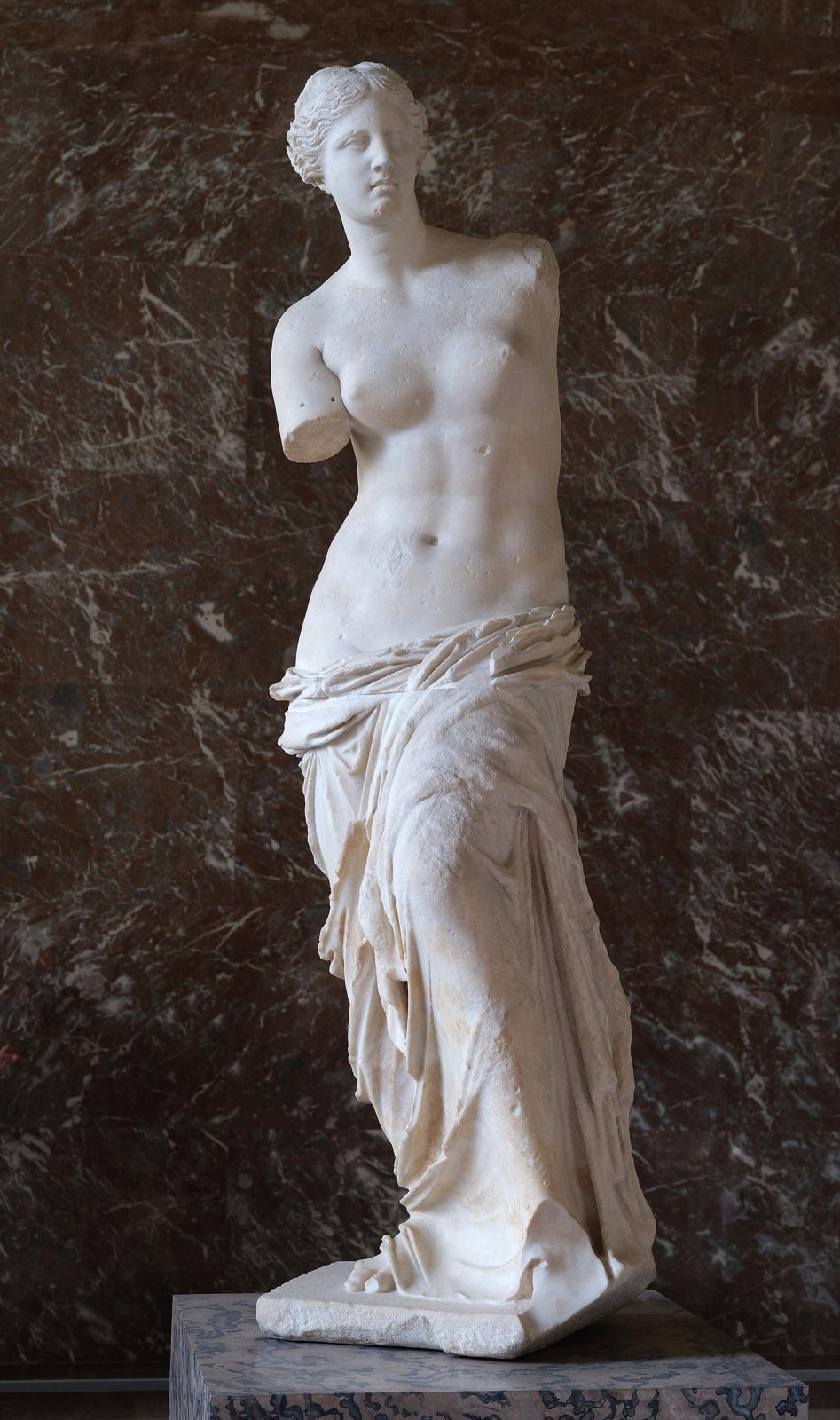
Take a moment to really look at the Venus de Milo. Notice how she stands, her weight shifted onto her right leg, while her left leg is gracefully raised. This pose isn’t just about beauty; it’s a celebration of movement, a snapshot of a moment frozen in time. Now, let your eyes wander to the intricate drapery that cascades over her lower half. See how the fabric clings and flows, revealing the artistry of the sculptor who carved it from solid marble over two thousand years ago.
These details matter because they reflect the blend of classical and Hellenistic styles, showcasing the evolution of art during that era. The smoothness of her flesh contrasts with the chisel marks on the drapery, suggesting that while she was crafted with precision, the artist was also experimenting with new techniques. This duality is what makes the Venus de Milo a masterpiece; it captures both the idealized beauty of the goddess and the raw, tactile reality of the material.
Discovered in 1820 on the island of Milos, this statue was a sensation, not just for its beauty but also for its mystery—missing arms and all. Scholars have debated her original pose for centuries, with theories ranging from her holding the apple of discord to gazing into a mirror. This uncertainty adds to her allure, inviting us to imagine the stories she could tell.
As you stand here, think about what this statue has witnessed over the centuries. What do you think she might say if she could speak?
As you gaze at the Venus de Milo, take a moment to appreciate the Parian marble from which she is carved. This particular type of marble is renowned for its fine quality and translucence, allowing the sculptor to achieve that smooth, almost ethereal finish on her skin. Notice how the flesh appears polished, almost glowing, while the drapery reveals the artist's skill in contrasting textures. The chisel marks on the fabric are still visible, hinting at the labor and care that went into its creation. The drapery on her right side is more elaborately carved, suggesting it was meant to be viewed from that angle. This attention to detail showcases not just the technical prowess of the sculptor but also the artistic choices made during the Hellenistic period, where realism began to blend with idealism. Can you feel the tension between the smoothness of her body and the intricate folds of her garment? It's as if the marble itself is alive, caught in a moment of divine grace.
The Venus de Milo, an iconic ancient Greek sculpture, was unearthed on April 8, 1820, by a Greek farmer on the island of Milos, which was then under Ottoman rule. This discovery was witnessed by Olivier Voutier, a French sailor with a keen interest in archaeology, who encouraged the farmer to dig deeper. Together, they uncovered several pieces of the statue, including fragments of an arm and a hand holding an apple, hinting at the goddess's identity as Aphrodite. The statue was soon after acquired by France, making a sensational debut at the Louvre Museum in 1821. This was a groundbreaking moment, as it was the first incomplete statue from Greece to be displayed in the museum. The Venus quickly captivated audiences with her beauty and the mystery surrounding her missing arms, sparking debates among scholars and art enthusiasts alike. Over the years, she has inspired countless poems and artistic movements, yet her Hellenistic origins have led some classicists to overlook her in favor of more traditionally recognized works. The statue's journey from a farmer's field to the grand halls of the Louvre is a tale of intrigue, negotiation, and the relentless pursuit of beauty in art.
The Venus de Milo is more than just a stunning piece of Hellenistic sculpture; it's a cultural icon that has shaped the way we view beauty and art. Discovered in 1820, this statue quickly became a cornerstone of the Louvre's collection, captivating audiences with its graceful form and enigmatic missing arms. Its influence rippled through the 19th century, inspiring poets and artists alike, and even playing a role in the Surrealist movement of the early 20th century. The Venus de Milo challenged the traditional notions of classical beauty, blending idealized features with a more realistic portrayal of the human body. This sculpture's legacy is evident in how it continues to inspire modern artistic projects, from films to advertisements. Remember, it’s not just a statue; it’s a conversation starter about beauty, identity, and the very nature of art itself.
This assumption was fueled by the discovery of a marble hand holding an apple found nearby. However, recent scientific analysis has cast doubt on this theory, suggesting that the hand may not have belonged to her at all. This ongoing debate adds another layer of intrigue to her story, as scholars continue to piece together the mystery of her original pose and purpose. Isn't it fascinating how even the most celebrated works of art can hold secrets waiting to be uncovered?
Olivier Voutier was a French sailor who witnessed the discovery of the Venus de Milo by a Greek farmer and encouraged him to continue digging, ultimately leading to the unearthing of the statue.
The Venus de Milo inspired over 70 poems and significantly influenced 19th-century art, as well as the Surrealist movement in the early 20th century, showcasing its lasting impact on artistic expression.
After its discovery in 1820, the Venus de Milo was acquired by France and displayed at the Louvre Museum in 1821, quickly becoming a cornerstone of its antiquities collection and a symbol of classical beauty.