 Image: Shonagon · Gargarapalvin · Gargarapalvin · Gargarapalvin
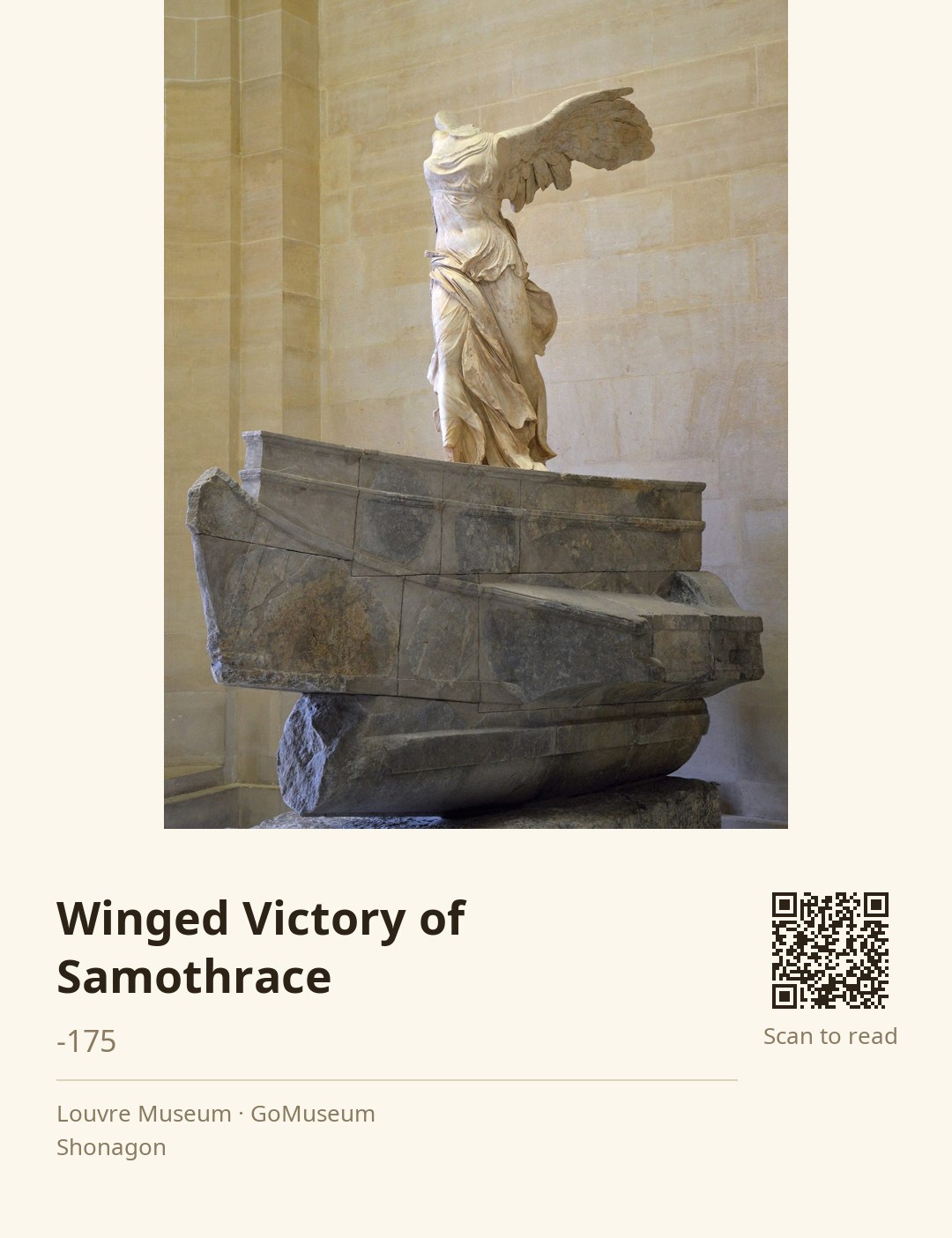
Winged Victory of Samothrace
🎧 Free preview: one of 5 works you can listen to here in full.
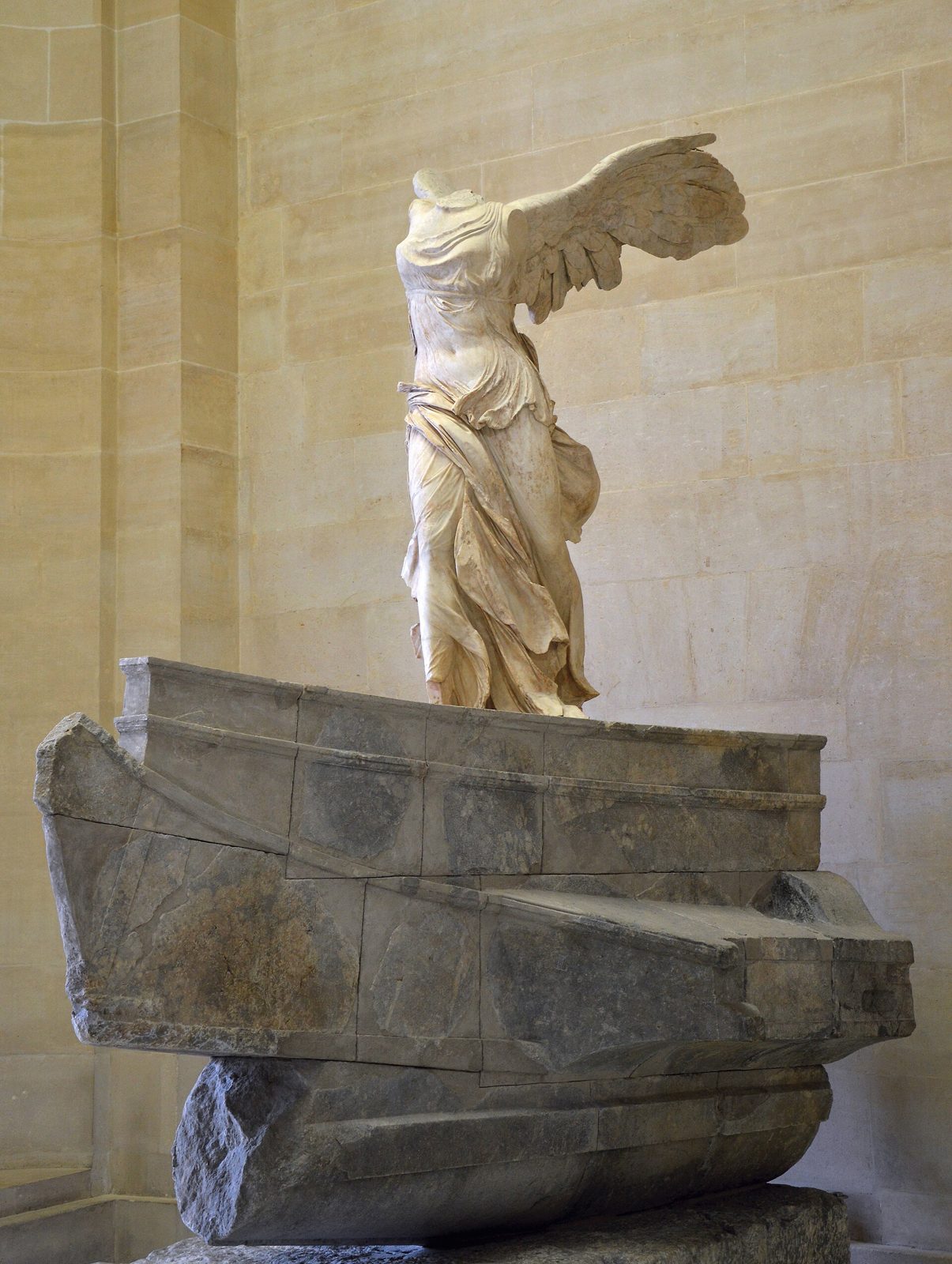
Take a moment to really look at the Winged Victory of Samothrace. Notice how she seems to soar, her drapery billowing as if caught in a fierce wind, even though she’s been standing still for centuries. The way her wings are poised, ready to take flight, gives her an almost ethereal quality, doesn’t it?
Now, focus on the intricate folds of her garment, especially the way they cascade down her legs. Each fold tells a story of movement and grace, capturing the very essence of victory. This isn’t just a statue; it’s a celebration of triumph, crafted to honor the goddess Nike, who embodies victory itself. The missing head and arms add a layer of mystery, inviting you to imagine her fierce expression and commanding presence.
The ship-shaped base hints at its maritime origins, connecting it to the sea and the battles fought upon it.
As you stand here, think about the journey this sculpture has taken—from the shores of Greece to the grand staircase of the Louvre. What do you think it must have felt like to witness her in her original setting, surrounded by the sounds of the sea and the cheers of victory?
As you gaze at the Winged Victory of Samothrace, take a moment to appreciate the craftsmanship that went into her creation. This sculpture is made from white marble, a material that not only conveys purity but also allows for intricate detailing. Notice the way the drapery flows and clings to her form, almost as if it’s alive. The artist has masterfully carved each fold, capturing the essence of movement and the wind’s embrace. The texture of the marble, polished yet raw in places, adds a tactile quality that invites you to imagine the coolness of the stone. The wings, with their feathered details, seem to flutter, showcasing the artist's skill in creating a sense of lightness and grace. Can you feel the energy radiating from her? It’s as if she’s about to take flight at any moment, a testament to the dynamism of Hellenistic art.
Discovered in 1863 by Charles Champoiseau, a French consul, she was unearthed in the ruins of a sanctuary dedicated to the Great Gods on the island of Samothrace. Initially, only fragments were found, but Champoiseau recognized the significance of the statue and sent it to the Louvre. After arriving in Paris in 1864, the statue underwent several restorations, with the first being led by Adrien Prévost de Longpérier. Over the years, archaeologists pieced together the monument’s original form, revealing its ship-shaped base that symbolizes naval victory. By 1884, the Winged Victory found her home at the Louvre, where she has captivated visitors ever since. Interestingly, her head and arms remain missing, adding an air of mystery to her already commanding presence.
As a prime example of Hellenistic sculpture, she embodies the era's shift towards emotional expression and dynamic forms. Her dramatic pose and intricate detailing influenced countless artists, inspiring movements from the Renaissance to modern sculpture. The way she captures the essence of victory and movement has made her a symbol of triumph in various cultures. Artists have drawn from her elegance and power, using her as a reference point for their own works. The Winged Victory also plays a crucial role in discussions about the preservation of cultural artifacts, as her story highlights the importance of heritage and the ongoing dialogue about ownership and restitution in the art world. Remember her not just as a statue, but as a beacon of artistic innovation and a catalyst for cultural conversations.
One fascinating tidbit about the Winged Victory of Samothrace is its dramatic discovery in 1863. Charles Champoiseau, the French consul, stumbled upon this magnificent statue while exploring the ruins of a sanctuary on the island of Samothrace. Imagine him digging through rubble and suddenly uncovering part of a large female figure, her wings still majestic despite the missing head and arms. But here’s the kicker: along with the statue, he found a jumble of large grey marble blocks that he initially thought were just leftover debris. It wasn’t until later that archaeologists realized these blocks formed the ship's bow that the statue stands upon today. Can you picture the excitement of piecing together this ancient puzzle?
The early restorations, particularly by Adrien Prévost de Longpérier, focused on displaying the body alone without reconstructing the head or arms, which emphasized the statue's dramatic form and left an air of mystery that continues to intrigue viewers.
Austrian archaeologists, led by Alexander Conze, were instrumental in identifying the ship-shaped base of the statue and provided a model for its reconstruction, which helped to restore the monument to a more complete form based on archaeological evidence.