 Image: HaguardDuNord · HaguardDuNord · HaguardDuNord · HaguardDuNord · Sailko
Pomone drapée by Aristide Maillol
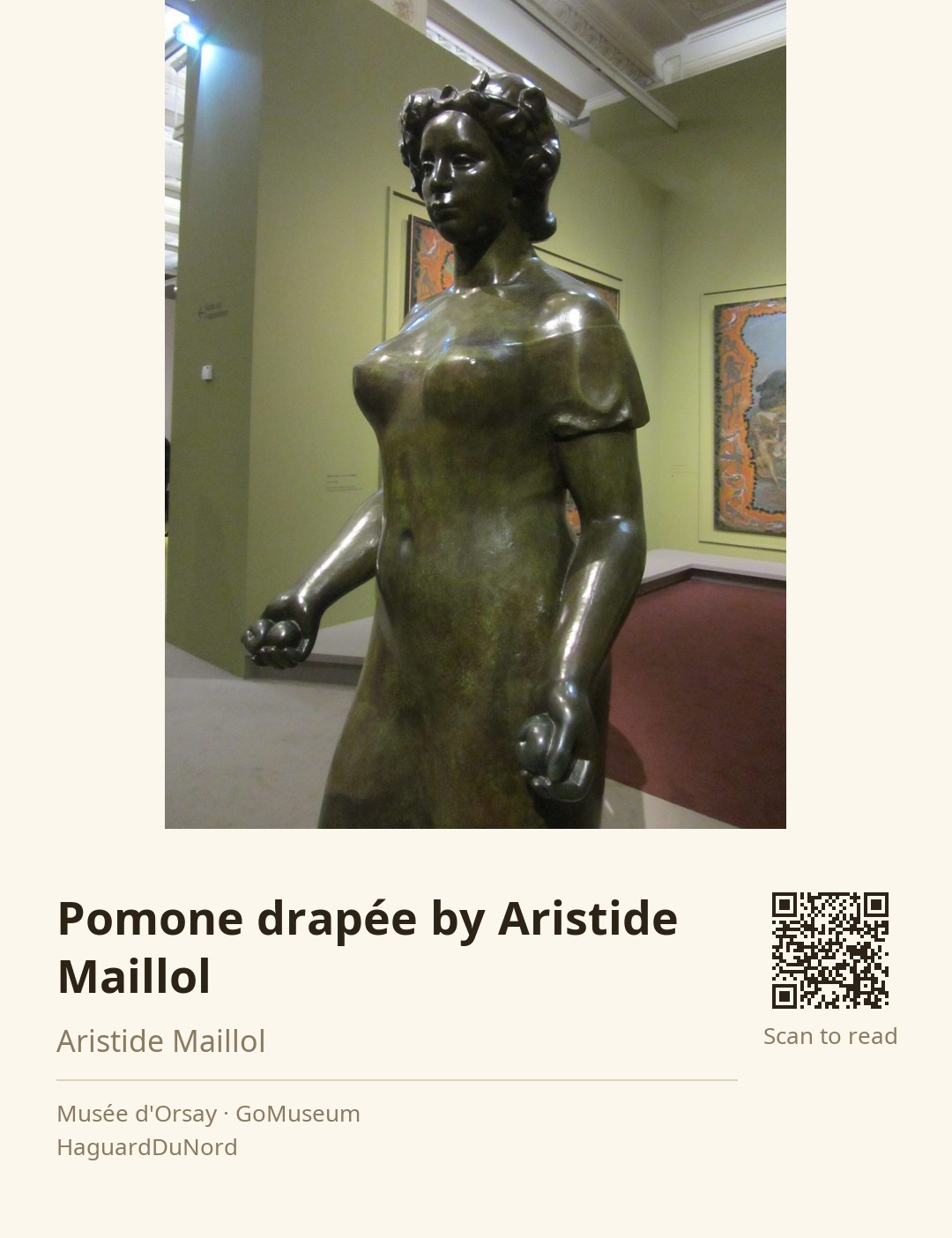
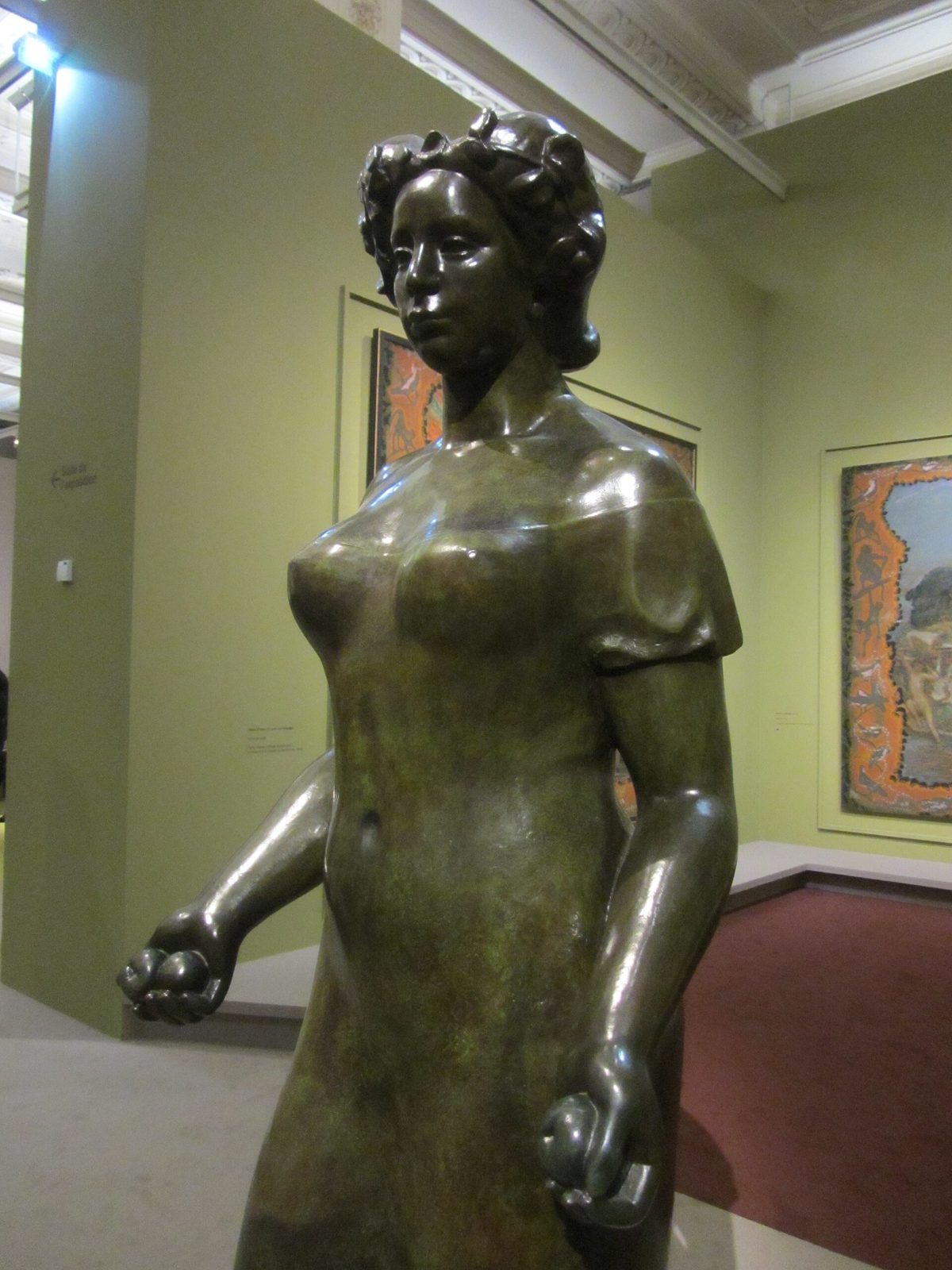
🎧 This work has audio narration — listen in the appPomone stands before you in dark, glossy bronze, her dress clinging close to her body and falling off her shoulders in a wide neckline. Look at the wreath crowning her curled hair, and at what she holds in her hands: rounded, apple-like forms, one cradled in her palm and others gathered against her. Those fruit are the clue to who she is.
It was cast in bronze at a workshop run by Émile Godard, who is credited alongside Maillol, and the piece bears the inventory number RF 4098. Its surface shows a deep brown patina with greenish mottling, polished to a soft sheen on the face, shoulders and arms, while the body is treated with smooth, simplified volumes that barely break into detail. That restraint is the heart of Maillol's approach. He began as a painter, moved into tapestry design and only turned seriously to sculpture around the age of forty, and he carried a painter's eye for mass and calm into the round.
Maillol built his mature career almost entirely on the female body, shaped toward stable, classical forms, and his serene style became a reference point for European figure sculpture for decades. The Pomone you see belongs to the same family of work that made him famous, though the surviving records here do not say when this particular bronze was cast or who first owned it. What the record does give you is its path into public life: it came to the museum through the collection of Dina Vierny, Maillol's model and companion in his last years, who later founded the Musée Maillol in Paris.
Aristide Maillol, born on December 8, 1861, in Banyuls-sur-Mer, was a prominent French Catalan sculptor, painter, and printmaker. Initially pursuing painting, he shifted his focus to sculpture in his early forties, becoming one of the most celebrated sculptors of his era. His works, characterized by a classical treatment of the female form, influenced notable artists like Picasso, Matisse, and Moore, marking a significant transition in modern sculpture.
Maillol's artistic journey began in Paris, where he studied at the École des Beaux-Arts under renowned instructors. His early works were shaped by the decorative arts, particularly tapestry, which he explored before fully dedicating himself to sculpture. His first major piece, "A Seated Woman," completed in 1902, exemplified his unique style, blending simplicity with a profound sense of beauty.
Throughout his career, Maillol received acclaim for his serene and monumental sculptures, which emphasized form over narrative. His public commissions included memorials and monuments, solidifying his legacy in art history. Despite the challenges he faced, including the loss of many artworks during the Nazi occupation, his influence persisted, with a significant collection of his works housed in the Musée Maillol in Paris. Maillol passed away in an automobile accident on September 27, 1944, leaving behind a transformative body of work that continues to resonate in the art world.
Look closely at the surface, because the material tells us something about how the bronze was finished. The figure is cast in bronze, and its skin is a deep brown patina with greenish mottling. Where the surface has been rubbed smooth, on the face, the shoulders and the arms, it takes on a soft gloss, while the body is left with broad, simplified volumes and very little fine detail. The fruit she holds are rounded, apple-like shapes, and the wreath in her hair is described as leaves or fruit, so the object is built from a few clear masses rather than from surface texture.
The sculpture is a bronze cast at the workshop of Émile Godard, who is listed alongside Maillol as the caster. Its inventory number is RF 4098, and it entered the collection through Dina Vierny, Maillol's model and companion in his last years, who later founded the Musée Maillol in Paris. The period is given as the first quarter of the twentieth century. The record does not say when this particular bronze was cast or who first owned it.
Maillol's home a few kilometers outside Banyuls, the village where he was born, has been turned into a museum, the Musée Maillol Banyuls-sur-Mer, and that is also where he is buried. Three of his bronzes stand on the grand staircase of the Metropolitan Opera House in New York, and one of them, Kneeling Woman: Monument to Debussy, is the artist's only reference to music.
Yes, during the German occupation of France dozens of Maillol's artworks were seized by the Nazi looting organization known as the E.R.R., or Reichsleiter Rosenberg Taskforce.