The copper fountain; Kitchen Interior
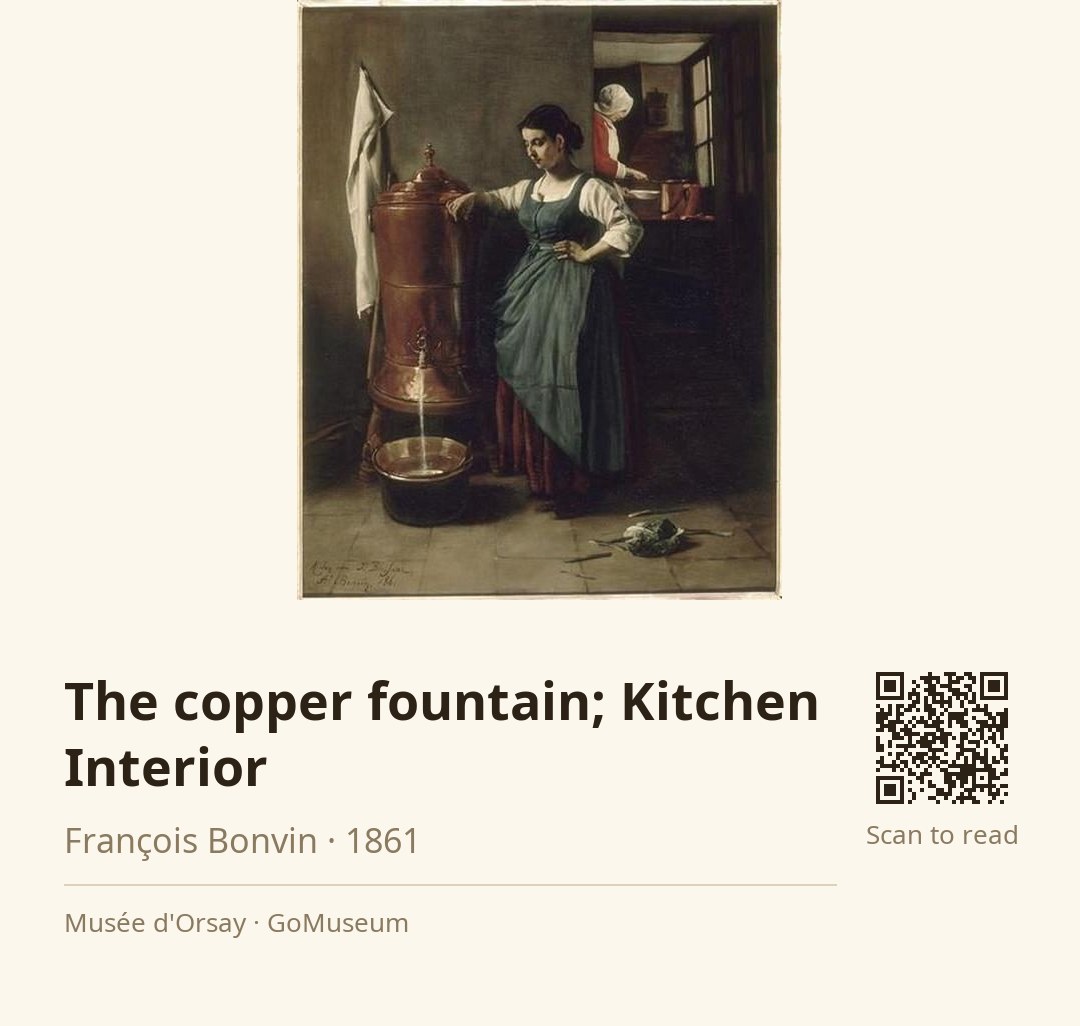
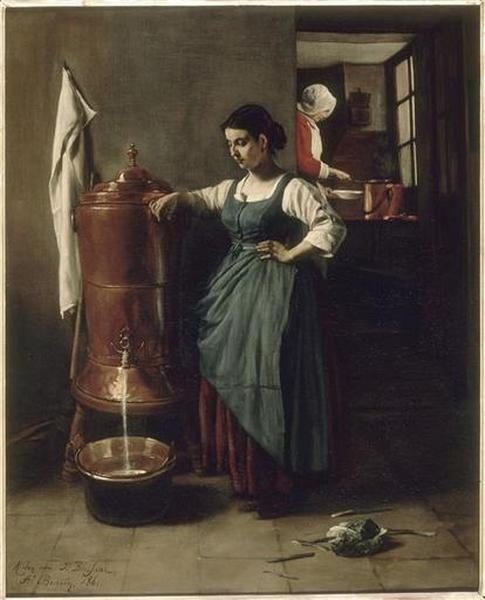
🎧 This work has audio narration — listen in the appA young woman stands at the left of a stone-floored kitchen, one hand on her hip, the other resting on a tall copper water urn. She looks down at a thin stream falling from its spigot into a dark basin below. Look closely at the domed lid and the small white cloth hanging from a hook on the grey wall behind her: they are the quiet, ordinary objects that make this a working room rather than a showpiece.
The copper of the urn is rendered with soft, blended browns and coppers, so the metal seems to hold the room's dim light rather than reflect it sharply.
The painting is oil on canvas, measuring 74 by 61 centimetres, and it is held at the Musée d'Orsay under the inventory number RF 462. Bonvin was a self-taught realist who had worked for the Paris police before turning fully to painting, and he became known for depicting the everyday lives of modest people with a delicate, quiet luminosity.
François Bonvin was a French realist painter born in Paris in 1817 into poverty. His father was a police officer and his mother a seamstress, and her early death from tuberculosis left him in the hands of a neglectful caretaker. His stepmother later mistreated and underfed him, and the household's hardship shaped his early years. Despite this, his talent for drawing was noticed by a family friend, who paid for him to attend a drawing school at eleven. Bonvin was largely self-taught after that, learning as much as he could from the Dutch and Flemish old masters he studied at the Louvre, and he regarded the painter François Granet as his only mentor.
To support himself he worked as a printer's compositor and later at the Paris police headquarters, where he remained until 1850. He married young and contracted an illness that troubled him for the rest of his life. Painting remained a passion, and his realistic scenes of the poor, drawn from his own experience, won recognition at the Salon of 1849 and 1850, where he stood alongside Courbet as a leading realist. Yet his modestly scaled works were less confrontational than Courbet's and were received warmly by critics and the public. His subjects, still lifes and the everyday activities of ordinary people, recall Pieter de Hooch and Chardin, especially in their quiet, delicate luminosity. In 1870 he was made a Chevalier of the Légion d'honneur.
Bonvin's life was marked by hardship and loss. His brother Léon, also an artist, took his own life in 1866 in despair over poverty and failing sales. Bonvin took part in the artists' federation that supported the Paris Commune in 1871, which led to his exile in London for a time. Later, an operation in 1881 failed to restore his health, and he went blind. Friends organized a retrospective exhibition in 1886 and a benefit sale in 1887 to support him. He died at Saint-Germain-en-Laye in December 1887.
Bonvin is remembered as one of the finest genre and still-life painters of the nineteenth century. His honest depictions of humble life, once only modestly appreciated, found favor from the late 1860s onward. He stands as a quiet but important figure of French realism, linking Dutch tradition to the modern painting of his era.
This painting was made in 1861 and shown at the Salon des Artistes français in Paris in 1863, catalogue number 212. Its earlier owners are on record: it was sold at the Bressant sale in Paris on 25 November 1880, and it later passed through the dealer Brame. Today it belongs to the Musée d'Orsay, under the inventory number RF 462.
Everything in the picture is painted in a narrow band of browns, coppers and greys, so the room feels dim and close. The copper urn with its domed lid and finial is the brightest, warmest thing in view, and the figure's blue-green apron and red skirt are the only real colour against that quiet ground. The second woman in the doorway at right is pale and small, pushed far back, so the eye travels from the near figure, through the open door, into the working household beyond. The brushwork is smooth and finely blended, with no visible strokes pulling attention away from the surfaces.
On the floor in the foreground, among the scattered vegetable scraps, lies a knife, and small handwritten lettering appears at the lower left of the canvas, though it is too small to read in the photograph.
It appeared at the Bressant sale in Paris in November 1880 and later passed through the dealer Brame before reaching its current collection.
After an operation in 1881 failed to restore his health, he lost his sight.