Arab Horses fighting in a stable
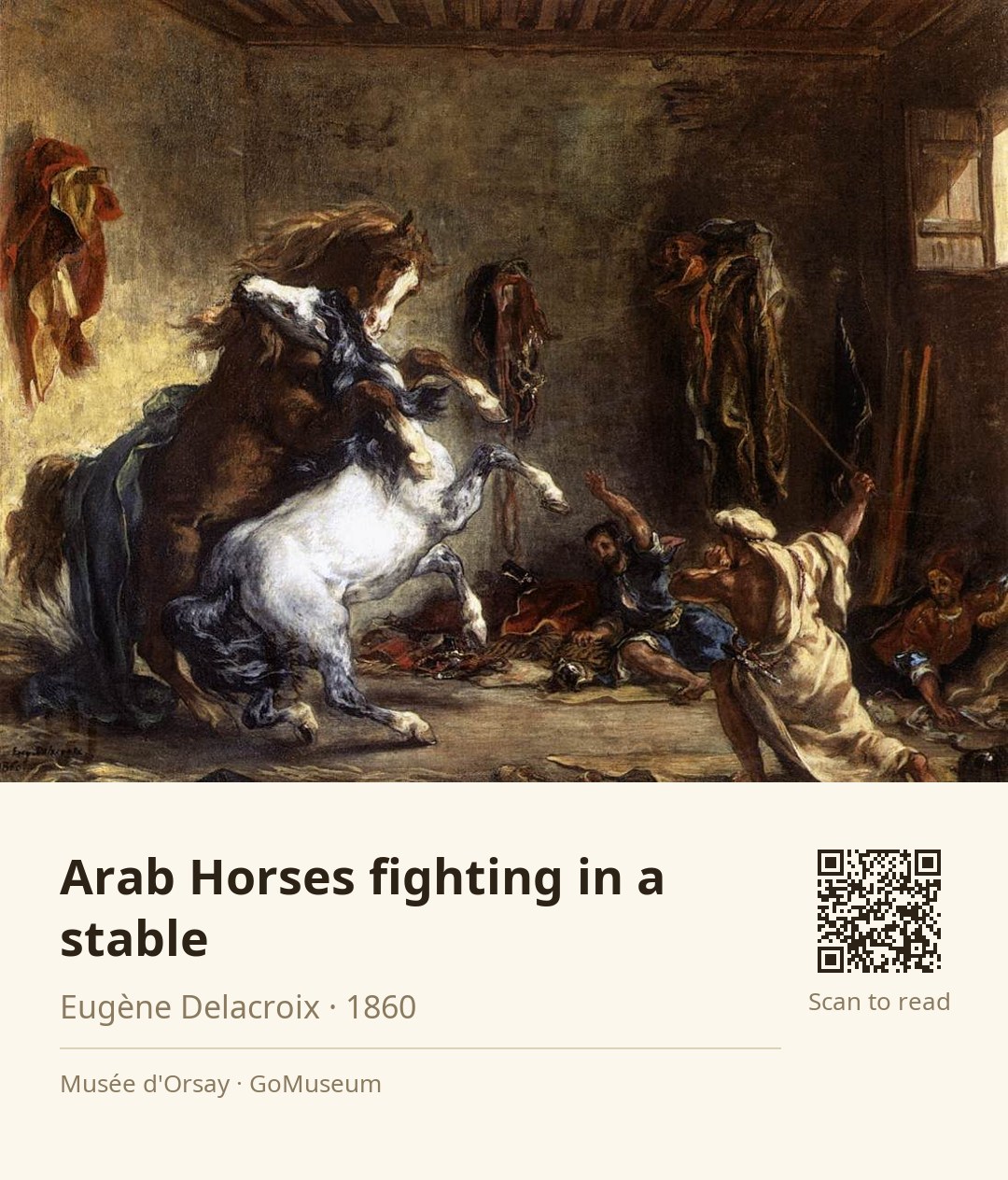
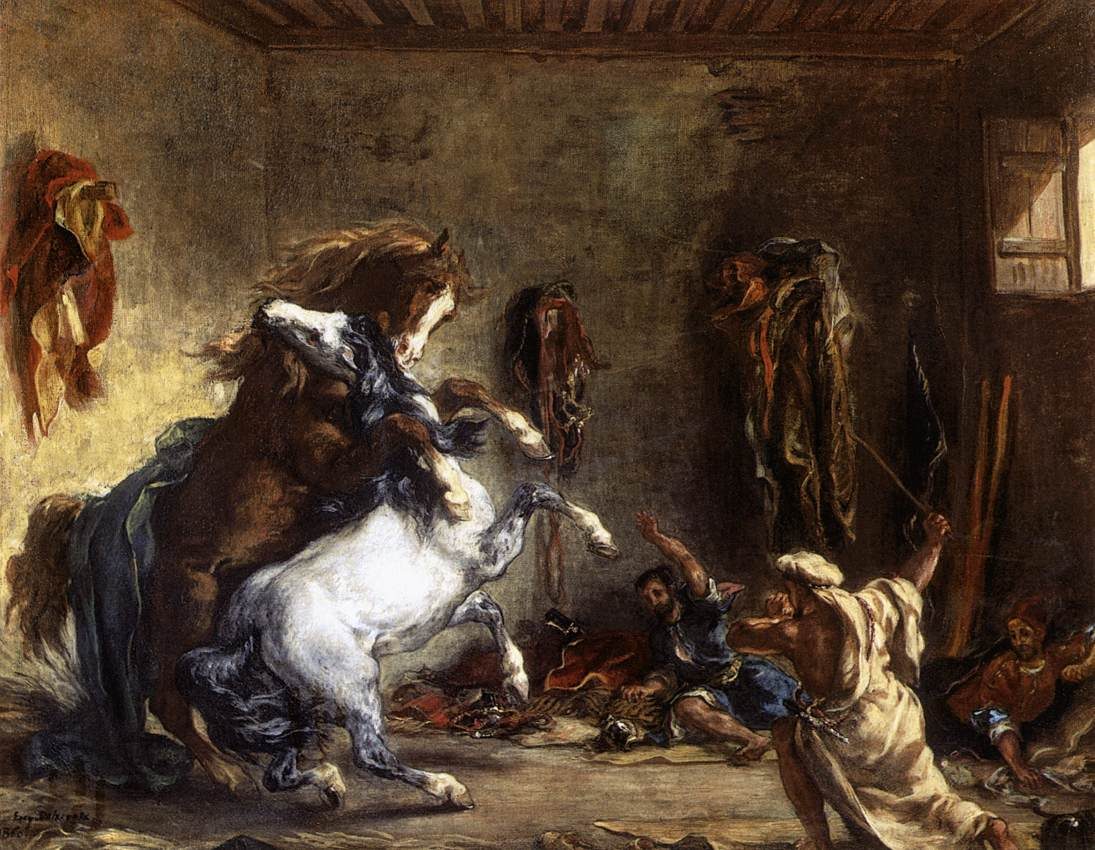
🎧 This work has audio narration — listen in the appTwo horses, a chestnut and a dapple-grey, rear and lock together in the bottom left of this dim, bare stable, and the grey's white highlights are the brightest thing in the room. Look at how Delacroix paints the loose blue-green cloth trailing from the chestnut's back, and how the saddle cloths and gear lie scattered across the floor as if the fight had just torn through the place. Those ragged, unfinished-looking strokes are what make the scene feel violent rather than posed; the diagonals of the two bodies crash across the frame and carry your eye straight into the chaos.
The story behind it reaches back to Morocco, where Delacroix watched a real fight between stallions in 1832 and wrote to his friends about it, sketching the moment and noting that the grey horse had passed its head under the neck of the other. He did not finish the painting until 14 June 1860, nearly thirty years later. The event had happened outdoors, but he chose to set the struggle inside a stable, a choice that compresses the action into a tight, enclosed space. The work was made for the art dealer Estienne, who had also commissioned Horses Leaving the Sea, and the two are usually considered a pair. The painting was sold at auction in Paris on 12 February 1872, and in 1873 John Saulnier acquired it in Bordeaux.
Eugène Delacroix, born on April 26, 1798, in Charenton-Saint-Maurice, emerged as a pivotal figure in the French Romantic movement. He diverged from the Neoclassical ideals of his contemporaries, such as Ingres, drawing inspiration from the vibrant colors and dynamic forms of Rubens and the Venetian Renaissance. His works, characterized by dramatic themes and a passion for the exotic, often reflected his travels in North Africa and his fascination with the sublime forces of nature, influenced by literary figures like Lord Byron.
Delacroix's career was marked by both acclaim and controversy; his early painting, "The Barque of Dante," stirred public debate but was ultimately recognized by the state. His later masterpieces, including "Liberty Leading the People," showcased his ability to blend historical and contemporary narratives, solidifying his status as a master of expressive brushwork and color theory. His innovative techniques laid the groundwork for Impressionism and inspired the Symbolist movement.
Despite personal struggles, including early orphanhood and financial hardships, Delacroix's legacy endures. He is celebrated not only for his paintings but also for his lithographs and writings, which reveal his artistic philosophy. As one of the last old masters, his influence resonates through art history, marking him as a cornerstone of Romanticism and a precursor to modern artistic movements. Delacroix passed away on August 13, 1863, leaving a profound impact on the art world.
The painting was made for the art dealer Estienne, and the material notes that it is usually considered a pair with Horses Leaving the Sea, which was made for the same dealer. Its roots go back to Morocco, where Delacroix witnessed a stallion fight that he mentioned in a letter to his friends dated 8 February 1832. In his diary entry of 19 June 1854 he listed this subject among several Morocco-themed works he had in mind, yet the material says he seems to have begun it only around two years later, in 1856. He completed it on 14 June 1860. The work was sold in Paris on 12 February 1872, and in 1873 John Saulnier acquired it in Bordeaux. It next passed to Charles Hayem in 1885, then to Isaac de Camondo. It was donated to the Louvre in 1908, shown there in 1911, and moved to the Musée d'Orsay in 1986.
The canvas measures 64.5 by 81 centimetres and is painted in oil. The material describes the palette as earthy browns, ochres and olive, with bright white on the grey horse and small touches of red. The room is bare, with thin, scumbled wall surfaces and a wooden-beamed ceiling. Red and yellow garments hang on the left wall, saddles and tack on the back wall beside a small shuttered window, and long poles lean in the right corner. At right, a man in a pale robe and white cap raises an arm holding a long stick or whip, a second man in dark blue sits on the floor with an arm flung up, and a third in red crouches in the lower right corner. The brushwork is described as loose and visible, with thick white highlights on the grey.
It was made for the art dealer Estienne, who also commissioned Horses Leaving the Sea, and the two are usually considered a pair.
John Saulnier bought it in Bordeaux in 1873, and it later belonged to Charles Hayem from 1885 and then to Isaac de Camondo.
It was given to the Louvre in 1908 and shown there in 1911, and in 1986 it was moved to the Musée d'Orsay.