The Immaculate Conception with Saint Andrew and Saint Paul
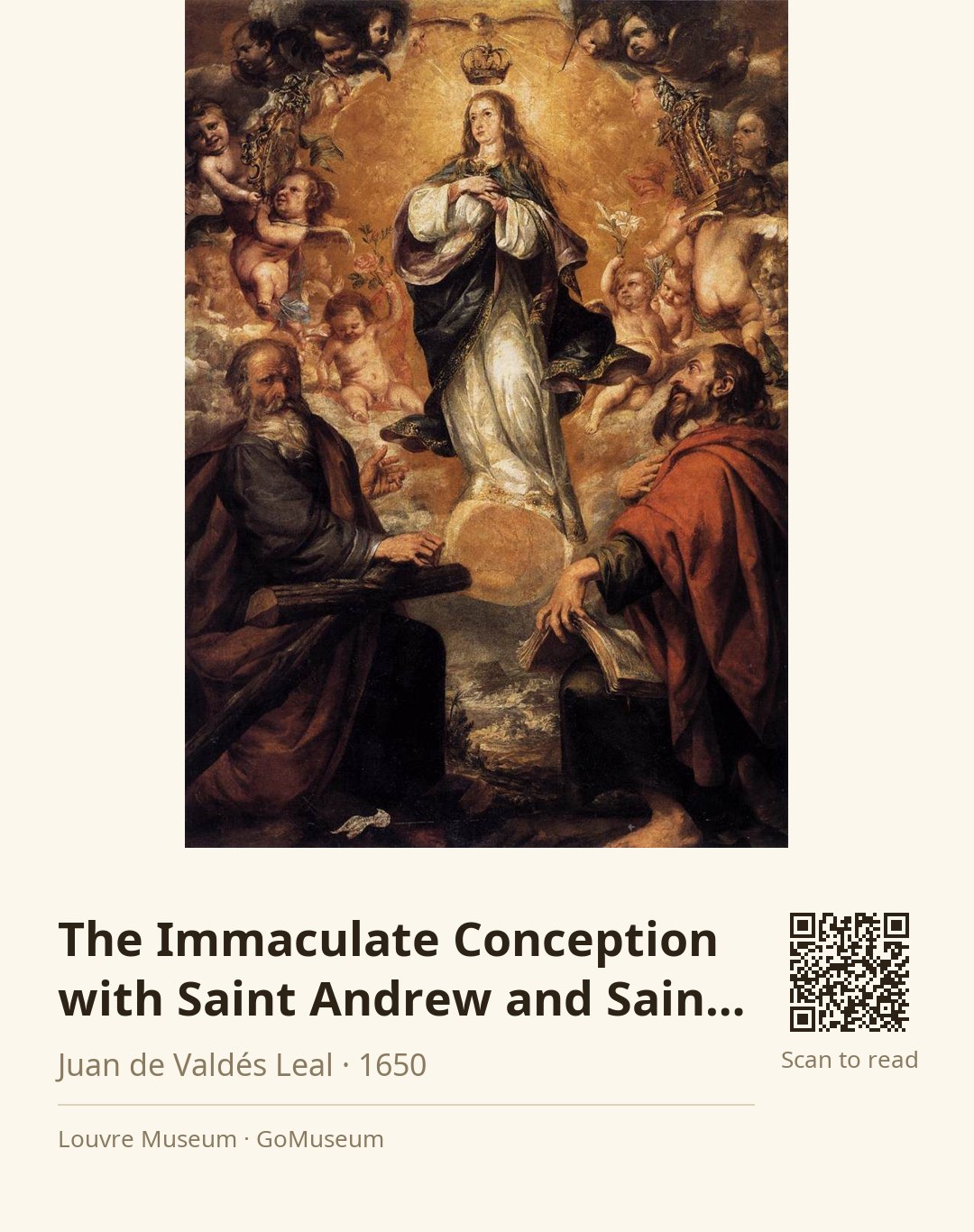
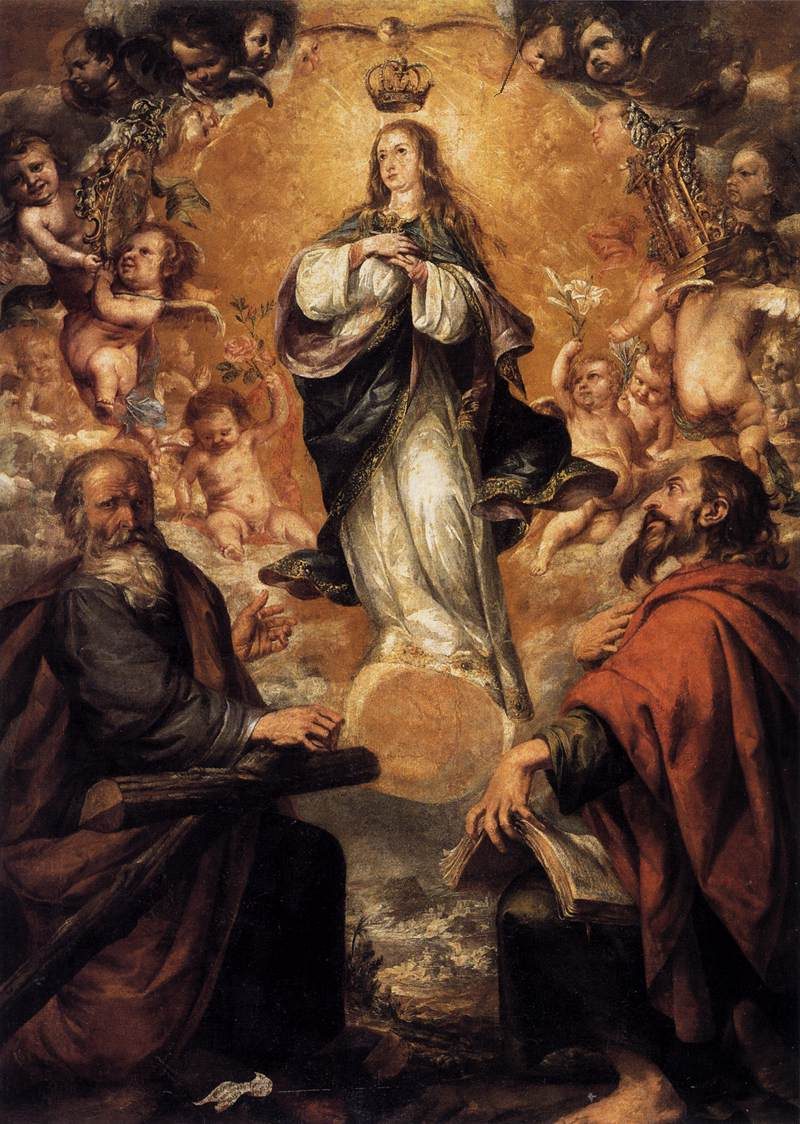
🎧 This work has audio narration — listen in the appA young woman in a white gown and dark blue mantle stands alone at the top of the canvas, hands folded over her chest, and it is her gesture that the whole painting seems to be built around. Her feet rest on a pale disc in a bank of clouds, and a golden glow rises behind her, with a crown and a small winged figure above her head. Below, two bearded men are tucked into the lower corners: on the left, an old man in grey and brown holds up a rough wooden beam; on the right, a barefoot man in a red cloak holds an open book and looks upward toward her. Between them, dark rocks and water, while a crowd of small winged children, the putti, swirl around her carrying a rose, a lily and clusters of gilded frames.
The two men are the apostles Andrew and Paul, which is why the title names them. Andrew is recognisable by the wooden cross-like beam he carries, the instrument of his martyrdom, and Paul by his book, the letters that made him a teacher of the faith. Their placement at the bottom and her elevation at the top set up a simple visual hierarchy: the saints look up, and the Virgin receives their gaze.
The work is an oil painting on canvas, measuring about 235 by 168 centimetres, and it belongs to the Louvre's collection, catalogued as RF 2372. The Louvre's records name a previous owner, Mr Carvalho, as the link in the painting's history before it reached the museum. Valdés Leal was born in Seville in 1622, trained in Córdoba under Antonio del Castillo, and later co-founded the Seville academy of art with his friend Bartolomé Esteban Murillo.
Juan de Valdés Leal (1622–1690) was a Baroque painter, etcher, and, by training, a sculptor and architect, born and buried in Seville. Born Juan de Nisa, he took his mother's surname, Valdés Leal, and in his twenties he trained under Antonio del Castillo in Córdoba, where he remained until returning to Seville in the mid-1650s. There he settled for good, living in the San Andrés district until his death in 1690.
His temperament, as the sources portray it, pulled him toward the dramatic and the grave. His religious and allegorical works, such as the History of the Prophet Elijah for the Carmelite church and the Triumph of the Cross for the Hospital de la Caridad, favor somber, forceful compositions. He was a close friend of Bartolomé Esteban Murillo, whose serene style contrasted sharply with his own, and the two worked together, notably on a commission for the Hospital de la Caridad alongside the sculptor Pedro Roldán. With Murillo and Herrera the Younger, he helped found the Seville Academy of Art, later serving as its president.
What drove his most distinctive work was a preoccupation with mortality. His vanitas paintings, including In ictu oculi ("in the blink of an eye") and Finis gloriae mundi ("the end of the world's glory"), meditate on transience and death, and the allegories of Time and Death he painted for the Charity Hospital in 1672 are among his best-known pieces. His energetic, free brushwork and rich colour gave these meditations a vivid immediacy.
Family was central to his life. He married the painter Isabella Carasquilla in 1647, and of their five children several became artists, with his daughters specializing in portrait miniatures. Valdés Leal occupies an important place in Spanish Baroque art as a counterpoint to Murillo, and as a master of the dark, dramatic, and mortality-minded strain of Andalusian painting.
The woman's gown is white with wide sleeves, and her mantle is a deep blue lined in a softer mauve. She stands on a pale disc within a bank of clouds, under a golden glow, and above her hover a crown and a small winged form. The lower corners are weighted by two bearded men, one in greyish brown and one in a red cloak, and between them rocks and water sink into darkness. The palette leans on gold, red and blue, and the paint is handled loosely, with brushwork that stays visible rather than smoothed away.
The two were close friends even though their work was very different: Leal favoured sombre, dramatic subjects, while Murillo's paintings were peaceful and serene.
Yes, his wife Isabella Carasquilla was also a painter, and their children Lucas, Juan, Luisa, Maria and Laura also became artists, with his daughters specialising in portrait miniatures.