The Temptation of Saint Anthony
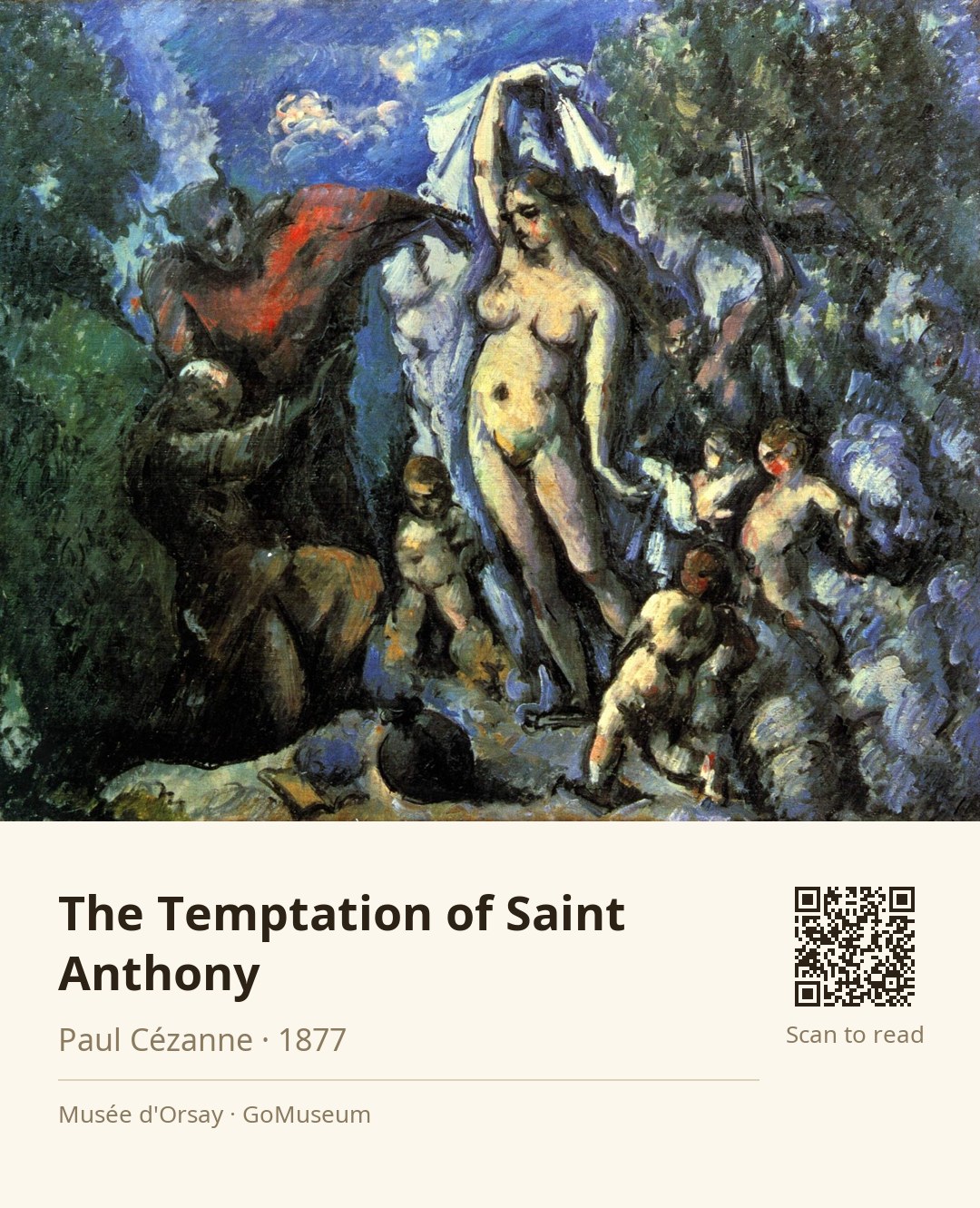
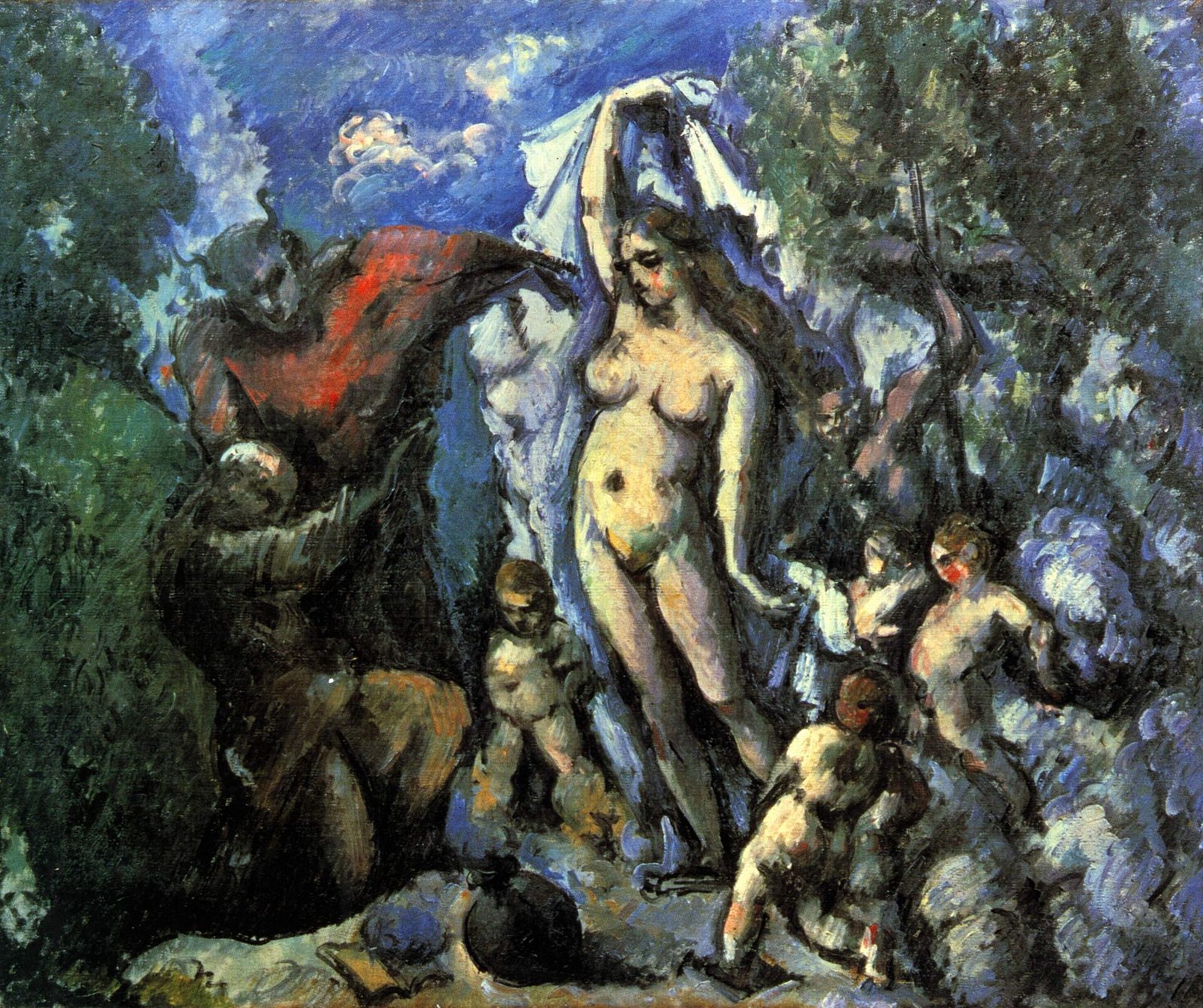
🎧 This work has audio narration — listen in the appBefore you, a woman stands bare in the middle of a green and blue thicket, one arm lifted high, holding a pale drapery above her head. Her face is turned away, her long brown hair falls down her back, and she seems to be doing something that requires all her attention. Look at the figure crouched to her left, hunched low in a brown robe and a red-and-blue cloak, its bearded face half lost in shadow. Then notice the small nude children at the right edge, twisting and bending, one of them leaning toward the rocky ground in the foreground.
Those hunched and twisting bodies are what make the scene feel unsettled rather than calm. The paint itself is short, thick and directional, and the heavy dark outlines around the figures hold them in place, so the woman's lifted arm and the stooped shadow beside her read as a tense exchange rather than a quiet pose. Cézanne could have softened all of this, but he leaves the edges rough and the forms half-finished, which keeps the temptation the title promises at the level of something you feel more than something you can name.
Paul Cézanne was a French Post-Impressionist painter born on January 19, 1839, in Aix-en-Provence. His innovative approach to color and form bridged the gap between Impressionism and the emerging Cubism of the early 20th century. Initially influenced by Romanticism and Realism, Cézanne developed a unique style that emphasized the underlying structure of objects, using repetitive brushstrokes and planes of color to create depth and complexity in his work.
Despite facing ridicule and misunderstanding from critics during his early career, Cézanne garnered support from fellow artists like Camille Pissarro and the art dealer Ambroise Vollard, who recognized his talent. His first solo exhibition in 1895 marked a turning point, leading to greater appreciation of his contributions to art. Cézanne's legacy is profound; both Henri Matisse and Pablo Picasso acknowledged him as a foundational figure in modern art, dubbing him "the father of us all." He passed away on October 22, 1906, leaving behind a transformative body of work that continues to influence artists today.
For a while it belonged to the collector Arsène Alexandre, and in May 1903 it was sold at the Galerie Georges Petit in Paris, lot number eight in that sale. After that it entered the collection of Eugène Blot, then Auguste Pellerin, and then his son Jean-Victor Pellerin. In 1982 the State accepted it in lieu of inheritance taxes owed to the national museums, and it was assigned to the musée d'Orsay, where it carries the inventory number RF 1982 46. It has been lent out often since, with appearances in a 1907 retrospective of Cézanne's work in Paris, a 1936 Paris Cézanne show, and a long run of international exhibitions through the 1990s and 2000s, including Tokyo, Hiroshima and Kyoto in 2008.
The woman stands in the centre with her head bent away, and the pale drapery she holds overhead is one of the few light, cool notes against all that foliage. To her left the hunched dark figure is almost swallowed by its brown robe and red-and-blue cloak, and behind her the paler torso and reddish form are barely there, more suggestion than body. On the right, the small nude children twist and crouch in a loose cluster, while at the bottom a dark round vessel and a little open book sit on the stony ground like objects left behind by someone who has just stopped reading. The sky is a deep blue with small white clouds, pressed high above the thicket. The paint is laid down in short, heavy, directional strokes, and the figures are fenced in by dark outlines that give them a stiff, almost carved quality.
The painting's provenance includes a 1903 sale through the Galerie Georges Petit in Paris, a sale that took place as a named auction with the work listed as number eight.
It passed through several private collectors, starting with Arsène Alexandre, then Eugène Blot, Auguste Pellerin and his son Jean-Victor Pellerin, before the State accepted it in 1982 in lieu of inheritance taxes.
It was accepted by the State as payment in kind of inheritance taxes owed to the national museums, rather than being bought outright.
It was lent to Tokyo, Hiroshima and Kyoto in Japan in 2008 for the exhibition Paris et les Parisiens (1830-1930), and it also appeared in shows in Copenhagen, Budapest, Warsaw, Bucharest and Basel.