Three Women with Parasols
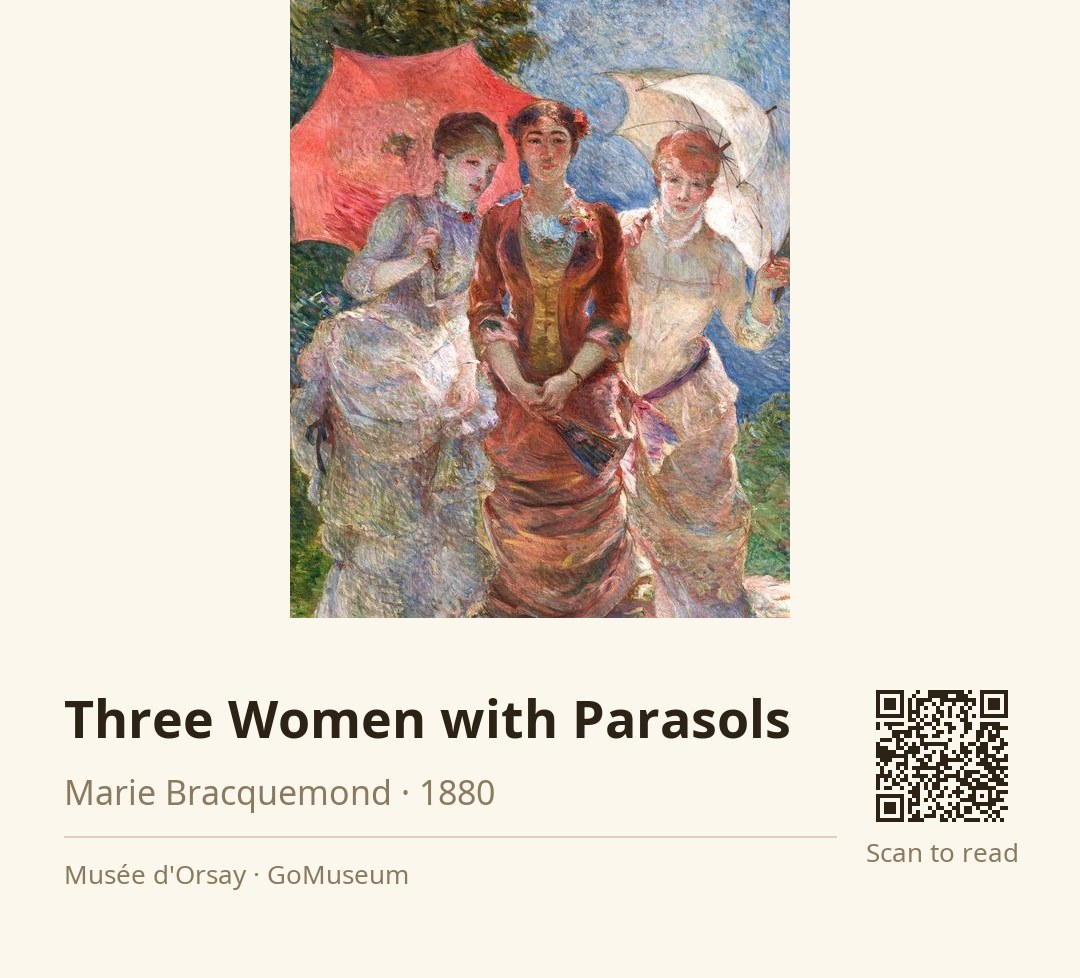
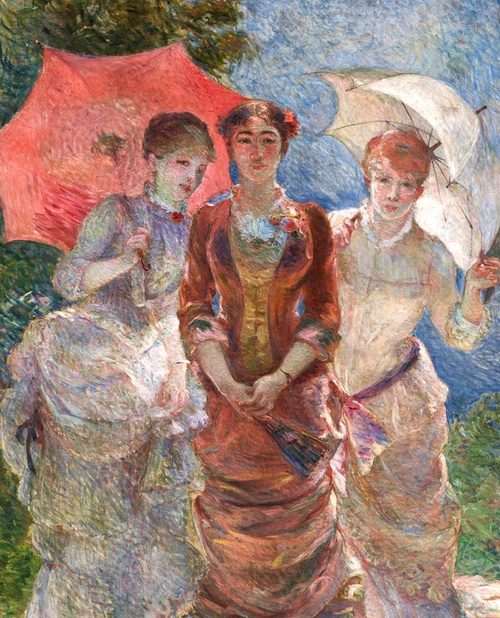
🎧 This work has audio narration — listen in the appThe woman on the left holds her coral-red parasol tilted so far over her head that it nearly swallows her face, while the central figure stares straight out at you, a closed dark fan pressed between her clasped hands. Together they make a tight little knot of three, shoulders touching, the whole group pushed so close to the edge of the canvas that there is no room to step back from them.
Look at how the painter built the surfaces: the paint goes on in short, feathery, broken strokes, and the colors are layered and mixed right on the canvas rather than smoothed flat. The mustard waistcoat and russet jacket of the central woman sit against the pale lilac and cream of her companions, and the small red flowers at her chest and in her hair repeat the coral of the parasol across the group. Behind them the foliage and sky dissolve into loose marks, so the figures seem to hover in light rather than stand in a room.
The painting was made in 1880, when Marie Bracquemond was exhibiting with the Impressionists, and the material tells us that the two women flanking the center were modeled on her half-sister Louise Quivoron, while the central figure was based on Marie's own likeness. Bracquemond made several studies for the work, and one may have been shown at the eighth Impressionist exhibition in 1886. The picture is often called The Three Graces, after the goddesses of Roman mythology who were a favorite subject in Western art. The critic Gustave Geffroy liked it so much that he bought it from her and hung it in the Luxembourg Palace.
Marie Anne Caroline Bracquemond, born on December 1, 1840, in Brittany, was a pioneering French Impressionist artist. Emerging from a challenging family background, she began her artistic journey at 17, studying under various mentors, including the renowned Ingres. Despite lacking formal training, her talent shone through early exhibitions at the Paris Salon.
Bracquemond married printmaker Félix Bracquemond, whose jealousy and disapproval of her work often overshadowed her achievements. She became a vital part of the Impressionist movement, participating in three major exhibitions and producing over 150 works, though many remain unaccounted for today. Her notable pieces include "The Lady in White" and "Afternoon Tea."
Despite her contributions, her legacy was often eclipsed by her husband's influence. After a brief but impactful career, she withdrew from the public eye in the early 1890s, largely due to health issues and familial constraints. Bracquemond's work is now increasingly recognized, solidifying her place among the great female artists of Impressionism. She passed away on January 17, 1916, leaving behind a rich, albeit underappreciated, artistic legacy.
According to the memoirs published by their son Pierre, yes: Félix sometimes concealed Marie's paintings when guests came to the house. The claim comes from a family account rather than from a documented event.