Self-portrait
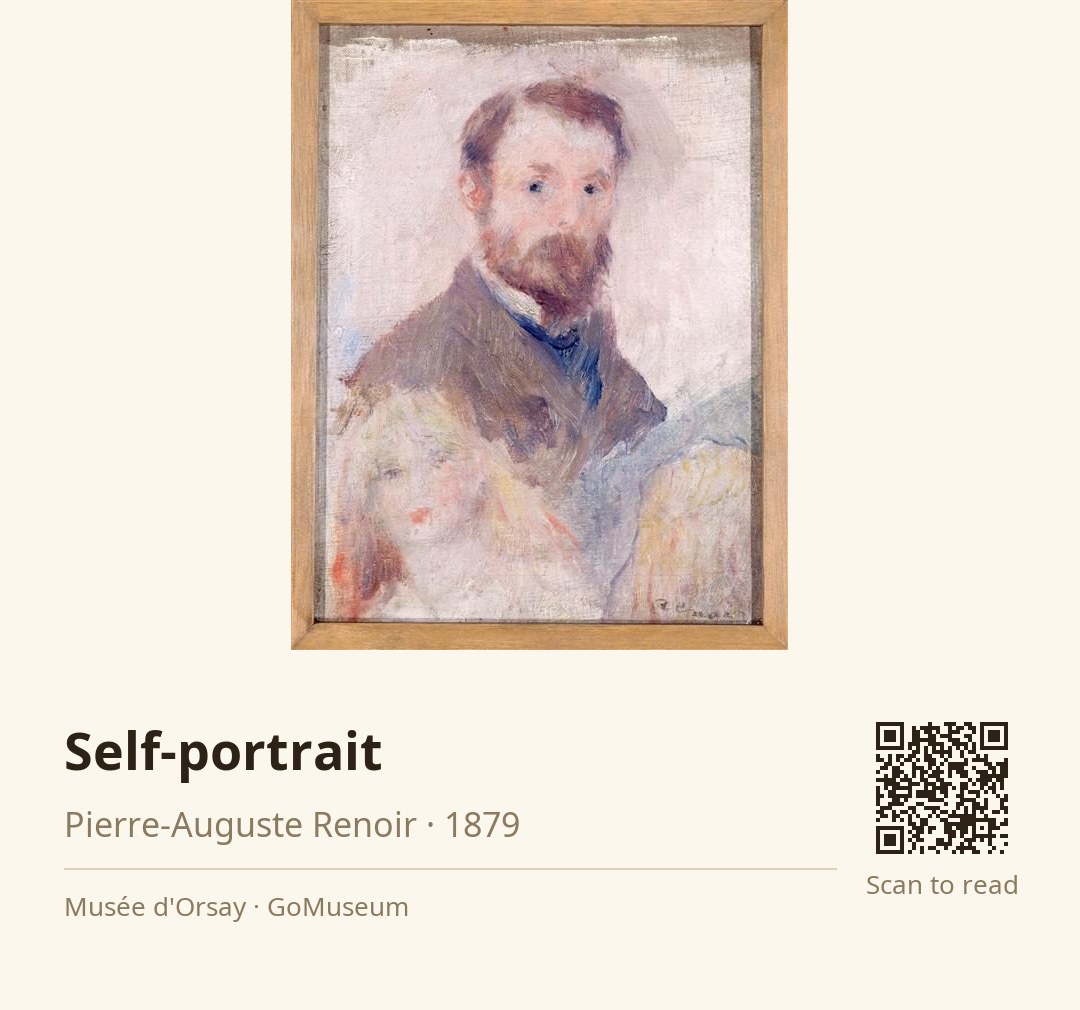
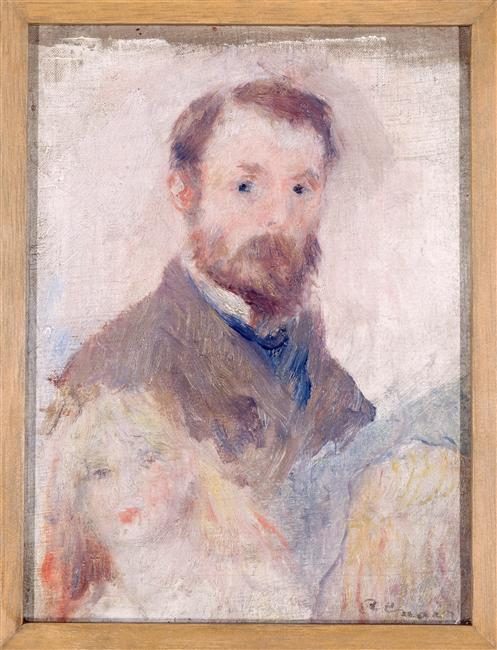
🎧 This work has audio narration — listen in the appRenoir looks out at you from a field of soft pink-white, bearded and bust-length, his reddish-brown hair and beard catching the light against a brown jacket and a dark blue cravat. Look closer at the lower left and a second face surfaces, a pale-haired child painted in thin yellows and pinks, a touch of red at the lips, almost dissolved into the ground. Nearby, at the lower right, a loose yellow-ochre shape hovers without declaring what it is.
What makes this small canvas so striking is how little it insists on. The man is built from quick, feathery strokes: the face is softly blended, while the coat is laid in broader, darker marks. The weave of the canvas shows through the thinnest paint, and bare ground is left visible along the top edge, so the picture never quite hides how it was made. Renoir seems more interested in the energy of the brush than in polished finish, which is part of what separates this from the carefully finished portraits he was then exhibiting.
Pierre-Auguste Renoir, born on February 25, 1841, in Limoges, France, emerged as a pivotal figure in the Impressionist movement. His early life in a modest family led him to Paris, where he honed his artistic skills amidst the masterpieces of the Louvre. Initially apprenticed in a porcelain factory, Renoir's passion for painting flourished, particularly after studying under Charles Gleyre, where he befriended fellow artists like Monet and Sisley.
Renoir's work celebrated feminine beauty and vibrant social scenes, exemplified in iconic pieces like "Dance at Le Moulin de la Galette." Despite facing criticism early on, he gained recognition, especially after participating in the first Impressionist exhibition in 1874. His style evolved over the years, transitioning towards realism influenced by classical masters like Raphael.
Throughout his life, Renoir balanced personal struggles, including health issues, with a prolific output, reportedly creating around four thousand works. He became a beloved figure in art history, known for his warm palette and expressive brushwork. Renoir passed away on December 3, 1919, leaving a legacy that continues to inspire artists and art lovers alike.
This small self-portrait is dated 1879 and was painted by Pierre-Auguste Renoir. The material also lists two catalogue references, Daulte 293 and Fezzi et Henry 329. Beyond that, the record does not say where the work was first shown or how it was received, so those parts of the story are simply not on file here.
The man fills the centre and upper field of the canvas, turned at a slight three-quarter angle, with his gaze coming straight out at the viewer. The palette is restrained: reddish-brown hair and beard, a brown jacket over a pale collar, and a dark blue cravat. The background is a pale pinkish-white, and the ground is left bare along the top edge. The face is worked in soft, blended strokes, while the coat gets broader, darker marks. The child's face in the lower left is painted in thin yellows and pinks, and the yellow-ochre shape at lower right is loosely brushed and not clearly identifiable.
The painting is an oil on canvas measuring 19 by 14 in its registered dimensions, and its French title is Portrait de l'artiste.
Yes, at thirteen he became an apprentice at a porcelain workshop, where he decorated pieces, and in 1858 he painted fans to earn money.