 Image: Phyrexian · Mary Harrsch · Sailko · Phyrexian
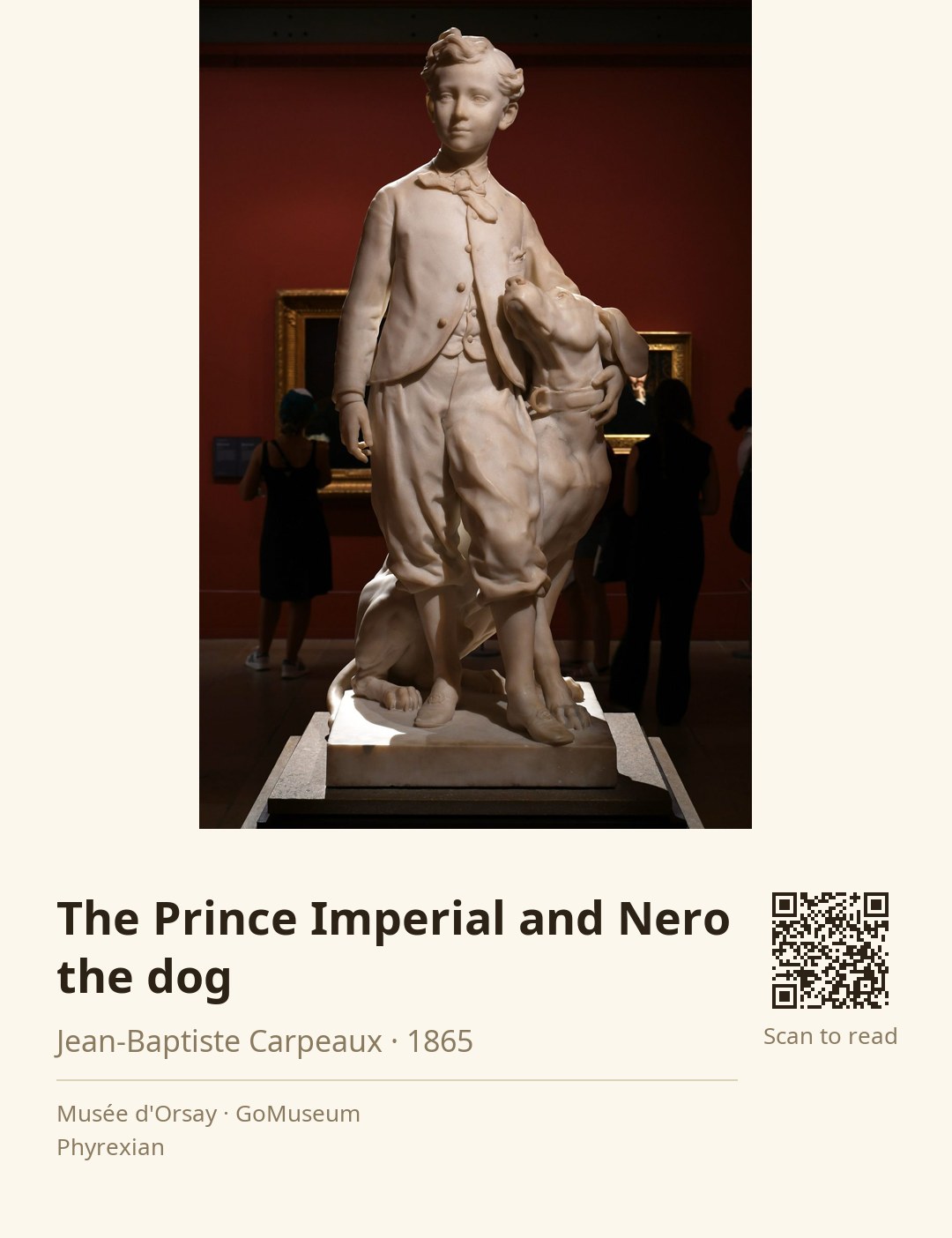
The Prince Imperial and Nero the dog
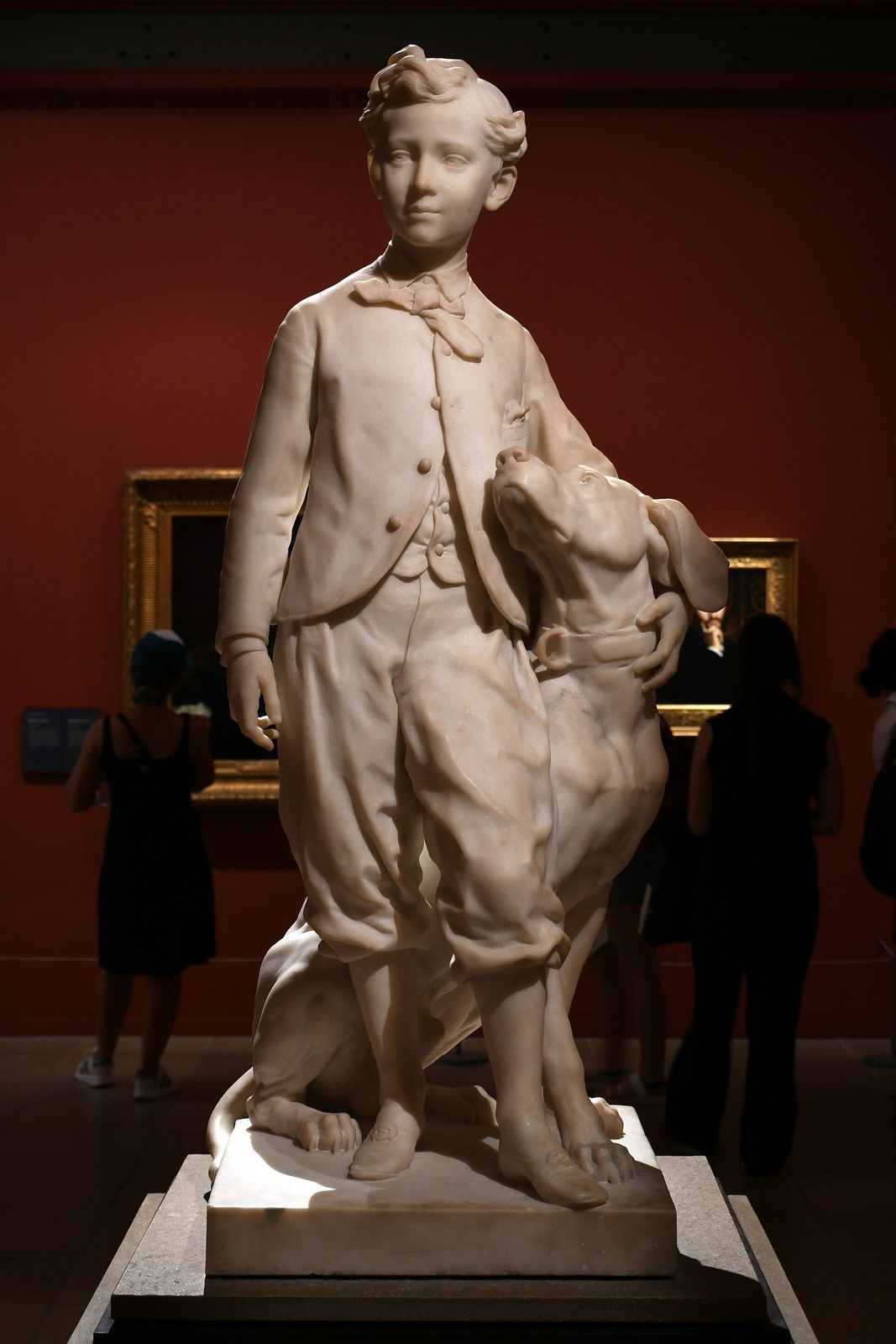
🎧 This work has audio narration — listen in the appThe boy in this marble is Louis-Napoléon, the only son of Napoléon III and the Empress Eugénie, and the dog beside him is Nero. Look at the hand resting on the hound's neck: the boy's arm wraps around the animal in an easy, unposed gesture, and the dog looks up at him with its long ear hanging down. The boy stands with his weight on one leg, his head turned a little away from us, and that small shift is what makes him seem caught mid-moment rather than frozen for a formal portrait.
The clothes carry much of the story. The buttoned jacket, the waistcoat and the loosely knotted bow tie are carved with care, and so are the gathered knee-length trousers and the flat shoes with their small decorative bows. The cloth is creased where a real child's clothes would crease, and the hair is cut into short, soft waves. Pale marble is hard to make look like living skin, and Carpeaux has made the surface smooth and warm, with faint veining running through it.
Carpeaux was a sculptor who had made his name by breaking with stiff academic conventions, and he had a real admiration for the emperor. He gave lessons in drawing and modelling to the young prince in 1864, and that closeness gave him the chance to make the portrait. The sculptor himself said the statue would be a fine emblem of modern times, and he described it as a step on the ladder of his own fame. Reduced copies were produced soon after, and the imperial household bought back the rights to them in 1869. In 1868 he also made a version in silvered bronze without the dog, meant for the Hôtel de Ville in Paris, which was destroyed in the fire of 1871.
Jean-Baptiste Carpeaux was a prominent French sculptor and painter born on May 11, 1827, in Valenciennes. Coming from a humble background as the son of a mason, he pursued his passion for art against his father's wishes, studying under François Rude at the École des Beaux-Arts. His artistic journey took him to Rome after winning the Prix de Rome in 1854, where he drew inspiration from the works of Michelangelo and Donatello, embracing a style that celebrated movement and spontaneity over classical tradition.
Carpeaux's career flourished during the Second Empire, where he became known for his dynamic sculptures, including the famous "Neapolitan Fisherboy" and the allegorical group "Ugolino and His Sons." His work often reflected a blend of realism and emotional depth, which resonated with the public and earned him numerous commissions, including from Emperor Napoleon III. He was not only a celebrated artist but also a savvy entrepreneur, producing variations of his works to reach a broader audience.
Despite his success, Carpeaux struggled with the constraints of academicism and sought to break free from traditional norms. His innovative spirit and dedication to capturing the essence of life left a lasting impact on the art world. He passed away on October 12, 1875, but his legacy endures through his influential works and the artists he mentored, securing his place in art history as a key figure of the 19th century.
The work is dated 1865 and the catalogue records its title as Le Prince Impérial (1856-1879) et son chien Nero. It was included in the Exposition universelle in Paris in 1867, catalogued as number 23. Its provenance runs from the Empress Eugénie, whose sale at Farnborough took place on 18 July 1927 as catalogue number 1317, to Fabius and later to Mme Raba Deutsch de la Meurthe. It was shown again in the exhibition of Souvenirs de la famille impériale at the Château de la Malmaison in 1927, as number 73.
The catalogue records a name that is easy to miss: the sculpture is credited to the practitioner Bernaerts as well as to Carpeaux, a reminder that many marbles of this period were realised by skilled carvers working from the sculptor's models.
Yes, Carpeaux described the statue as a step on the ladder of his own fame, and he called it a fine emblem of modern times.
A silvered bronze version without the dog was made in 1868 for the Hôtel de Ville in Paris, but it was destroyed in the fire of 1871.