 Image: Gsimonov
The Decisive Attack of Micheletto Attendolo at San Romano
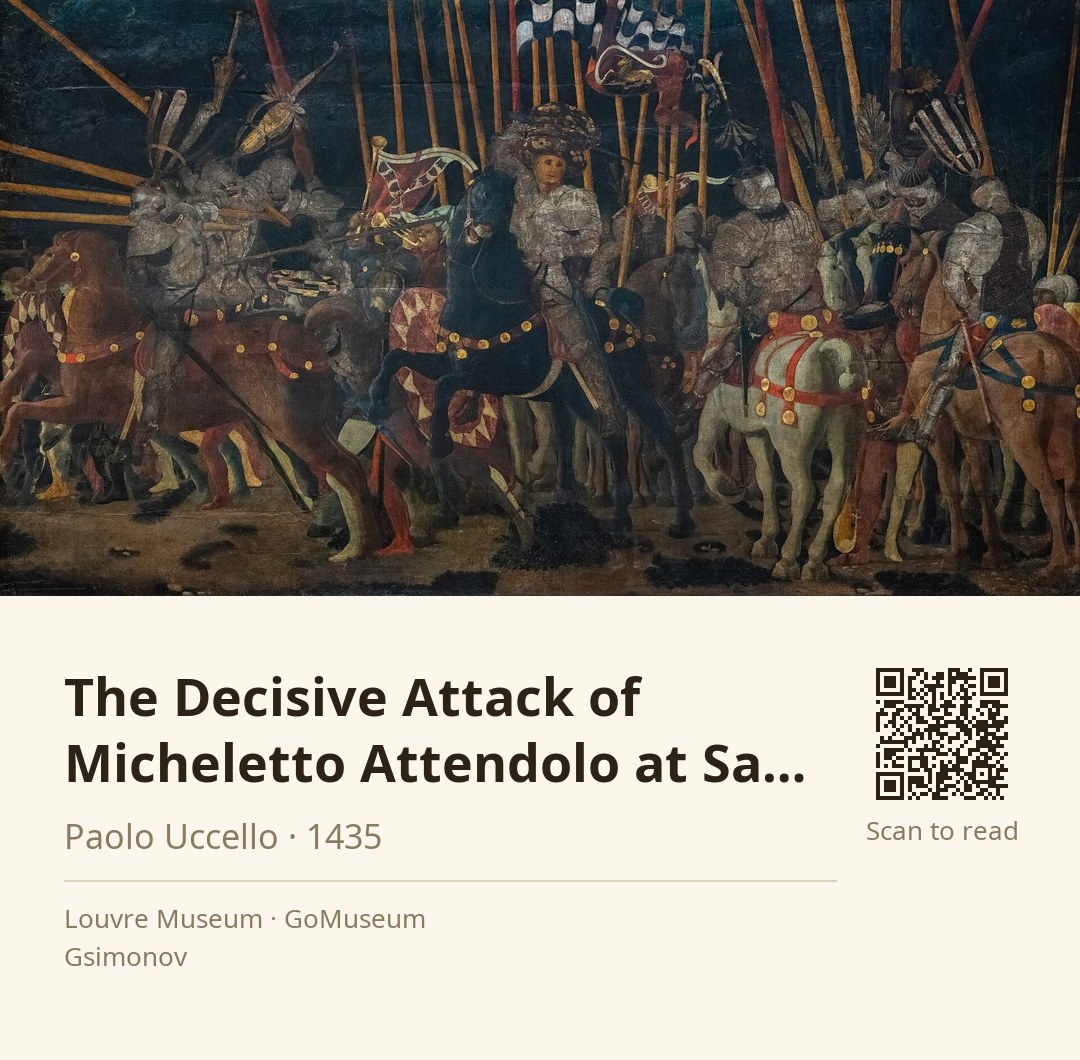
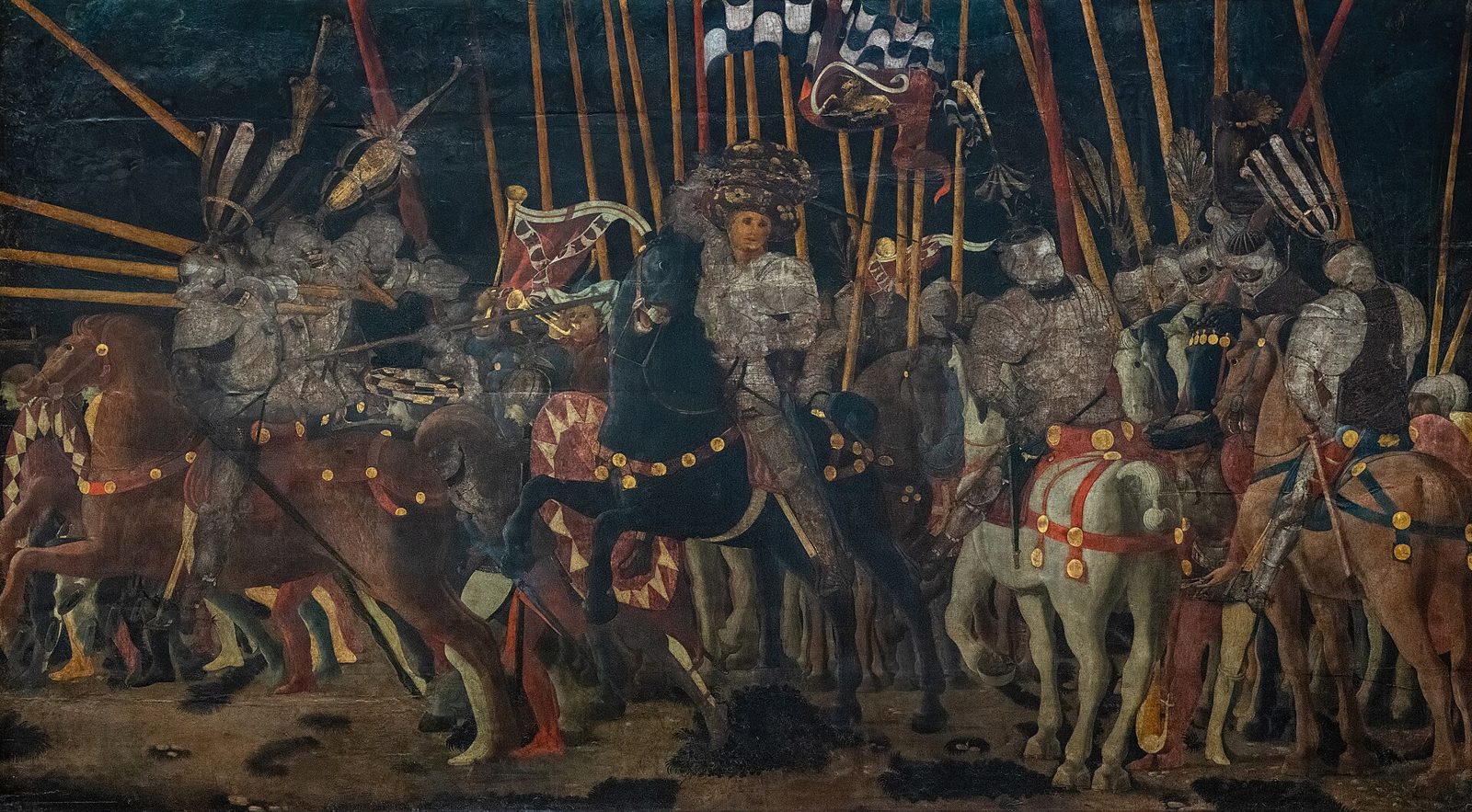
🎧 This work has audio narration — listen in the appA rider on a rearing black horse, his face bare beneath a large patterned turban-like hat, sits at the centre of this crowded field of armour. Around him, riders in silvery-grey plate press forward on chestnut, brown and white mounts, their red harness straps and round gold studs catching the eye. Above them, long lances and poles slant leftward across the dark ground, with checkered and red banners among them, and one banner carries a lion. At the left edge, lances thrust horizontally into a tangle of fighters, while plumed and striped helmets crown several of the figures. Down in the foreground, small figures with bare, differently coloured legs crowd between the hooves, and a few dark shapes lie on the ground. The paint is flat and worn, its surface scratched in places, so the scene reads more as a jostling pattern of colour than as a finely modelled view of the fight.
The painting is a panel in tempera on wood, and it is one of three pictures depicting the Battle of San Romano, fought in 1432. The other two are in London's National Gallery and in the Uffizi in Florence; together they form a cycle, and this panel, shown here in the Louvre, shows the counterattack led by Micheletto Attendolo da Cotignola.
Paolo Uccello, born Paolo di Dono around 1397 and dying in Florence in 1475, was a Florentine painter whose devotion to visual perspective set him apart in the early Renaissance. The son of a barber-surgeon, he earned his nickname "little bird" from his fondness for painting birds and other animals, which he kept in his home in considerable variety. As a young man he trained in the workshop of the sculptor Lorenzo Ghiberti, whose narrative, sculptural style left a lasting mark on him, and he formed a lifelong friendship with Donatello.
By all accounts Uccello was consumed by his study of perspective. Giorgio Vasari, writing some seventy-five years after the painter's death, described him staying up through the night in his study, trying to pin down the exact vanishing point. This obsession shaped his work: he used perspective to create depth, as in his Annunciation with its large columned building, which became a model for later artists seeking convincing illusions of space. His most famous achievement is the three panels depicting the Battle of San Romano, now scattered across Florence, London and Paris, where his geometric experimentation gives the scene its striking, almost fantastical order.
Though rooted in the Late Gothic tradition, with its emphasis on colour and pageantry, Uccello's style was idiosyncratic and left no school of followers. Vasari recorded him as solitary, eccentric, melancholy and poor in his final years. His reputation revived in the twentieth century, when writers such as Marcel Schwob, Antonin Artaud and Bruno Tolentino drew on his figure, and he is now remembered as a painter who pushed the new science of perspective to its limits.
The material gives only a few concrete historical markers for this panel. It is one of three pictures depicting the Battle of San Romano, a 1432 engagement, and this panel shows the counterattack led by Micheletto Attendolo da Cotignola. Its title is given as 'The Decisive Attack of Micheletto Attendolo at San Romano,' and the Louvre records a date of 1435 for the work. Its later history is traced through a dealer and collector trail: it passed through Giraldi in Florence (recorded 1844), then Lombardi et Baldi as dealers, and then the marquis Campana. The Louvre holds it under inventory number MI 469, and it is part of the cycle whose other two panels are in London's National Gallery and in the Uffizi.
The panel is painted in tempera on wood, and it is large, measuring 182 by 317 units. The visual description gives a dense mass of armoured horsemen that fills the picture. At the centre a rider on a rearing black horse wears a large patterned turban-like hat and pale armour, his face bare. Around him riders in silvery-grey plate sit on chestnut, brown and white horses, many with red harness straps and round gold studs. Long poles and lances rise and slant leftward across a dark background, with checkered and red banners among them, one bearing a lion. At the left, lances point horizontally into a knot of fighters, and plumed and striped helmets crown several figures. In the foreground, small figures with bare, differently coloured legs crowd between the hooves, and a few dark shapes lie on the ground. The paint surface is flat and worn, with scratches visible.
The records give 1435 as the work's date, three years after the 1432 battle it depicts. The material does not say why that date was chosen or explain the gap.
Its recorded owners include Giraldi in Florence (recorded in 1844), the dealers Lombardi et Baldi, and the marquis Campana. The material lists these owners in order but does not say when or how the panel reached the Louvre.