The Death of Leonardo da Vinci
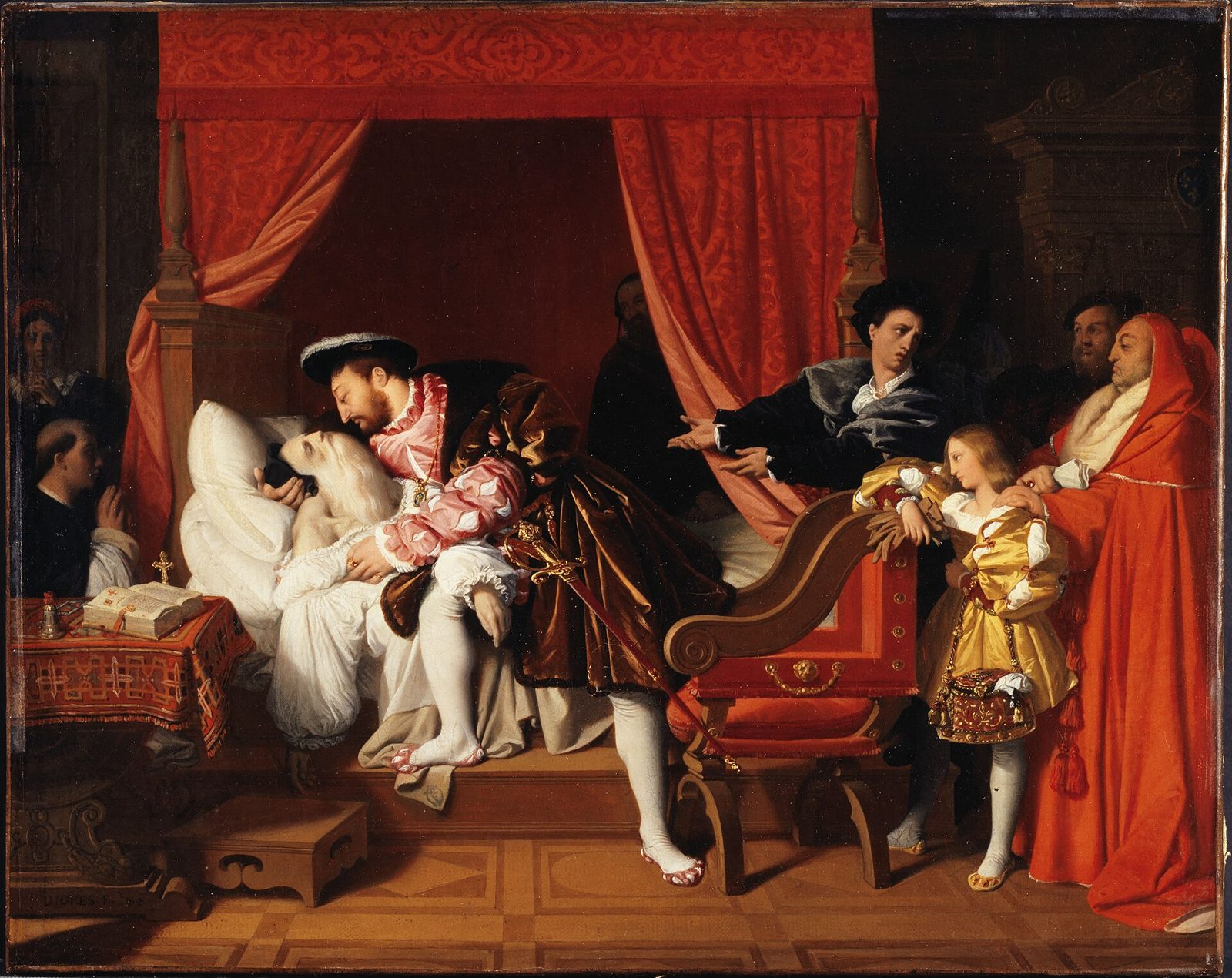
🎧 This work has audio narration — listen in the appThe pale figure of Leonardo da Vinci lies on a lavish bed draped in rich red fabric, cradled by Francis I, who leans in closely, his face filled with concern. The open book and small crucifix on the table beside them hint at the profound spiritual and intellectual legacy Leonardo leaves behind.
This intimate moment captures the end of an era, as the king's gentle hold symbolizes not just a farewell to a great artist, but also the intertwining of royal patronage and artistic achievement. Ingres draws from Giorgio Vasari's accounts, portraying Leonardo's death on May 2, 1519, as a poignant moment in history, where the king's affection for the artist is palpable. The figures surrounding the bed, including a distressed Francesco Melzi, Leonardo's student, and a shadowy doctor, further emphasize the gravity of this farewell.
Ingres, commissioned by Pierre Louis Jean Casimir de Blacas, crafted this painting in 1818, reflecting both a tribute to Leonardo's genius and an affirmation of the Ultra-Royalist ideals of his time. The work, steeped in Neoclassical tradition, serves as a reminder of the enduring bond between art and power, immortalizing a moment that reverberates through history.
Jean-Auguste-Dominique Ingres was a pivotal figure in French Neoclassicism, born on August 29, 1780, in Montauban. He was the son of a versatile artist, which nurtured his early artistic inclinations. Ingres studied under Jacques-Louis David in Paris, where he developed a commitment to academic traditions, aspiring to elevate history painting above all genres. His early career was marked by struggles, as critics dismissed his style as archaic, yet he persevered, achieving recognition with works like "The Vow of Louis XIII" in 1824.
His portraits, characterized by expressive distortions, became his most celebrated contributions, influencing modern artists such as Matisse and Picasso. Ingres's time in Italy, from 1806 to 1824, was crucial; he immersed himself in the study of Renaissance masters, which shaped his distinctive style. Despite facing criticism for his meticulous approach, he remained steadfast in his vision of beauty, emphasizing drawing over color.
Later in life, he returned to Paris, where he continued to create significant works, including "The Turkish Bath." Ingres's legacy endures as a bridge between classical traditions and modern art, embodying the tension between adherence to established norms and the evolving landscape of artistic expression. He passed away on January 14, 1867, leaving behind a profound impact on the art world.
Commissioned in 1818 by Pierre Louis Jean Casimir de Blacas, the French ambassador in Rome, Ingres's painting was intended to honor the legacy of Leonardo da Vinci while reinforcing the ideals of the Ultra-Royalist movement. This was a time when the French government sought to celebrate the Ancien Régime and its artists. Ingres's work found a permanent home in the Petit Palais in Paris, where it remains today. The painting's provenance includes notable figures like Félicie de Virieu, Marquise, who owned it before it was acquired by the museum. Interestingly, Ingres's portrayal of this historical moment was influenced by Giorgio Vasari's accounts, which, while not entirely accurate, shaped the narrative of Leonardo's final moments.
Ingres employed oil on canvas to create a rich tapestry of textures and colors that evoke the emotional weight of the scene. His brushwork is meticulous, particularly in the rendering of fabrics—the sumptuous red drapery and the delicate white linens contrast sharply, drawing the viewer's eye to the central figures. The composition is carefully balanced, with Leonardo's pale figure reclining against the vibrant backdrop, while Francis I's dynamic posture suggests urgency and compassion. Ingres's choice to depict the king without gloves adds a layer of intimacy, emphasizing the personal connection between the two men. The figures surrounding the bed are rendered with a sense of depth, their expressions and gestures contributing to the overall narrative of loss and reverence. Ingres's revisions to the original drawing, including adjustments to the figures and drapery, showcase his commitment to achieving a harmonious and impactful composition.
A fascinating tidbit about this painting is that Ingres initially conceived it in a wash drawing during the 1820s, and he made several alterations before arriving at the final composition. One of the most interesting changes was the addition of a young priest figure, which Ingres included as an afterthought, showcasing his evolving vision for the scene. This reflects Ingres's meticulous nature and his desire to capture the essence of the moment with precision.
Vasari's accounts, although not fully accurate, provided the narrative framework that Ingres used to depict Leonardo's final moments.
It is currently housed in the Petit Palais in Paris.