The Sleepers
🎧 Free preview: one of 5 works you can listen to here in full.
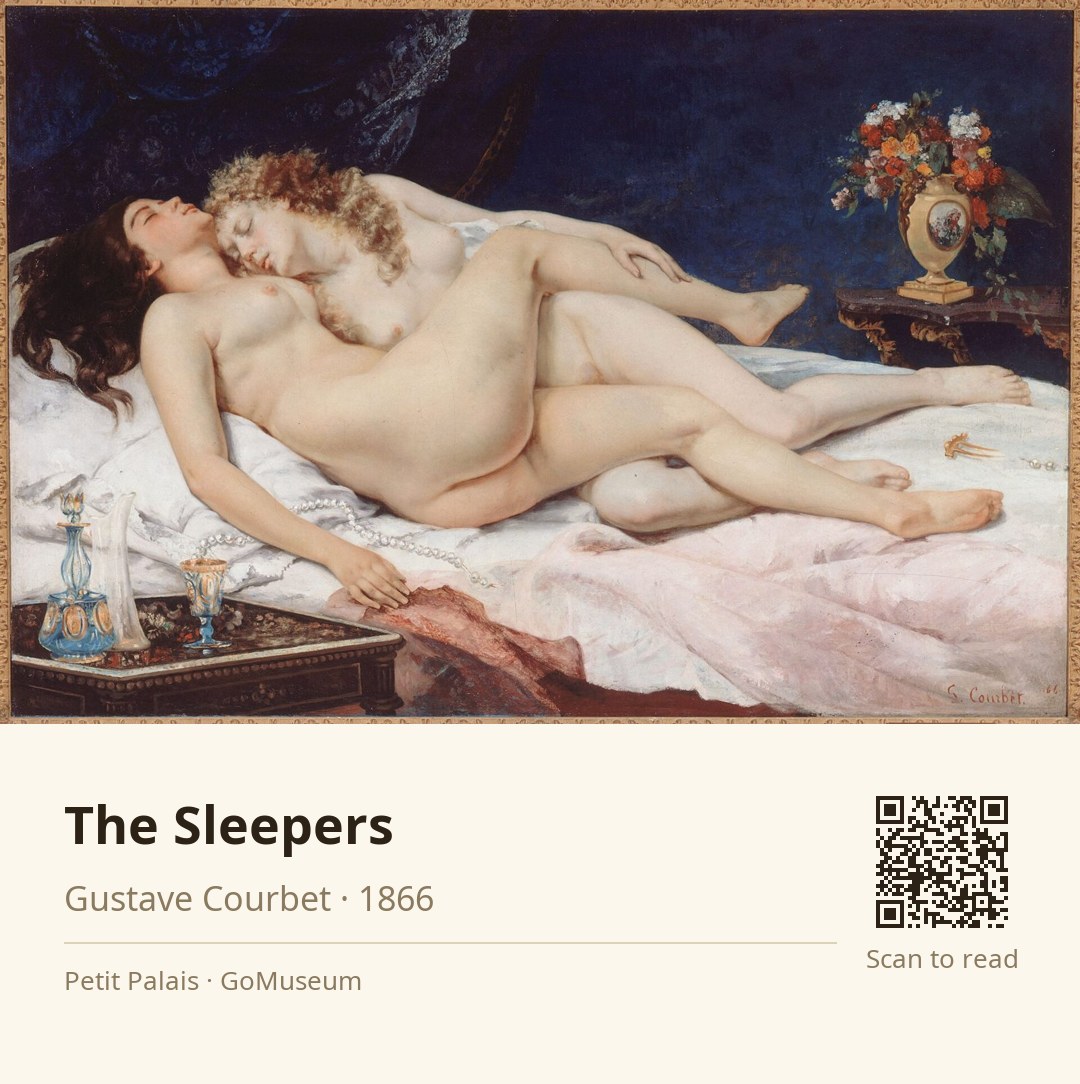
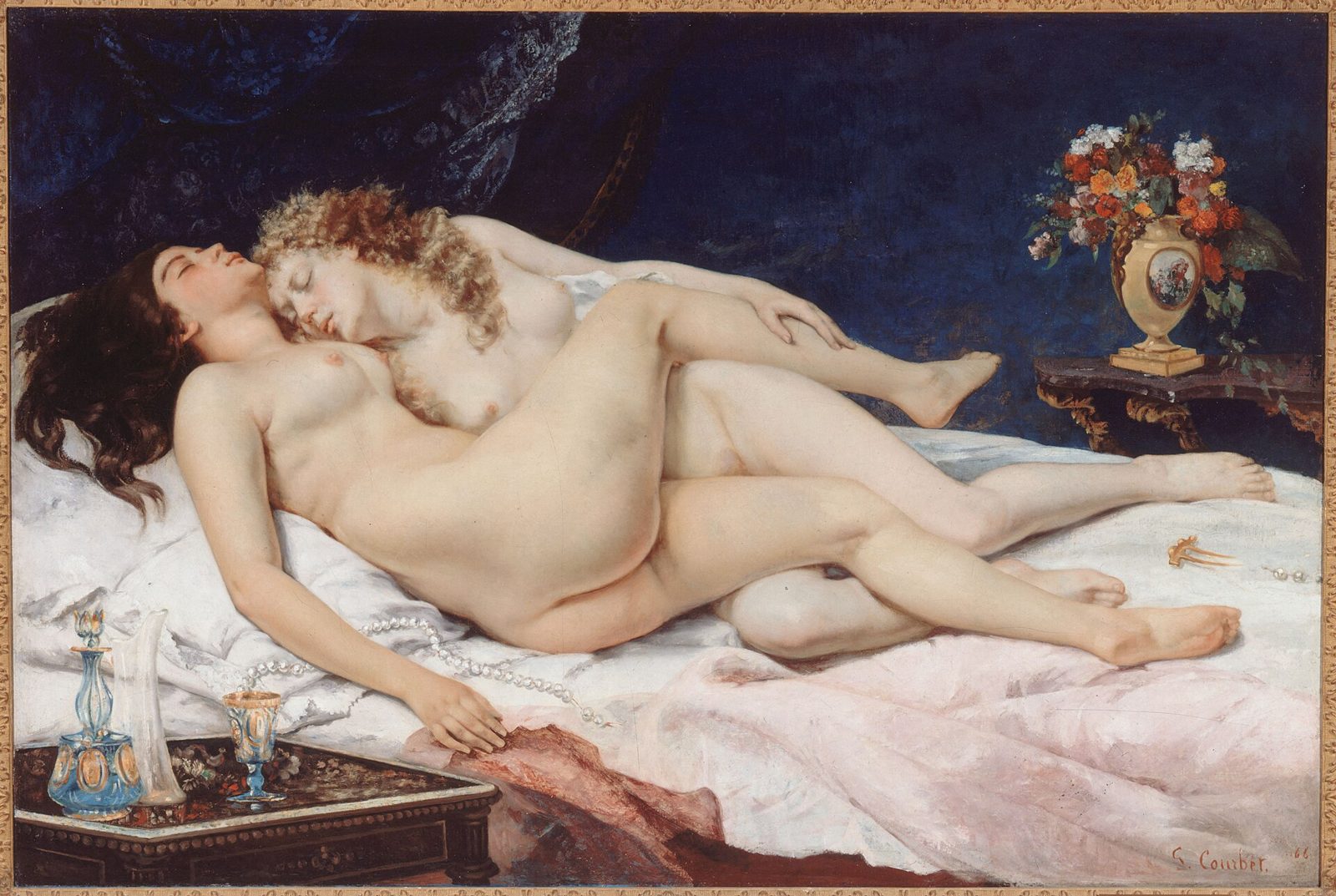
Two nude women lie intertwined on a bed, their bodies partially draped in soft white and pink sheets, inviting a sense of intimacy and vulnerability. The woman on the left, with dark hair, cradles the blonde woman’s head on her shoulder, creating a tender connection between them. A blue glass decanter and goblet rest on a tray in the foreground, while a string of pearls and a vase of colorful flowers add a touch of elegance to the scene.
This intimate portrayal of female companionship and sensuality challenges the norms of 19th-century art, where such depictions were often shrouded in taboo. Courbet's choice to depict these women in a relaxed state, surrounded by personal items, suggests a moment of quiet intimacy after a shared experience, inviting viewers to reflect on the nature of their relationship. The deep blue background contrasts beautifully with the lighter tones of their skin and linens, enhancing the emotional depth of the scene.
Commissioned by the Turkish diplomat Halil Şerif Pasha, "The Sleepers" was created in 1866 and remained privately held for many years, not being publicly exhibited until 1988. This painting, also known as "The Two Friends," has since become a significant work in discussions about lesbian representation in art, influencing contemporary artists and contributing to a gradual shift in societal attitudes towards such themes.
Gustave Courbet, born on June 10, 1819, in Ornans, France, was a pioneering painter who championed the Realism movement in 19th-century art. Rejecting the conventions of academic painting and the idealism of Romanticism, he focused on depicting the world as he observed it, often portraying unidealized peasants and workers in monumental compositions. His early works gained recognition, notably "After Dinner at Ornans," which won him a gold medal at the Salon of 1849, allowing him to exhibit without jury approval.
Courbet's commitment to realism was revolutionary; he believed that art should stem from personal experience rather than historical or mythological themes. His bold approach often sparked controversy, challenging societal norms and addressing social issues, which resonated with later movements like Impressionism and Cubism. Despite facing criticism and imprisonment for his political involvement during the Paris Commune, Courbet continued to create until his death on December 31, 1877, in Switzerland.
His legacy endures as a transformative figure in art history, whose unflinching depictions of everyday life laid the groundwork for modern artistic expression. Today, Courbet is celebrated for his vigorous and uncompromising work, which continues to engage audiences with its raw honesty and depth.
Gustave Courbet's 'The Sleepers,' created in 1866, was commissioned by Halil Şerif Pasha, a Turkish diplomat who had settled in Paris. This painting, also known as 'The Two Friends,' was a bold exploration of female intimacy, a subject that was largely taboo in the 19th century. Interestingly, it was not publicly exhibited until 1988, despite being shown briefly in 1872, which led to a police report due to its provocative nature. The painting's journey through ownership is quite fascinating; after its commission, it was sold alongside Courbet's more notorious work, 'L'Origine du monde.' Following the auction of Pasha's collection in 1868, it passed to opera singer Jean-Baptiste Faure, and later to Swiss surgeon Auguste Reverdin. In 1953, it found its way to the Petit Palais in Paris, where it remains today. One of the models for this painting was Joanna Hiffernan, who had a romantic connection with the artist James Abbott Whistler, adding another layer of intrigue to the work's backstory.
In 'The Sleepers,' Courbet employs oil paint on canvas to create a strikingly intimate scene. The brushwork is both bold and delicate, capturing the softness of the women's skin against the textured linens. The deep blue background serves not just as a backdrop but as a dramatic contrast that enhances the warmth of the figures. Courbet's technique reveals his commitment to realism; he does not shy away from the imperfections of the human body, instead celebrating them. The positioning of the women, intertwined and relaxed, suggests a moment of vulnerability and connection, inviting viewers to ponder their relationship. The careful arrangement of objects in the foreground—a blue glass decanter, a goblet, pearls—adds a layer of narrative, hinting at a shared experience that transcends mere physicality. The overall composition, with its horizontal format, draws the eye across the canvas, emphasizing the closeness of the subjects while keeping the viewer engaged in their serene world.
Joanna Hiffernan was one of the models for 'The Sleepers' and she was romantically linked to the artist James Abbott Whistler.
'The Sleepers' was not publicly exhibited until 1988, despite being created in 1866.
In 1955, Bernard Buffet created his own version of 'The Sleepers' as a tribute to Courbet, showcasing its influence on later artists.