Apartment Corner
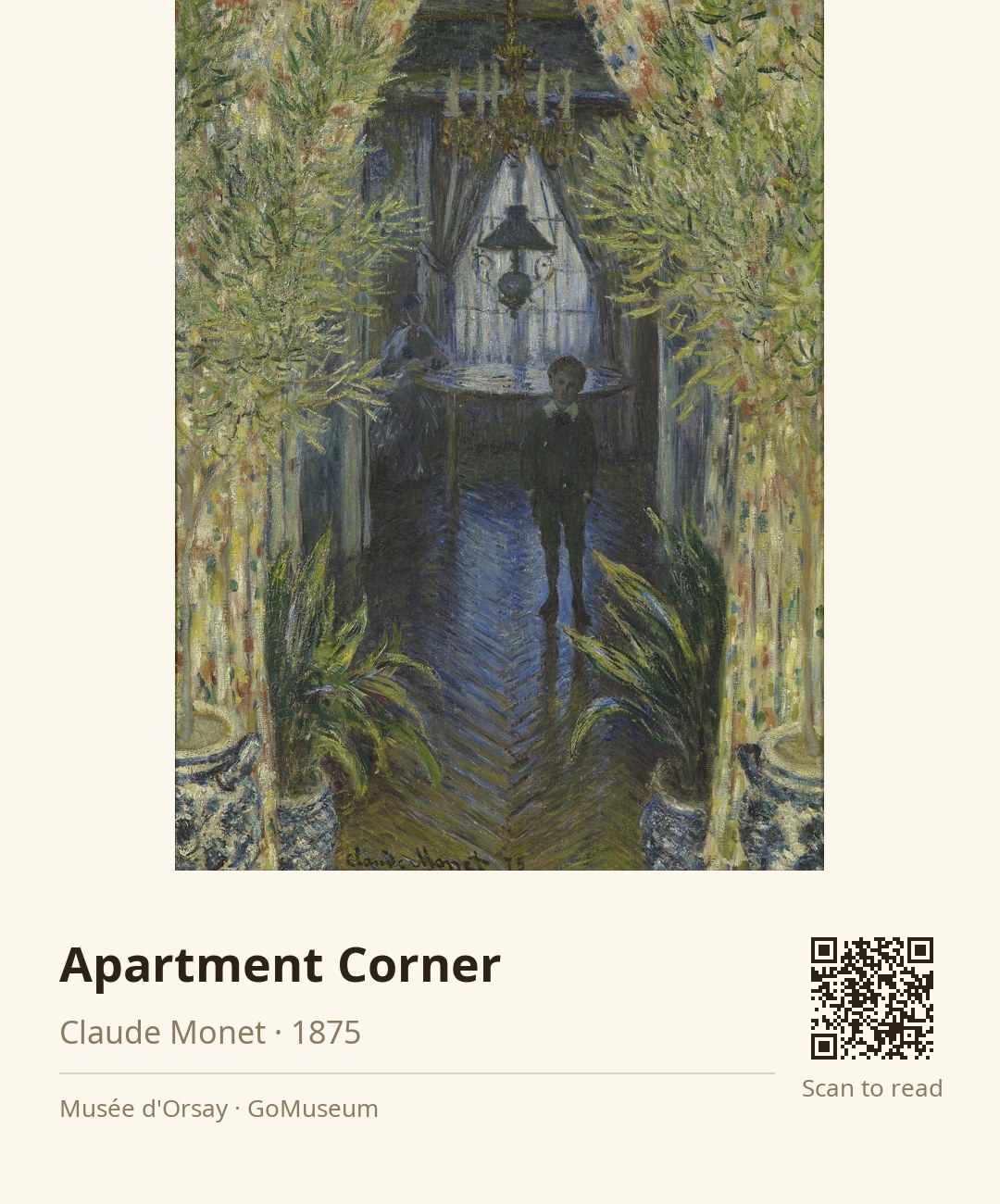
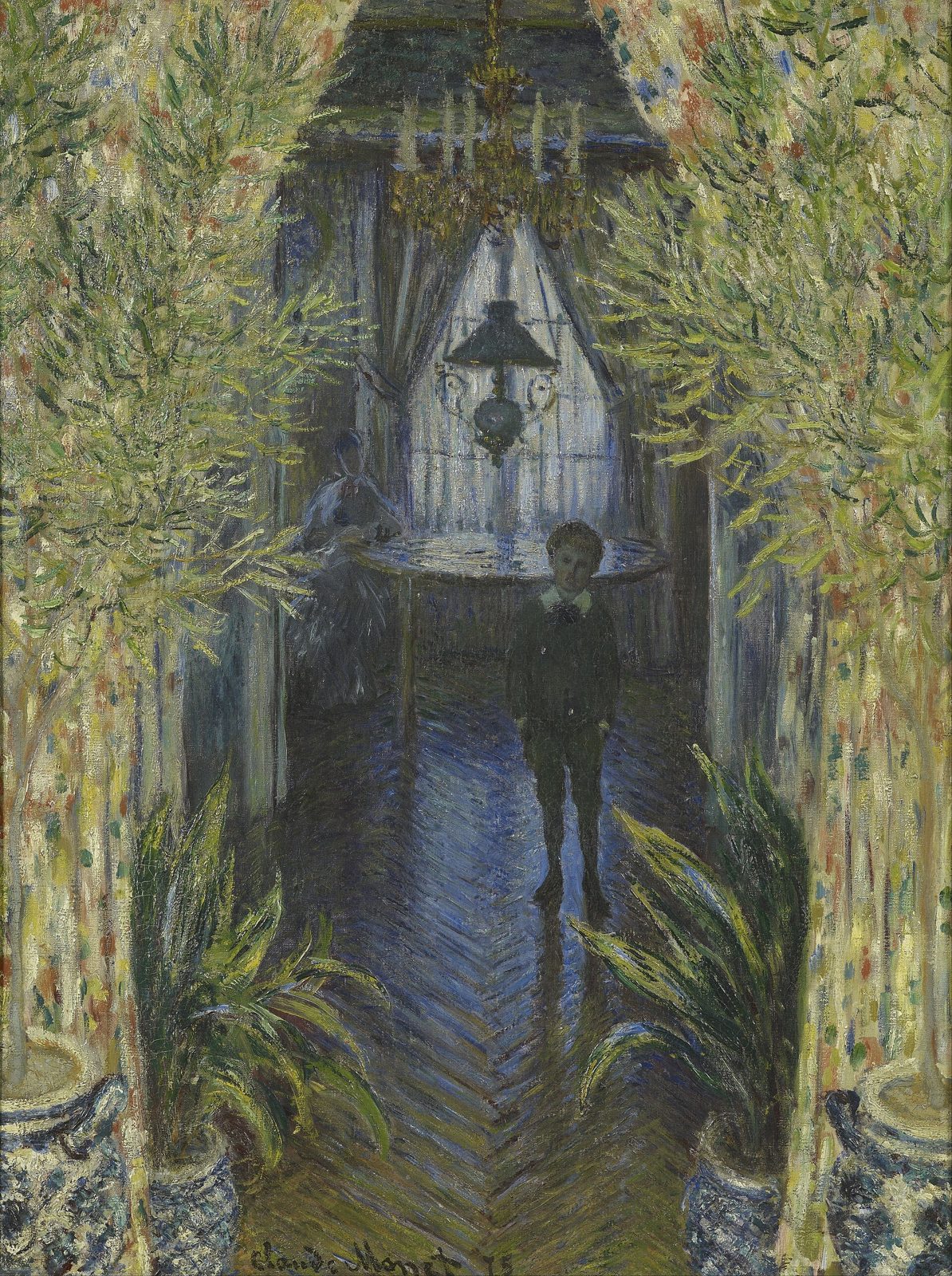
🎧 This work has audio narration — listen in the appTwo tall blue-and-white jars stand at the edges of this canvas, each holding a leafy plant that spills into the frame, and between them a small boy in a dark suit stares straight out at you. That pairing, a child set against a domestic interior, is the thread running through the whole picture. Monet painted this in oil on canvas in 1875, a sheet of cloth stretched and primed for the studio, and its vertical format frames the room the way a doorway would.
Look at the foreground first. The plants in the jars are rendered with thick, short dabs of paint, especially in the feathery green shrubs at the top, so the foliage reads as a mass of light and texture rather than individual leaves. The floor beneath the boy is a herringbone of wood reflecting cool blue light, and the strokes there are looser, almost loose enough to wander. Why does this matter? Because Monet is already doing what made him famous: letting the surface of the paint carry the sense of light, so that a room in the late afternoon feels as much like weather as furniture.
The painting is also a family picture, and the material ties it to real people. Monet's wife, Camille Doncieux, is widely identified with the seated, grey-blue figure in a bonnet at the table, and the standing boy is his son, Jean. The work was included in the sale held by the Impressionist circle in Paris on 24 March 1875, in the Hôtel Drouot, where it was catalogued under the number 14. It was then shown in the Third Impressionist Exhibition in Paris in 1877, and again at the Sixth International Exhibition of Painting and Sculpture in Paris in 1887. Its current inventory number is RF 2776.
Oscar-Claude Monet, born on November 14, 1840, in Paris, was a pioneering French painter and a founder of Impressionism, a movement that transformed the art world. Raised in Le Havre, he developed a passion for nature and painting early on, encouraged by his mother, while his father hoped he would pursue a business career. After his mother's death in 1857, Monet moved in with his aunt, who supported his artistic ambitions.
Monet's career began with caricatures, but he soon sought formal training, studying under Eugène Boudin, who introduced him to plein air painting. His breakthrough came in 1866 with "La Femme à la robe verte," which garnered attention at the Salon. The term "Impressionism" originated from his work "Impression, Sunrise," exhibited in 1874, marking a shift away from traditional art.
Throughout his life, Monet focused on capturing the essence of light and color in nature, creating series of paintings that depicted the same scenes under varying conditions, such as his famous haystacks and water lilies. He settled in Giverny in 1883, where he cultivated a beautiful garden that became his muse. Despite personal hardships, including the loss of loved ones and health issues, Monet's relentless dedication to his craft solidified his place in art history as a master of modernism, influencing countless artists and leaving a lasting legacy. He died on December 5, 1926, in Giverny, celebrated as one of the most significant figures in art.
Stand back from the jars for a moment and look at how the room is built around them. The tall blue-and-white vessels sit at either edge, and the plants inside them spill upward and outward, so the picture is framed by foliage before the boy even enters it. Between those green masses hang curtains in cream, orange and green, patterned rather than plain, which keeps the middle of the room busy with colour. The boy in his dark suit, with his pale collar and bow, is the one dark note near the centre, standing square to you on a floor of herringbone boards that catch a cool blue light. Behind him a round table waits under a lamp with a dark shade, and a seated figure in a grey-blue bonnet is tucked partly out of sight at its left edge. High in the back, a chandelier with candle-like arms hangs in front of a pale, curtained window. Notice how the painter stacks the room in layers: the foreground greenery, the patterned hangings, the figure and the table, then the window light at the very back, so that depth comes from overlapping shapes rather than from any single perspective trick.
The number RF 2776 identifies the work in the museum's collection records, which is the kind of catalogue reference that is useful for tracking where a painting has been filed and documented.