Young Woman with a Mandolin
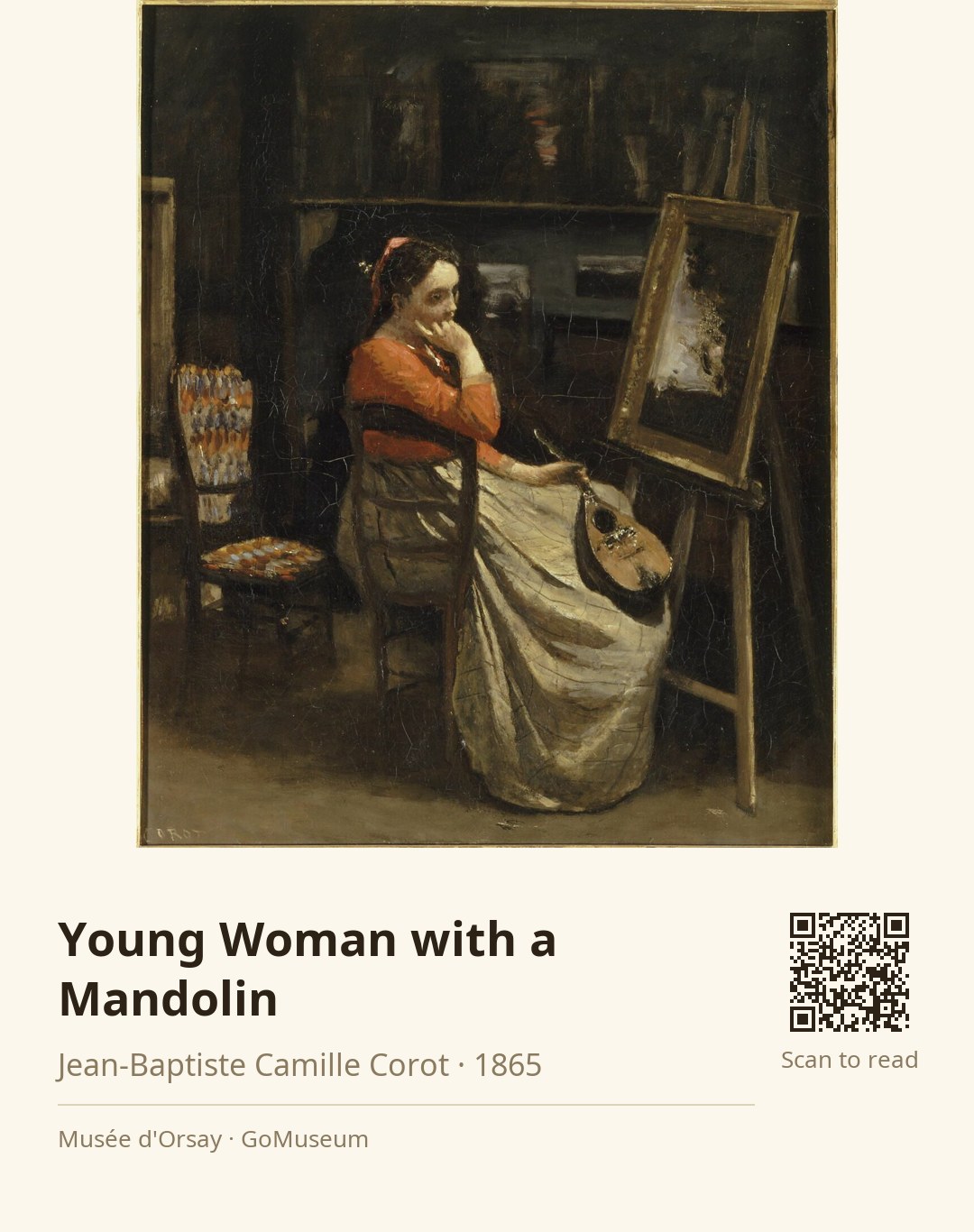
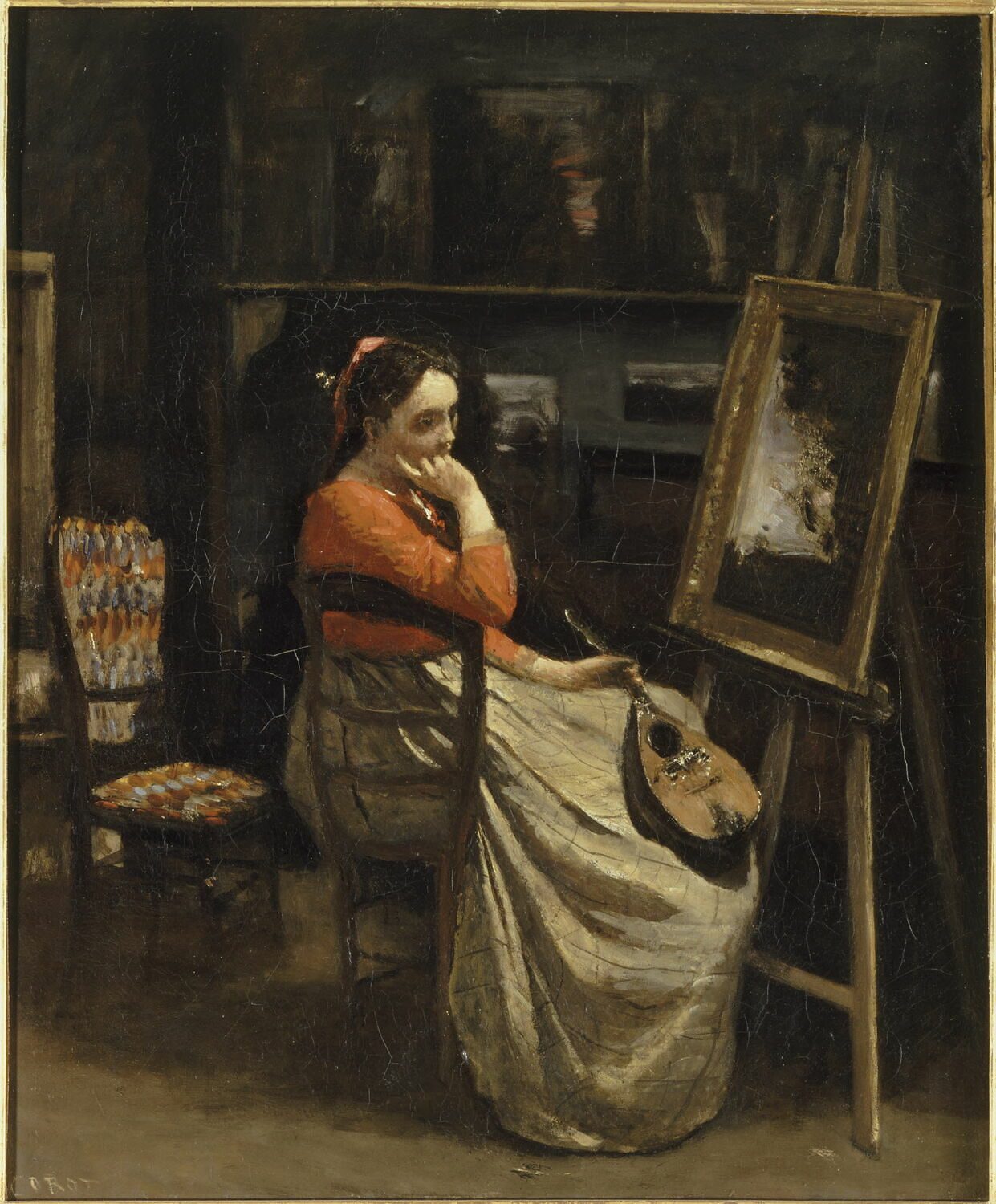
🎧 This work has audio narration — listen in the appA young woman sits with her chin propped on one hand, a mandolin resting across her lap, while her eyes drift toward a small, dim landscape on an easel at the right. Her orange-red blouse is the warmest thing in a room otherwise swallowed by deep brown-black shadow.
Look closely at the chair beside her: its seat and back are daubed with thick, quick strokes of orange, blue and white, so that the furniture seems to dissolve into color rather than wood. Then notice the surface of the skirt, which is covered in a fine network of cracks, the craquelure that has spread across the whole canvas over time. Together these touches show a painter more interested in the feel of paint than in polished finish, and the contrast between loose, thick marks and the smooth, dark background pulls the eye exactly where Corot wants it, to the woman's face and the glimmer of her hand.
What the material establishes is this: Corot, the Paris-born landscape painter who was a pivotal figure in nineteenth-century French art, painted this canvas in 1865, in the third quarter of the century. The work is an oil on canvas, and it is catalogued in the Musée d'Orsay under inventory number RF 3745. Its listed French title is L'atelier de Corot, "Corot's studio," which places the scene in an artist's workroom, a setting the painted palette and easel also suggest. Corot's own training, first in the wig-and-millinery business of his family and then in the studios of Achille Michallon and Jean-Victor Bertin, gave him a lifelong pairing of classical ideals with direct observation of nature, and this interior, with its unfinished-looking forms, shows how far he could let the painting's own surface speak.
Jean-Baptiste-Camille Corot, born on July 16, 1796, in Paris, was a pivotal French landscape and portrait painter whose work bridged the Neo-Classical tradition and the emerging Impressionist movement. Coming from a well-off bourgeois family, he was able to pursue art without financial constraints after receiving a yearly allowance following his sister's death in 1822. Initially uninterested in art, Corot's passion ignited during nature walks with a family friend, leading him to study under Achille Etna Michallon, who encouraged outdoor painting.
Corot's early career was marked by a struggle between commercial obligations and his artistic aspirations, but he eventually dedicated himself fully to painting. He became known for his serene landscapes, often capturing the essence of light and atmosphere, which would later influence Impressionists. Despite being regarded as an amateur for much of his life, he gained recognition around 1850 and became a founding figure of the Barbizon School, emphasizing realism in nature. Corot's legacy endures as a bridge between classical ideals and modern artistic expression, making him a significant figure in art history. He passed away on February 22, 1875, leaving behind a vast and influential body of work.
Corot painted this canvas in 1865. It was first in his own possession, the collection of the artist himself. In 1866 it passed to his friend Louis Briand, recorded as an owner from that year. It later came through the sale of Hubert Morand at the Hôtel Drouot in Paris on 3 March 1933, lot 49. Today it is catalogued in the Musée d'Orsay under inventory number RF 3745.
The canvas measures 56 by 46 centimetres and is an oil painting on canvas. The woman sits on a ladder-back chair in three-quarter view, her chin on one hand and a mandolin angled across her lap, her gaze turned toward a framed landscape on an easel at right. The easel's gilt frame holds a dim landscape with a single pale, whitish patch. A second chair at left has a seat and back dabbed with thick orange, blue and white strokes. The background is deep brown-black with shelves and indistinct framed pictures, and the floor is a flat tan-brown. Brushwork is loose in the shadows and thicker in the chair daubs, and fine craquelure covers the whole surface.
Yes. Before he became a painter he worked in the family's fashion business, and the sense of colour and texture he gained handling fabrics is credited with building his aesthetic sense.
Yes. Corot grew up with his parents and siblings living on the upper floor above their millinery shop in Paris.