The Spinner, Auvergnat Shepherdess
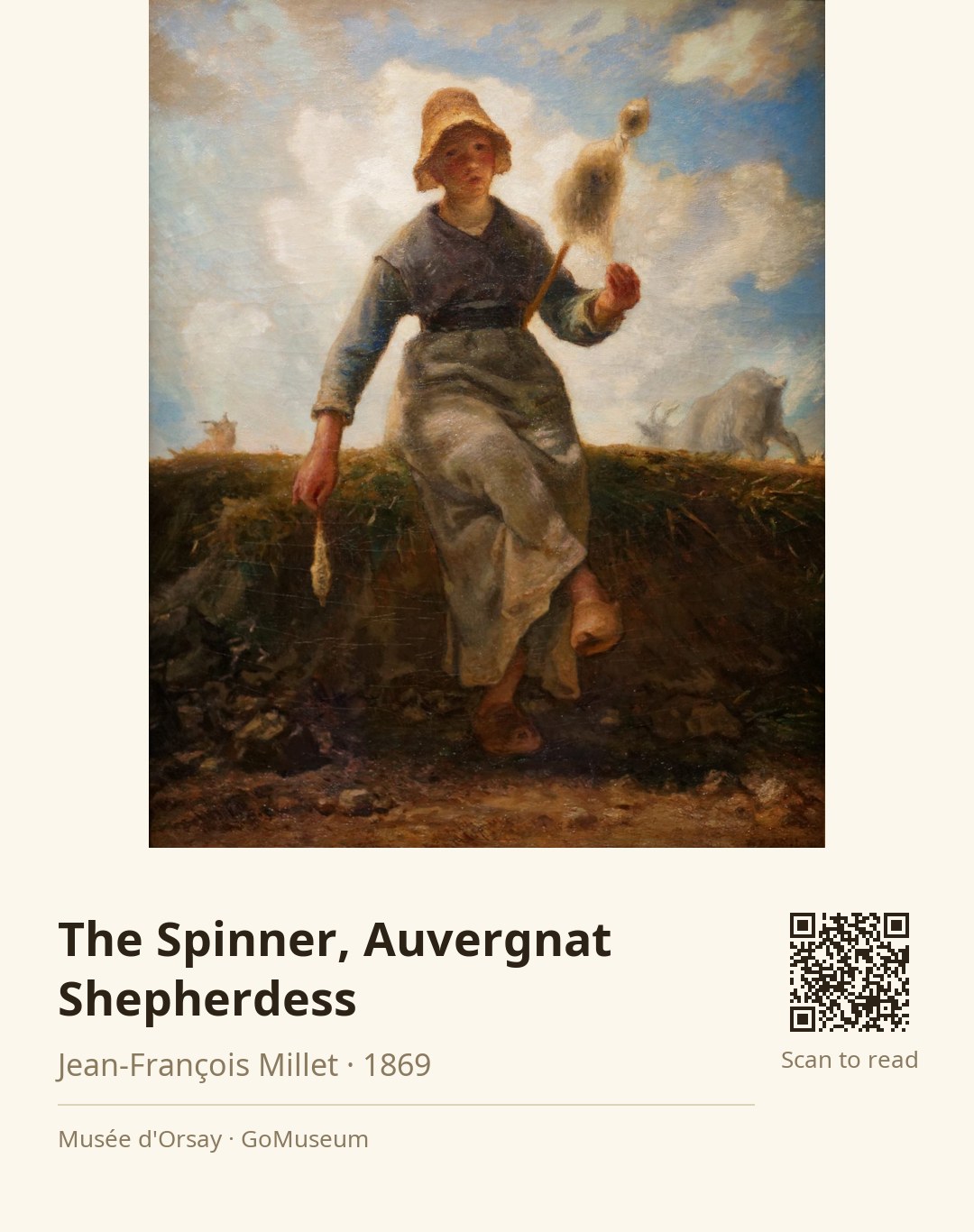
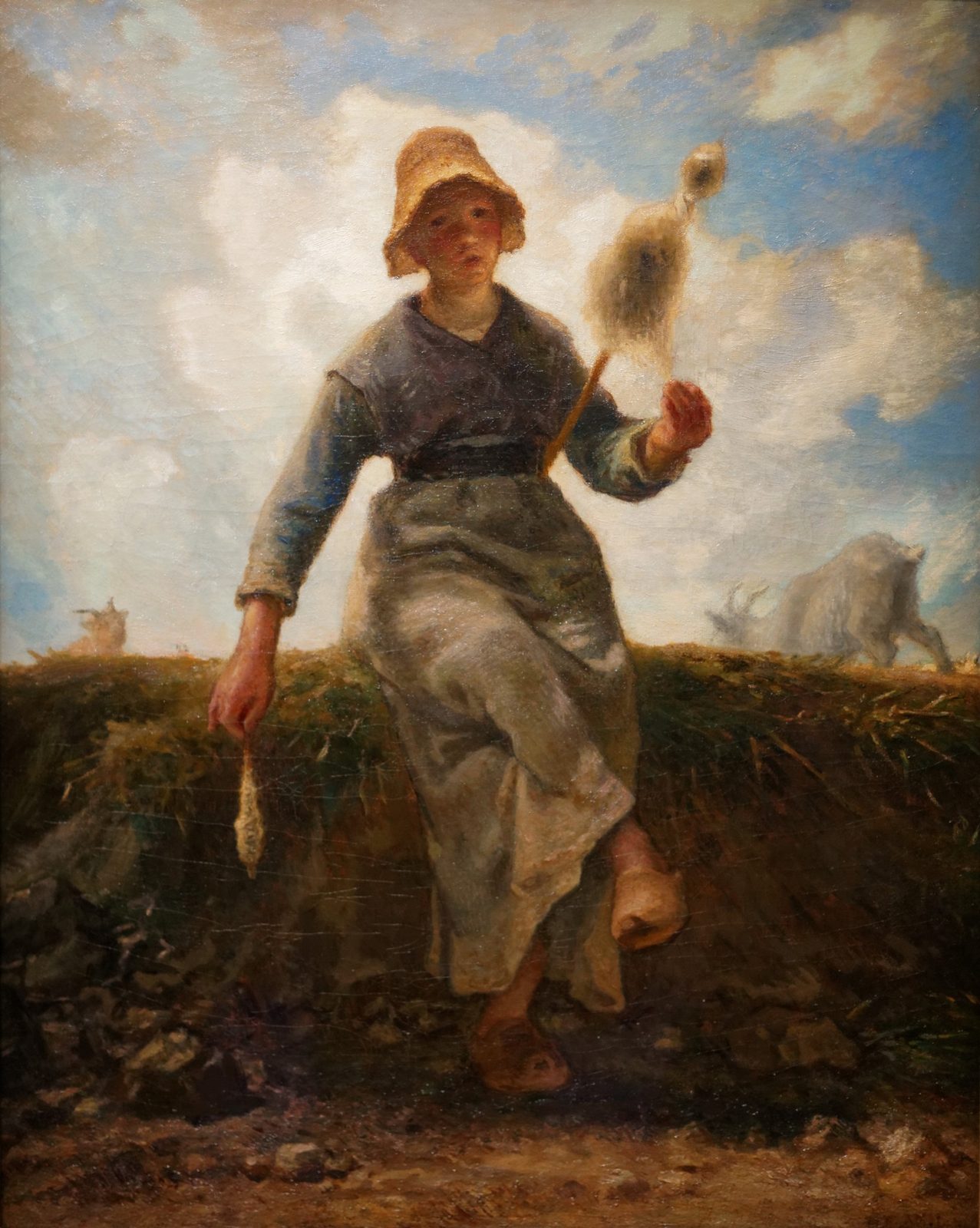
🎧 This work has audio narration — listen in the appLook up at the woman in the straw hat, perched on a grassy bank with one wooden clog dangling from a crossed leg. She is spinning wool by hand, a drop spindle raised in one hand, a wrapped distaff held low in the other, while a pale goat stands at the right edge of the scene. Her bodice is a faded blue-gray, her skirt a long gray-green, and the thick white clouds above her are painted in soft, feathery strokes that make the sky seem to drift.
What makes the picture work is how plainly it presents her. She is not posed as a heroine or a fairy-tale shepherdess; she is simply working while she watches over her animals, and the artist gives her the same weight and steadiness he gives the sky. Seen from low down, she seems to hold the ground beneath her, and the tufts of wool trailing from the spindle tie her task directly to the goats and the earthen slope she sits on.
The subject is a young peasant woman from the Auvergne, a region in central France, shown spinning as she tends goats on a hillside. The painting is an oil on canvas, standing upright at about ninety-two centimetres high, and it was bought by the collector Alfred Chauchard, who bequeathed it to the state in 1909 and 1910.
Jean-François Millet was a pivotal figure in 19th-century French art, born on October 4, 1814, in Gruchy, Normandy. As a founding member of the Barbizon school, he is celebrated for his profound depictions of peasant life, embodying the Realism movement. Millet's early years were steeped in agricultural labor, which deeply influenced his artistic themes. After studying under various artists, he moved to Paris, where he initially struggled but eventually gained recognition for his work.
Millet's paintings often highlighted the dignity of rural laborers, showcasing their struggles and connection to the land. His notable works, such as "The Gleaners" and "The Angelus," reflect a shift from idealized pastoral scenes to a more authentic representation of contemporary social conditions. Despite facing criticism early in his career, he found success in the mid-1850s, producing masterpieces that resonated with the public and critics alike.
Millet's legacy lies in his ability to elevate the everyday lives of farmers to the realm of fine art, influencing generations of artists and solidifying his place in art history as a champion of the working class. He passed away on January 20, 1875, in Barbizon, leaving behind a rich body of work that continues to inspire.
The material gives us a few concrete anchors. The painting is dated 1869, and the extract places its making between 1868 and 1869 at Barbizon. It passed through the sale of Liebig et Fremyn at the Hôtel Drouot in Paris on 8 April 1875, catalogue number 51, and then came into the hands of Alfred Chauchard. It entered public collections through Chauchard's bequest in 1909–1910, was kept at the Louvre until 1986, and has since been at the Musée d'Orsay. Its inventory number is RF 1880.
The woman is seen from low down, and her crossed legs throw one wooden clog forward toward you. Her bodice is blue-gray over a pale blue sleeved undergarment, and a dark waistband cuts across her middle before the long gray-green apron-skirt falls away. Her raised right hand holds the drop spindle with its trailing tufts of pale wool, while her lowered left hand grips a small wool-wrapped distaff, so the two hands are set one above the other like a vertical line of work. To the right, the pale goat stands just beyond the bank, and at far left a smaller, indistinct form hovers at the edge of the picture, barely resolved. The sky is blue, with thick white and cream clouds that sit heavily above her. The foreground is dark earth, scattered with stones and a pebbly path, which gives the lower part of the picture a rougher, heavier texture than the airy sky above.
The extract notes that this painting was executed as a portrait of a young peasant woman from the Auvergne, shown spinning wool while she guards goats on a hillside, and that it is an upright oil on canvas made at Barbizon.
Yes. In 1847 his painting Oedipus Taken down from the Tree won him his first Salon success, and in 1848 the government bought his The Winnower.
Yes. Born into a farming family in Gruchy, Normandy, he was the eldest son and helped his father with all kinds of farm work, including mowing, threshing, ploughing and sowing, and those motifs returned in his later art.