Entrance to Voisins
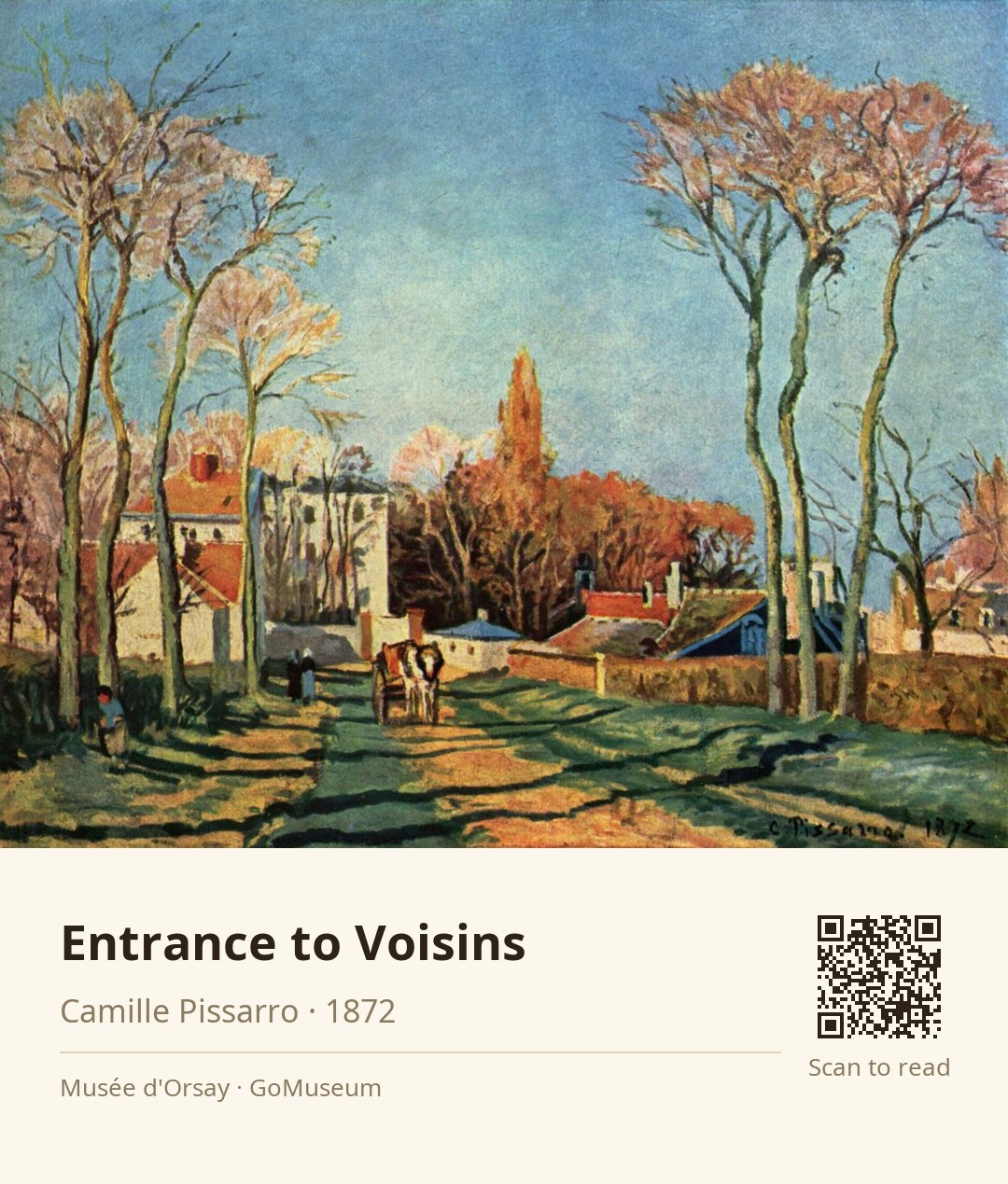
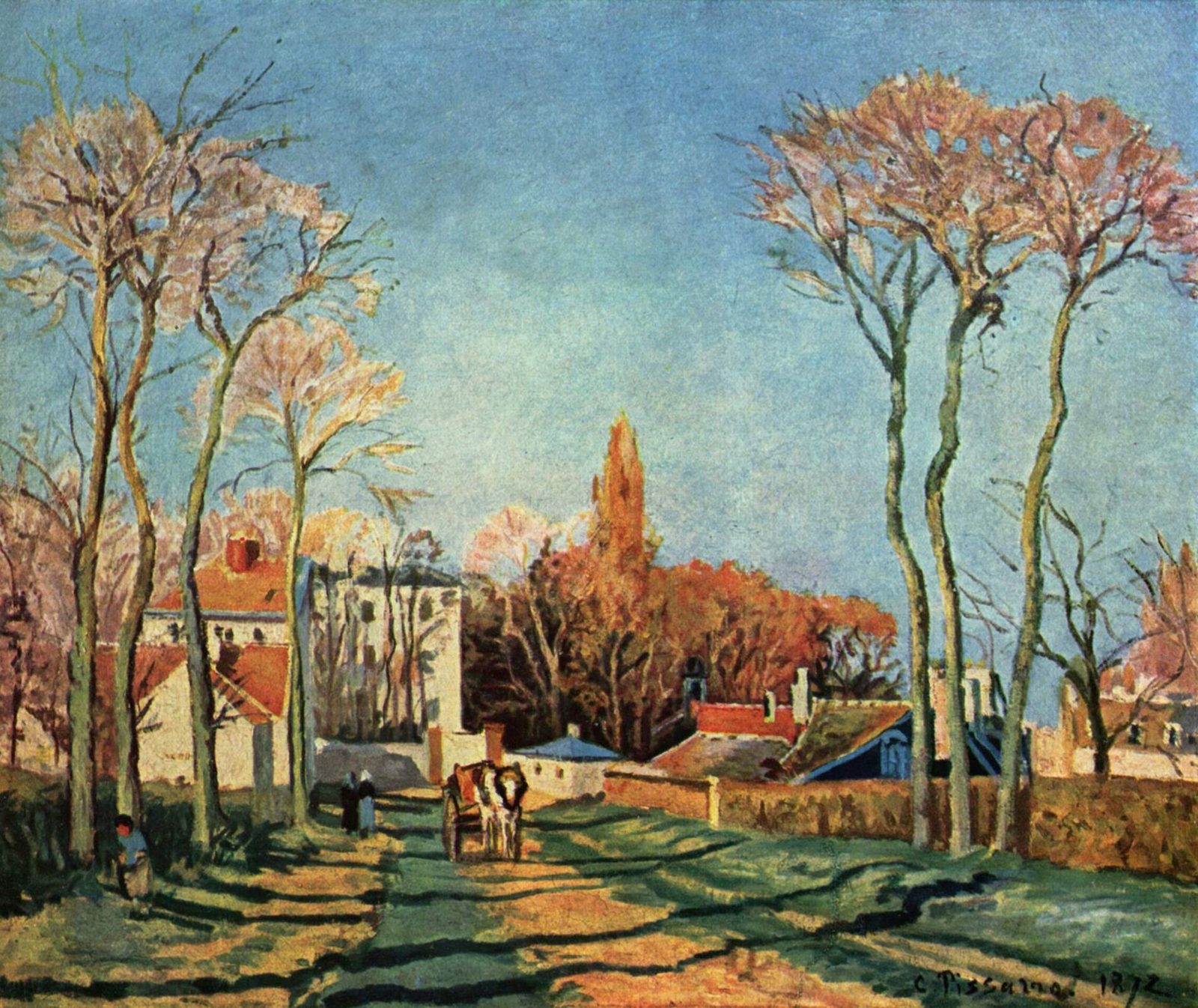
🎧 This work has audio narration — listen in the appUnder a pale blue sky, a village road runs straight into the middle of this small canvas, and a horse-drawn cart is making its way along it. Look at the shadows first: long blue-green bars lie across the grass in the foreground, and the strokes that build them are short and broken, so the ground seems to shimmer rather than sit flat. On either side of the road, tall, thin trees with pinkish, feathery crowns lean over the path, and behind them white walls and orange-red roofs step back toward a mass of russet foliage.
Those broken strokes are the key to the whole picture. Pissarro does not blend his colours into smooth surfaces; he lays one touch of paint beside another and lets your eye do the mixing. The result is the sensation of sunlight moving over grass and leaves, which is what he was after. The cart and the horse are small, yet they set the scale of the village and make the road feel like a place people actually travel.
This painting was made in 1872 at Louveciennes, a village outside Paris, and it shows the landscape around the Château de Voisins. Pissarro painted it in oil on canvas, and it measures 46 by 55.5 centimetres. It was shown at the 1900 Exposition Universelle in Paris, and it appeared in a Pissarro exhibition at the Galerie Durand-Ruel in 1904.
Jacob Abraham Camille Pissarro, born on July 10, 1830, in Saint Thomas, was a Danish-French painter pivotal to the Impressionist and Neo-Impressionist movements. His artistic journey began under the influence of masters like Courbet and Corot, and he later collaborated with Seurat and Signac, embracing Neo-Impressionism at age 54. Pissarro's dedication to depicting rural life and the working class set him apart; he painted everyday scenes without grandeur, focusing on authenticity.
As a mentor, Pissarro played a crucial role in the development of fellow artists, including Cézanne, Gauguin, and Van Gogh, earning him the title "dean of the Impressionist painters." His warm personality and wisdom made him a father figure within the art community. Pissarro was the only artist to exhibit in all eight Paris Impressionist exhibitions from 1874 to 1886, solidifying his legacy. Despite facing criticism for his subjects, he remained committed to his vision, advocating for a personal approach to classicism. Pissarro passed away on November 13, 1903, leaving an indelible mark on art history.
The picture is small, about 46 by 55.5 centimetres, and it is painted in oil on canvas. The road runs straight back into the middle of the picture, and the ground in the foreground is striped with long blue-green shadows over patches of ochre and green grass. A small figure in a blue garment bends low at the lower left, which gives you a sense of how little the people are against the land. Two dark-clothed figures stand or walk further back at the left, and the light-coloured horse moves the cart in the middle distance. The trees are tall, thin and bare, with pinkish, feathery crowns that lean in from both sides. Past them, the white walls and orange-red roofs sit beside a low brown wall, blue-grey roofs, and a dense mass of orange-russet foliage with one tall, narrow tree rising at the centre.
The source material says that the painting is one of the finest Pissarro canvases of that region, and that it is one of the last he painted before settling in Pontoise.
It was given to the museum by Ernest May in 1923, having previously passed through the sale of his collection in 1890 where he bought it back.
Yes, a life-size reproduction has been displayed since the 1990s on the spot where he painted it, along a Pays des Impressionnistes trail. The landscape has changed little since, apart from the railway line built in 1884, which runs in a cutting at that point.