Self-Portrait at the Easel
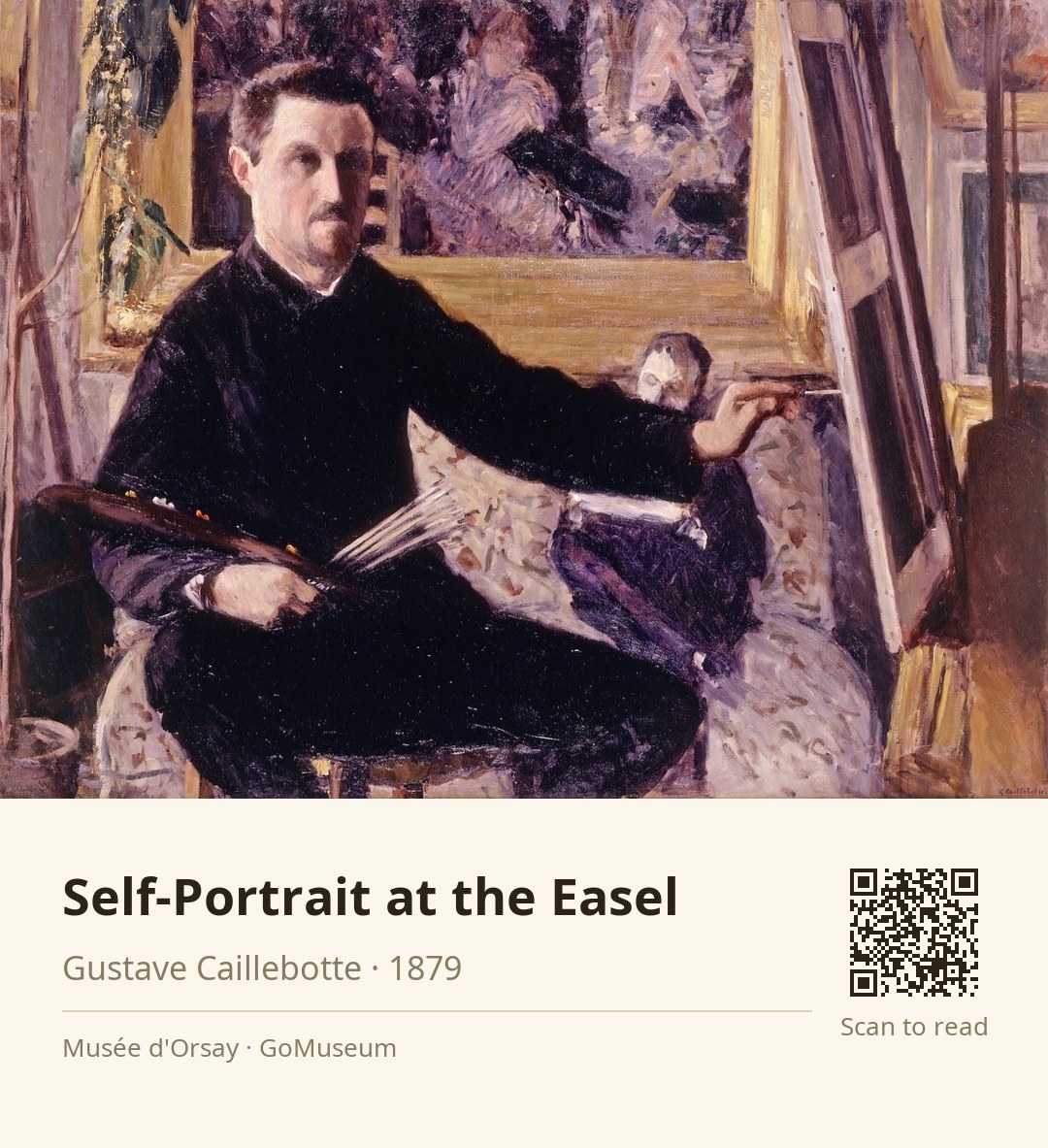
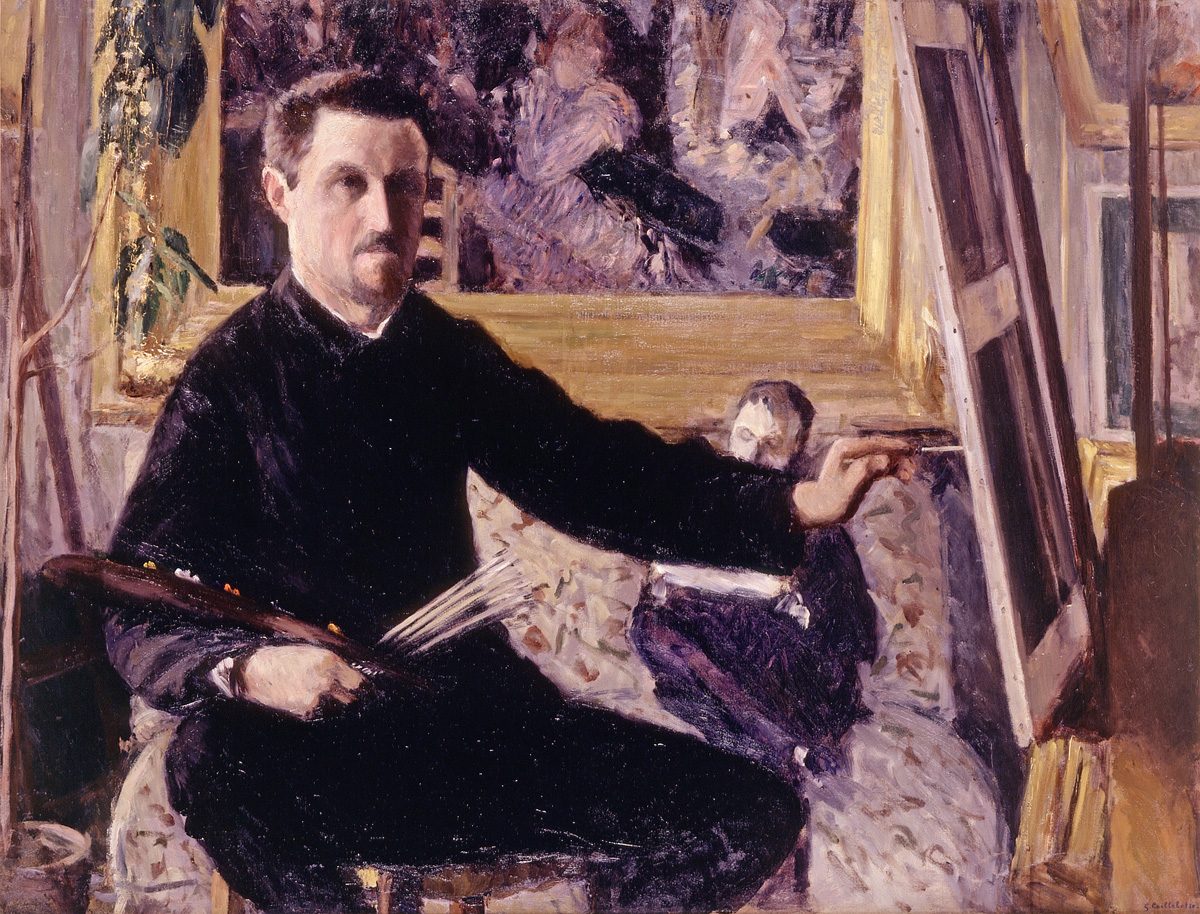
🎧 This work has audio narration — listen in the appA man in a dark jacket sits in the foreground, a palette and a bundle of brushes in one hand, the other arm reaching toward a canvas on an easel that we see only from behind. That painter is Gustave Caillebotte, and the picture is his self-portrait, painted in 1879 in the Boulevard Haussmann apartment where he had just moved and where he kept a great many of his paintings.
Look at what hangs behind him: a large gilt-framed canvas full of hazy figures in lavender, rose and ochre. It is Renoir's Bal du moulin de la Galette, which Caillebotte owned and kept in his studio. Caillebotte is shown not only as a painter but as a collector who backed his friends. He bought their canvases when few others would, and he bought his first works at the Impressionist sale of 24 March 1875 at the Hôtel Drouot. His first known purchase from Claude Monet, a 1875 canvas called Un coin d'appartement, followed in February 1876. Gallo lived near the Caillebotte brothers, and according to the art historian Marie Berhaut he gave real comfort after the death of the brothers' mother in 1878.
The painting was shown at the Impressionist exhibition of 1880, and Caillebotte left the Renoir to the French state when he died in 1894, sixty-seven works in all.
Gustave Caillebotte was a French painter born on August 19, 1848, into an affluent Parisian family. His upbringing afforded him the luxury of pursuing art, which he began seriously after serving in the Franco-Prussian War. Caillebotte's early works reflected a realistic style, often capturing contemporary life with a focus on urban scenes and laborers, as seen in his notable painting "The Floor Scrapers." His artistic journey was intertwined with the Impressionist movement, where he played a dual role as both a creator and a patron, supporting fellow artists like Monet and Degas.
Despite his contributions, Caillebotte's work was often overshadowed by his more famous contemporaries, and he did not receive significant recognition until long after his death on February 21, 1894. His collection of Impressionist works, bequeathed to the French state, became a cornerstone of the movement's legacy. Caillebotte's unique perspective, blending realism with the emerging Impressionist style, positioned him as a pivotal figure in art history, though it took a century for his contributions to be fully acknowledged through retrospectives and exhibitions. His legacy continues to resonate, illustrating the complexities of artistic recognition and the evolution of modern art.
The surface gives itself away from a few steps back. The strokes are thick and loose, left visible rather than blended smooth, so the painter's hand stays on the canvas as a record of the making. The palette is dark and warm in the foreground, with that blackish-purple jacket swallowing light, while the cream, pink and green of the sofa and the lavender, rose and ochre of the big gilt-framed picture behind lift the upper half. Green leaves hang in at the upper left, a small cool note in a room otherwise full of warmth.
It is Richard Gallo, Caillebotte's childhood best friend, who appears in at least seven of Caillebotte's paintings and is shown reading with his legs folded beneath him.
Yes. According to the art historian Marie Berhaut, Gallo lived near the brothers' Boulevard Haussmann home and gave them great comfort after their mother died in 1878.