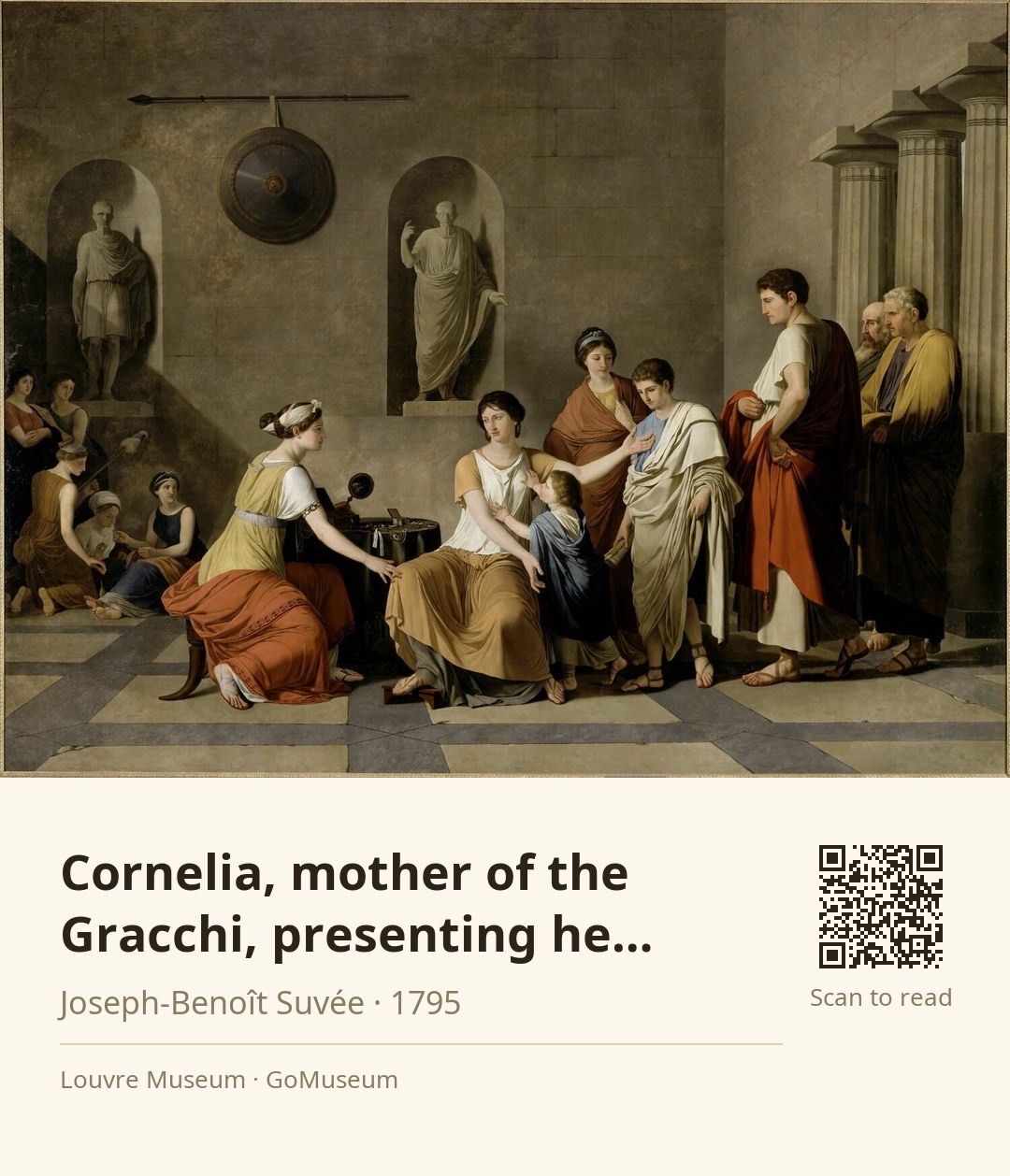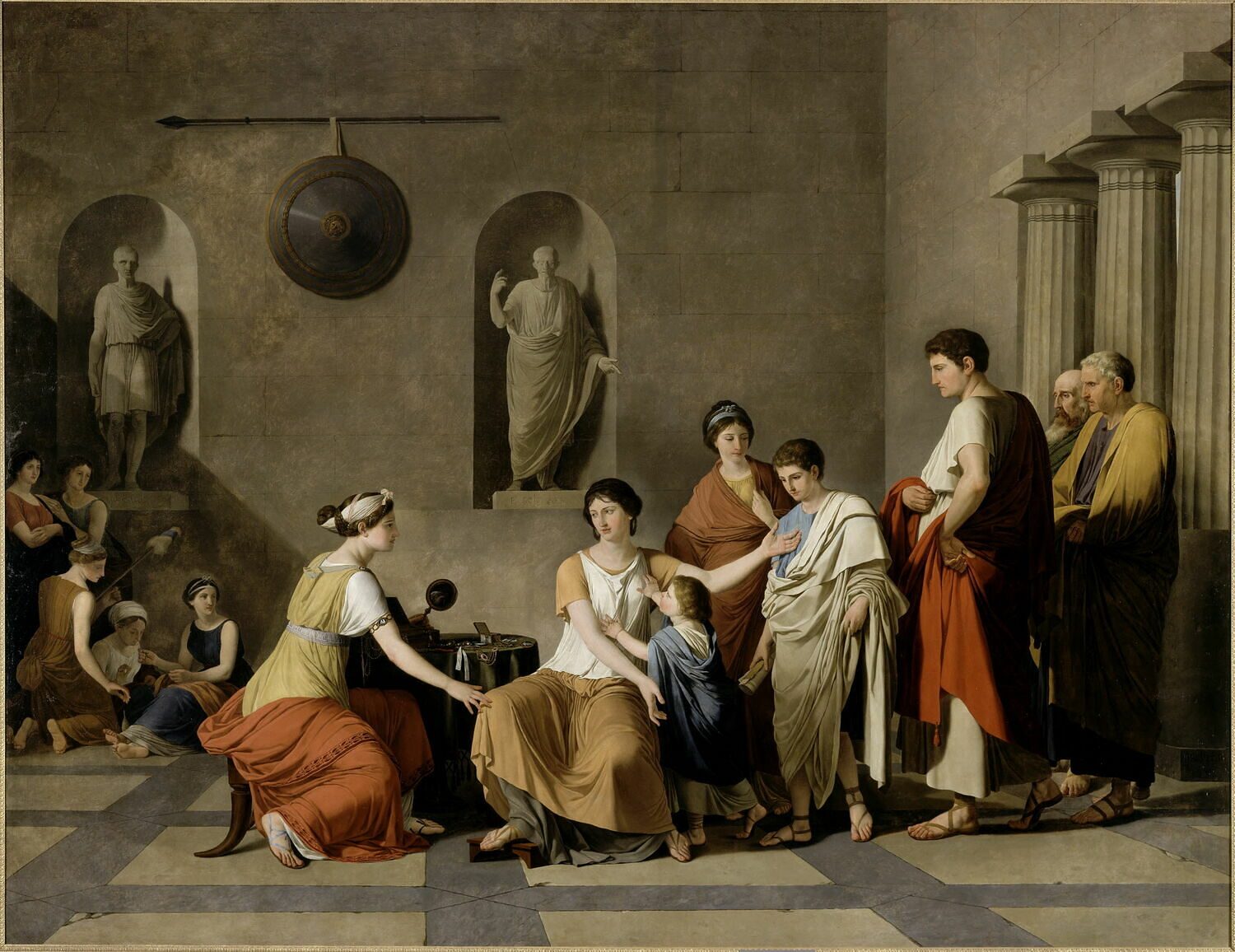
Cornelia, mother of the Gracchi, presenting her children and saying: "Here are my treasures"
🎧 This work has audio narration — listen in the appCornelia stands at the heart of this crowded hall, a seated woman in ochre and white who gestures toward the youth beside her, while a small child in blue reaches up toward her hand. Look to the left, where a kneeling woman in olive and orange drapery extends her arm over a draped table holding jewelry, and you'll see the scene's central claim spelled out in gold and gems. On the far left, four women sit or kneel at their spinning and sewing, the domestic work of a Roman household, while tall columns and older men in cloaks frame the rear of the room.
The painting carries its meaning in those gestures. The stone hall with its checkered floor, the spear and round shield hanging above two arched niches of statues, and the spinning women all sketch a world of Roman civic virtue, in which a mother's pride rests on her children rather than on her possessions.
It is an oil painting on canvas, measuring 320 by 414 millimeters, dated 1795, and created by Joseph-Benoît Suvée, a Flemish painter whose work was shaped by French neoclassicism. This canvas was shown at the Salon des artistes français in Paris in 1795 and passed through the hands of Louis XVI and the French Crown, which is how it came to rest in the national collection, where it is catalogued as inventory INV 8075.
Joseph-Benoît Suvée was a Flemish painter born on January 3, 1743, in Bruges, whose career was deeply intertwined with the French neoclassical movement. After studying under Matthias de Visch, he moved to Paris at 19 to apprentice with Jean-Jacques Bachelier. His talent earned him the Prix de Rome in 1771, leading to a six-year stay in Rome, where he extended the typical duration for pensioners of the French Academy. Upon returning to Paris, he became an academician and opened an art school for young women, nurturing talents like Constance Mayer.
Suvée's rivalry with Jacques-Louis David marked his career, fueling a lasting animosity. In 1792, he was appointed director of the French Academy in Rome, but his tenure was delayed due to imprisonment. He eventually took up the post in 1801, where he continued to influence the art scene until his sudden death on February 9, 1807. His notable works include "Achilles depositing the body of Hector" and "Cornelia, mother of the Gracchi," both housed in the Louvre. Suvée's legacy is preserved through his students, who contributed to the evolution of art in the late 18th and early 19th centuries.
This canvas was shown at the Salon des artistes français in Paris in 1795, the same year it is dated to. It passed through the hands of Louis XVI and then the French Crown, which is how it came to be held in the national collection, where it is catalogued as inventory INV 8075.
The surface is smooth and finely blended, with muted browns and greys set against saturated patches of red, ochre and blue. Along the left edge four women sit or kneel at spinning and sewing, while on the back wall a spear and a round shield hang above two arched niches holding statues. The floor is a checkered pavement of pale and grey slabs, and the standing youth wears a white toga over a blue tunic.
The painter Joseph-Benoît Suvée won the Prix de Rome in 1771 and later competed with Jacques-Louis David, a rivalry the sources describe as earning him David's enduring hatred.