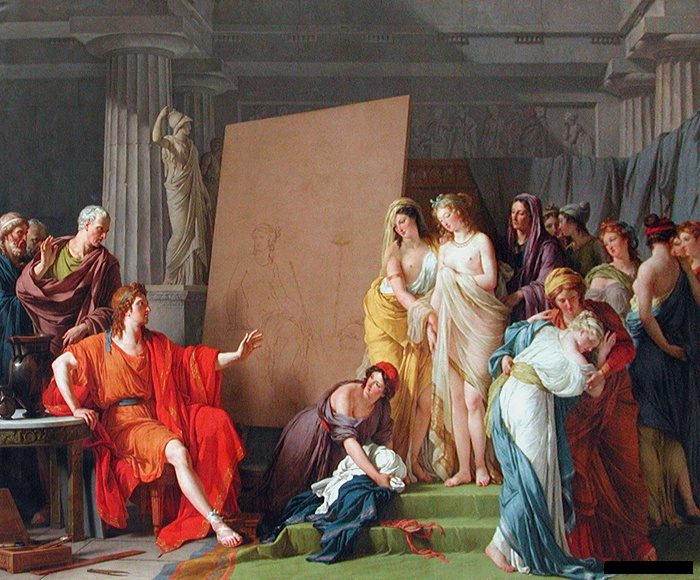
Zeuxis Choosing Models from the Beautiful Women of Croton
🎧 This work has audio narration — listen in the appHere, a young man sits on a stool with his arm stretched toward a large blank panel, its faint chalk outlines of a figure already sketched in. Behind him, two older bearded men in maroon and green robes look on, while a vase and a small table of painting tools sit at the lower left. Look closer at the right of the canvas, where a crowd of women in yellow, white, blue and plum drapery gathers on green steps. Two of them stand partly unclothed, and a kneeling woman clutches a length of cloth at the foot of the crowd.
Those details set up the scene's central moment. The story comes down to us through the writings of Pliny, the Roman author, and it is the source Vincent drew on when he chose this subject. Its style is Neoclassical, a movement that looked back to classical antiquity for its themes and its sense of order, and Vincent counted himself among its leaders in France, working in rivalry with Jacques-Louis David.
The painting was shown at the Salon of 1789 in Paris, and it was shown again at the Salon of 1791. It was owned by Louis XVI and then passed to the French Crown, and today it belongs to the Louvre. A smaller version of the same composition is held at the Cantor Arts Center at Stanford University in California.
François-André Vincent was a prominent French neoclassical painter born in Paris on December 30, 1746. The son of miniaturist François-Elie Vincent, he honed his craft under the guidance of Joseph-Marie Vien and attended the École Royale des Éleves Protégés. His artistic journey took him to Rome after winning the Prix de Rome in 1768, where he created notable works and portraits influenced by contemporaries like Jean-Honoré Fragonard.
Vincent's career flourished as he became a master of drawings for Louis XVI and later a professor at the Académie royale de peinture et de sculpture. His marriage to fellow artist Adélaïde Labille-Guiard further enriched his artistic environment. A key figure in the neoclassical movement, he was known for his innovative themes and high-quality works, often drawing inspiration from classical antiquity and the Italian Renaissance.
Despite facing competition from Jacques-Louis David, Vincent's contributions were significant, leading to his role as a founding member of the Académie des Beaux-Arts in 1795. As his health declined later in life, he painted less but continued to receive recognition, including the Légion d'honneur. Vincent passed away on August 4, 1816, leaving a lasting legacy in French art history.
This painting was made in 1789 by François-André Vincent. It was shown at the Salon des artistes français in Paris in 1789, and again at the Salon of 1791. Its provenance runs from Louis XVI to the French Crown, and today it is in the Louvre under inventory number INV 8453. A smaller version of the same composition is held at the Cantor Arts Center at Stanford University in California.
This is an oil on canvas, measuring 323 by 415 units. The architecture is classical, with fluted columns and a shadowy, draped ceiling overhead. At the left, a young man in an orange tunic and red cloak sits on a stool with his arm stretched toward a large blank panel, faint chalk or charcoal outlines of a figure already visible on it. Behind him two older, bearded men in maroon and green robes look on. A vase and a small table of painting tools sit in the lower left, and a statue of a draped woman rises on a plinth behind them. On the right, a crowd of women in yellow, white, blue and plum drapery gathers on green steps. Two stand partly unclothed, one embraces another, and a kneeling woman clutches cloth at the base of the group. The palette is warm reds and golds set against cool grays, and the paint is smoothly and finely blended.
It passed from Louis XVI to the French Crown, and it is now held by the Louvre under inventory number INV 8453.
Yes, a smaller version of the same composition is held at the Cantor Arts Center at Stanford University in California.