St. Sebastian
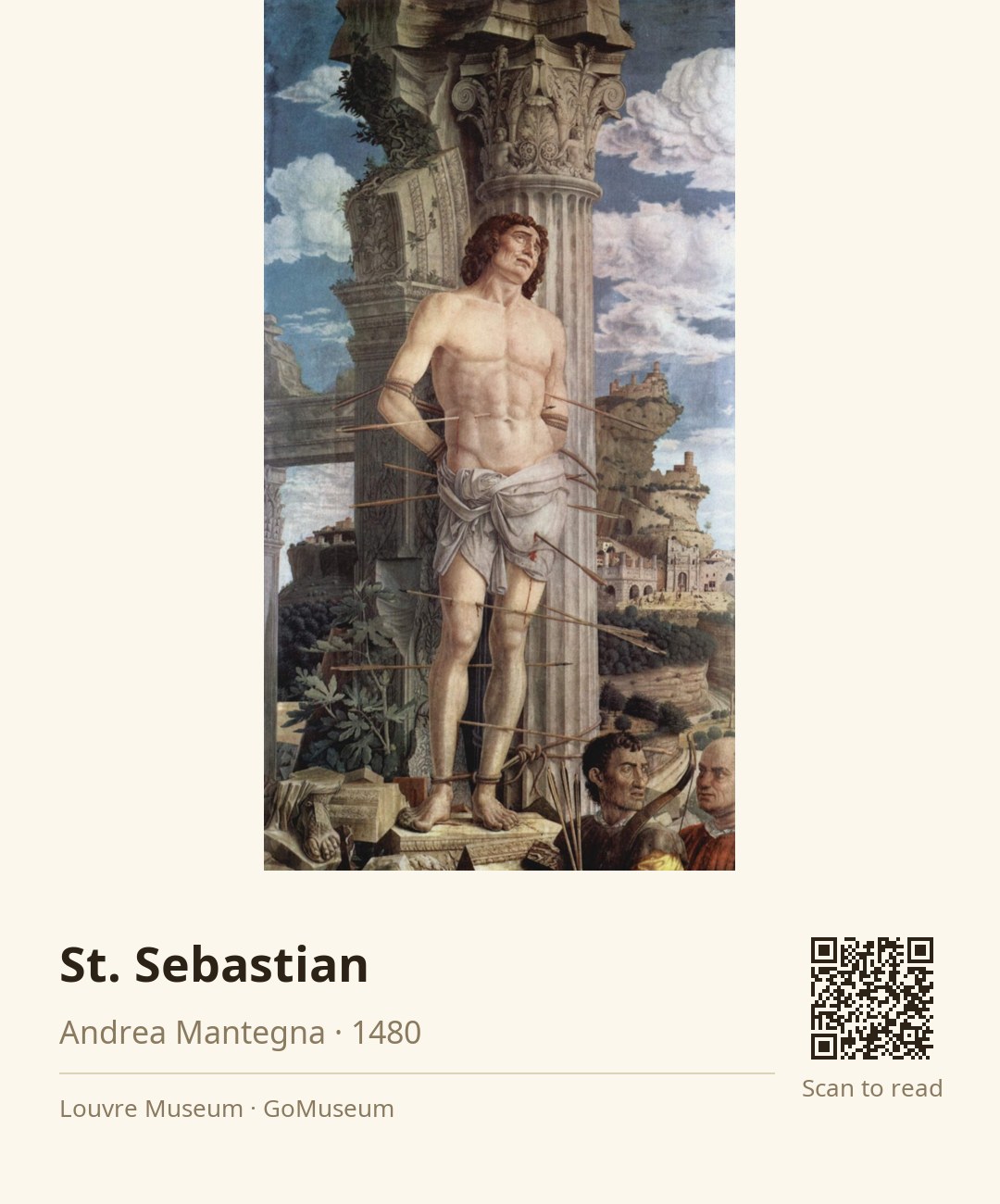
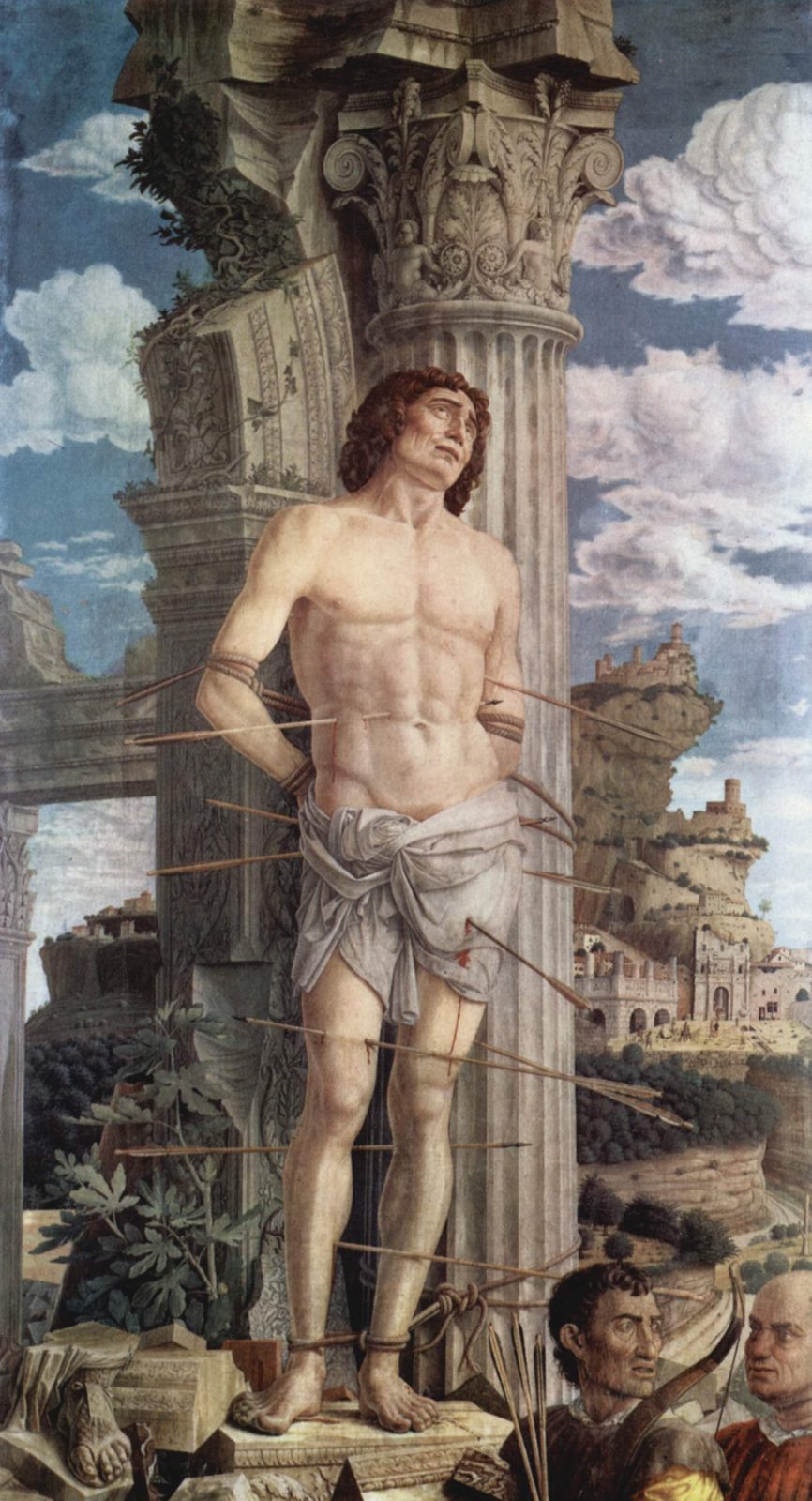
🎧 This work has audio narration — listen in the appHere stands a young man tied to a fluted column, his arms bound behind him and his body pierced by arrows, yet his face lifts upward with a furrowed brow rather than sinking into pain. Look at the rope knotted at his wrists and ankles, and at the pale cloth wrapped around his hips, where the arrows pass through and leave small red wounds on his skin. Around his feet lie broken fragments of classical stone, a carved foot and a leafy plant, all scattered as if the ancient world itself had been left in ruins.
Mantegna paints this with the exactness of someone who studied Roman sculpture closely, as his teacher Francesco Squarcione had trained him to do.
It is dated to 1480, painted in tempera and oil on canvas, and it measures about 255 by 140 centimetres. It belongs to the late fifteenth century, a period when Mantegna had already built his reputation in Padua and was working within the orbit of the Italian courts. The landscape behind the saint shows walled towns on cliffs beneath a wide blue sky, a view that lends the scene a distance and calm at odds with the violence at its centre. Mantegna was born around 1431 near Padua, the son of a carpenter, and in his youth he was apprenticed to Squarcione, who sent him to study the antiquities he collected.
Andrea Mantegna, born around 1431 in Isola di Carturo, was a pivotal figure in the Italian Renaissance, renowned for his innovative approach to perspective and his sculptural style. Apprenticed to Francesco Squarcione, he absorbed a passion for classical antiquity, which profoundly influenced his artistic vision. Mantegna's early works, including the frescoes in the Ovetari Chapel, showcased his mastery of dramatic perspectives and detailed architectural elements, although many were tragically lost during World War II.
His marriage to Nicolosia, daughter of Jacopo Bellini, further anchored him in the vibrant artistic community of Venice. Mantegna's distinct style, characterized by flinty landscapes and statuesque figures, often drew criticism for its rigidity, yet it marked a significant departure from Gothic traditions. He was instrumental in elevating the status of the artist in society, embodying the Renaissance ideal of the creative genius. Mantegna's legacy endures, influencing generations of artists and cementing his place in art history as a master of both painting and printmaking. He passed away in 1506, leaving behind a rich body of work that continues to inspire.
It also gives an inventory number, RF 1766. Beyond these, it does not say who commissioned the painting, where it was first shown, or how it was received, so we cannot go further than the bare record.
Set against a tall, fluted column with a carved Corinthian capital, the young saint is nearly nude, with curly auburn hair. A pale cloth is knotted at his hips, and arrows pass through it and his legs, leaving small red wounds. His ankles are roped to the stone base, and his arms are bound behind him at the wrists and upper arms. In the foreground, broken classical masonry, a fragment of a carved foot and a leafy plant sit on the ground. At lower right, two men's heads and a bow appear beside a bundle of arrows. Behind the figure, rocky cliffs carry walled towns and an arched gateway under a blue sky with large white clouds. The surface is smooth and finely detailed, and no inscription is legible. The material does not describe brushwork or layering, so we can say nothing more about how the paint was applied.
According to the account given here, his master Squarcione taught him Latin, along with studying fragments of Roman sculpture, which fits the classical care visible in this painting.
Francesco Squarcione, the Paduan painter who trained Mantegna, had started out as a tailor before becoming devoted to ancient art.