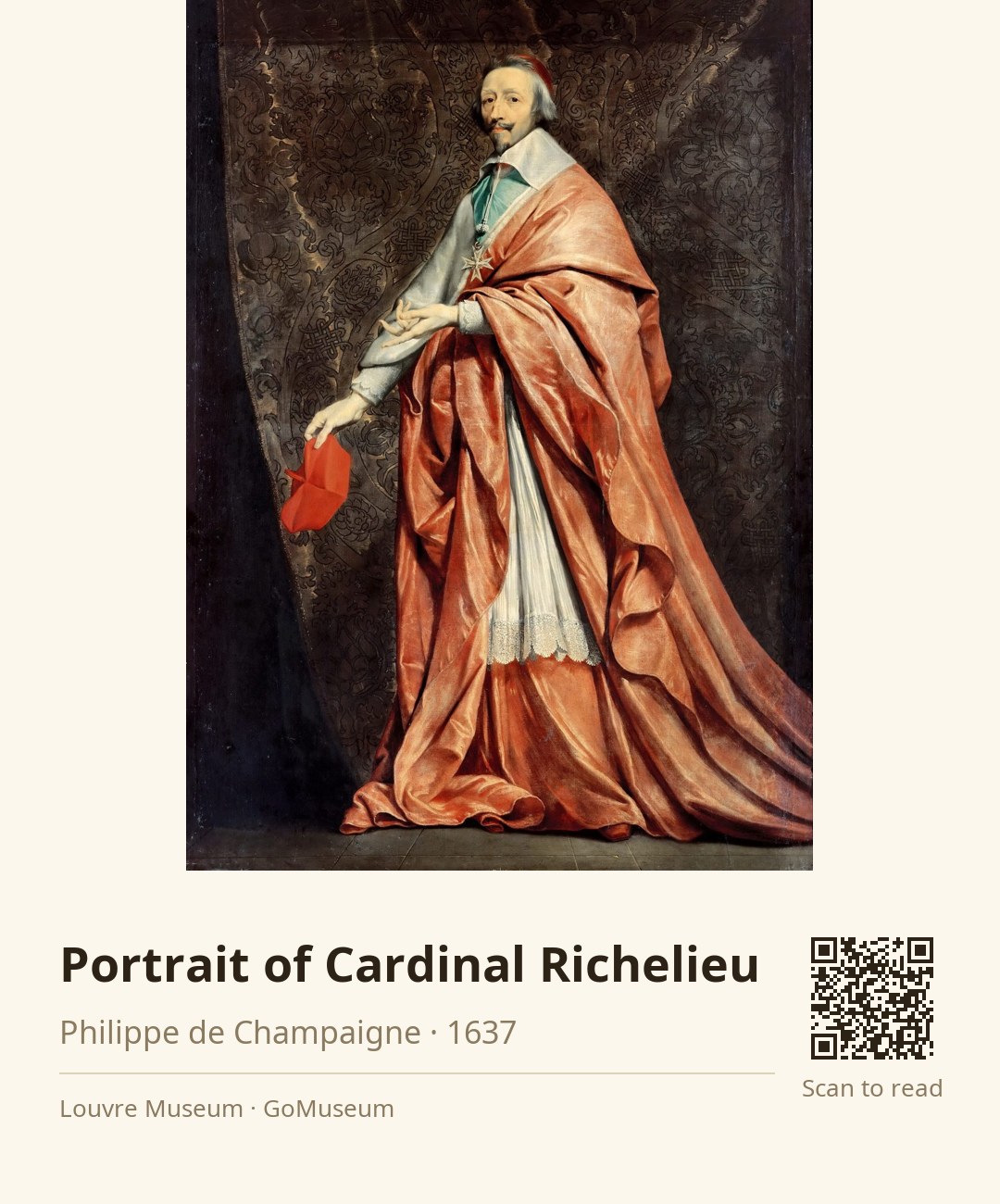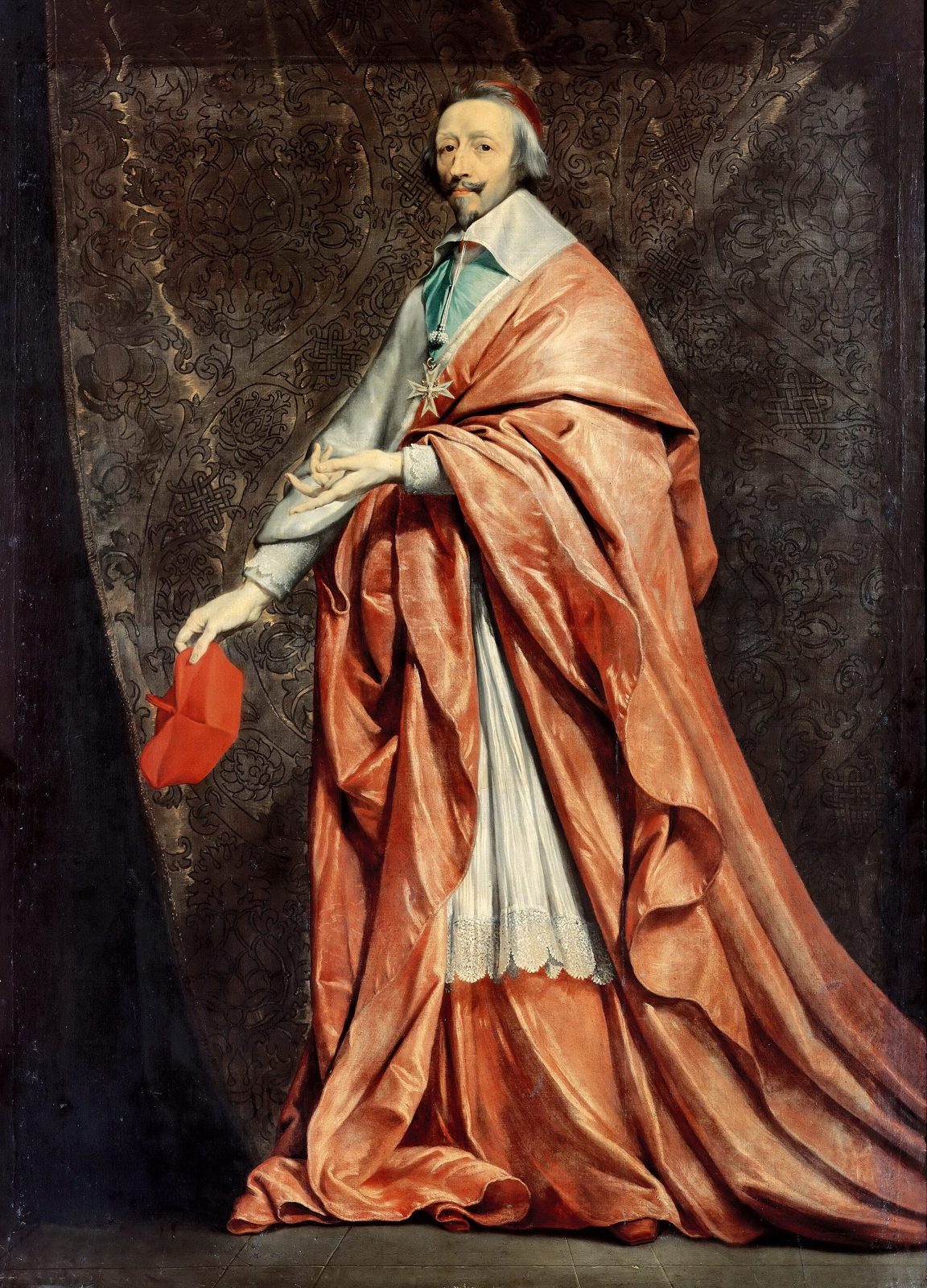
Portrait of Cardinal Richelieu
🎧 This work has audio narration — listen in the appRichelieu stands full length, nearly life-size, in a cardinal's scarlet cape that spills across the floor in a heavy train. Look at the way that cape hangs: its glossy folds catch the light and seem to carry the weight of the man inside them. Beneath it a white lace-edged surplice and a small white cross on his chest mark his church rank, while the hand at his side holds a red square cap, the very object that signals his office.
Those details are the point. The pyramid built by the figure, broad at the floor and narrowing toward the head, gives the portrait a sense of steadiness, while the man's gaze falls directly on the viewer. Richelieu was then chief minister to Louis XIII and at the height of his power, and the painting was made to present that power as composed and unshakable.
The record of the picture itself is fairly clear. It was likely intended for the Hôtel de Toulouse, and over time it passed to Louis II Phélypeaux, marquis de La Vrillière, and then to the Duke of Penthièvre.
Philippe de Champaigne was a prominent French Baroque painter born on May 26, 1602, in Brussels. Coming from a humble background, he trained under notable artists before moving to Paris in 1621, where he became an independent master. Champaigne gained recognition as the Queen's Painter, creating significant works for the royal family and religious institutions. His style evolved from the vibrant influences of Rubens to a more austere approach, characterized by the psychological depth of his subjects.
A founding member of the Académie royale de peinture et de sculpture, he played a crucial role in shaping French art during the Ancien Régime. His notable works include portraits of the French court and religious scenes, such as "Ex-Voto," which reflects his personal life and Jansenist beliefs. Champaigne's legacy endures through his masterful compositions and the emotional resonance of his paintings, securing his place in art history as a key figure of the Baroque era. He passed away on August 12, 1674, leaving behind a rich artistic heritage.
The painting was probably made around 1635 to 1640, and it is one of twenty-one portraits Philippe de Champaigne made of Cardinal Richelieu. It was probably meant for the Hôtel de Toulouse. Its later owners were Louis II Phélypeaux, marquis de La Vrillière, and then the Duke of Penthièvre. In 1793 it was seized from the Duke's collection at the château d'Anet, and in 1798 it was deposited at the Louvre, where it is still kept. Sometime in the 19th century the canvas was enlarged by a strip of 20 cm at the top and 5 cm on each side during a relining, which means the picture you see is not quite the size it was first painted.
The canvas measures about 2.22 by 1.55 metres, so the figure is shown at near life size and seems to stand right in front of you. The palette is built around a few strong colours: the salmon-red cape with its glossy folds and train pooling on the grey tiled floor, set against a dark brown-black hanging with scrolling floral motifs and knot-like ornaments. The cape's white collar, the lace-edged surplice, the grey sleeves with lace cuffs and a pale blue-green garment at the neck give the eye small, light accents within that dark field. The sitter stands in three-quarter profile, turned toward the viewer's left while his gaze comes back out to you. His raised hand is curled with the fingers bent, while the lowered left hand holds the red square cap. Grey hair at the sides, a pointed moustache and goatee, and a small red skullcap complete the head. No inscription is visible on the picture.
The painting was not made for a public display in the usual sense: the material says it was probably intended for the Hôtel de Toulouse, and it later passed through private hands before reaching the Louvre.
Yes, he was one of the founding members of the Académie royale de peinture et de sculpture, which was established in Paris in 1648.