 Image: Sailko
Christ on the Mount of Olives
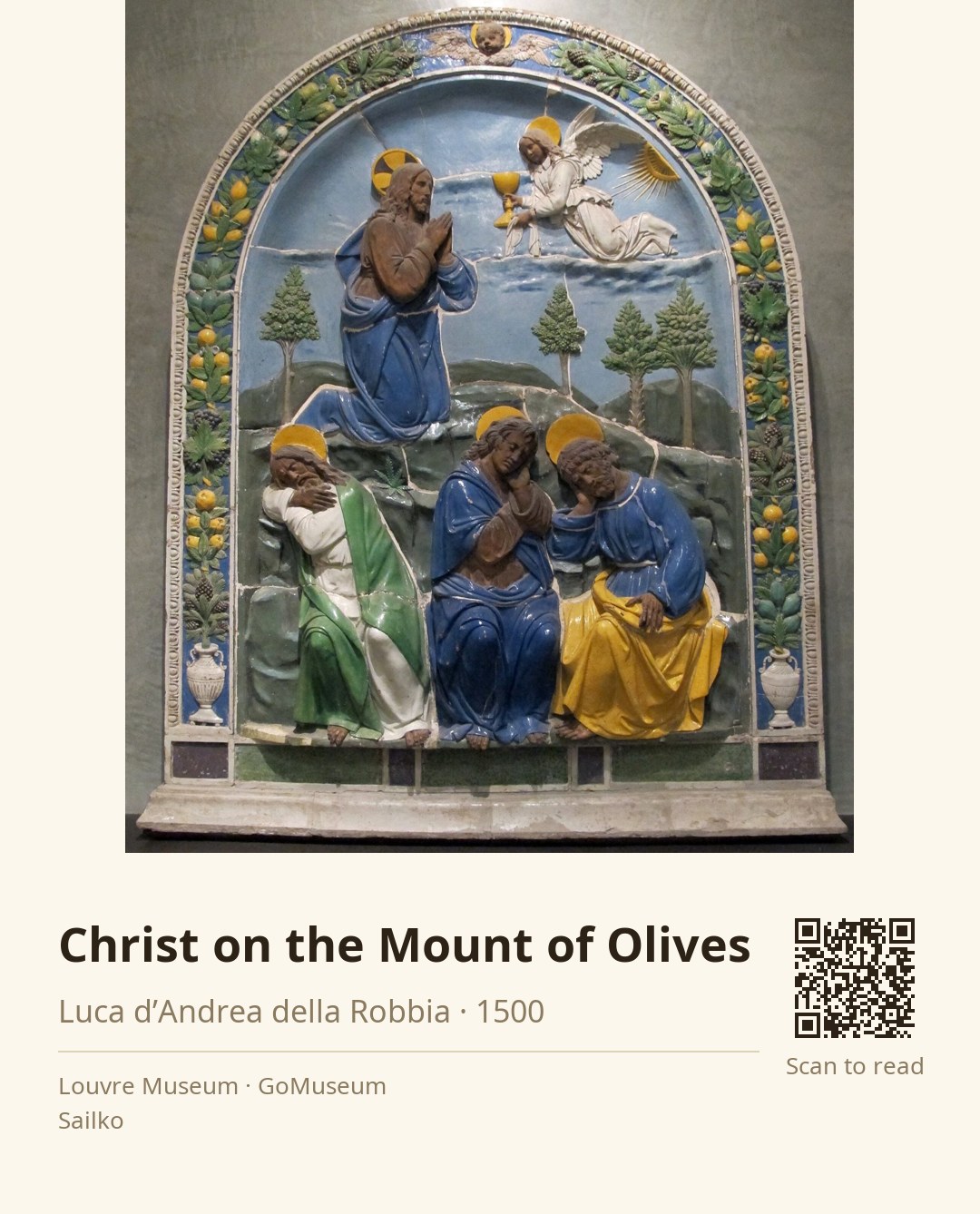
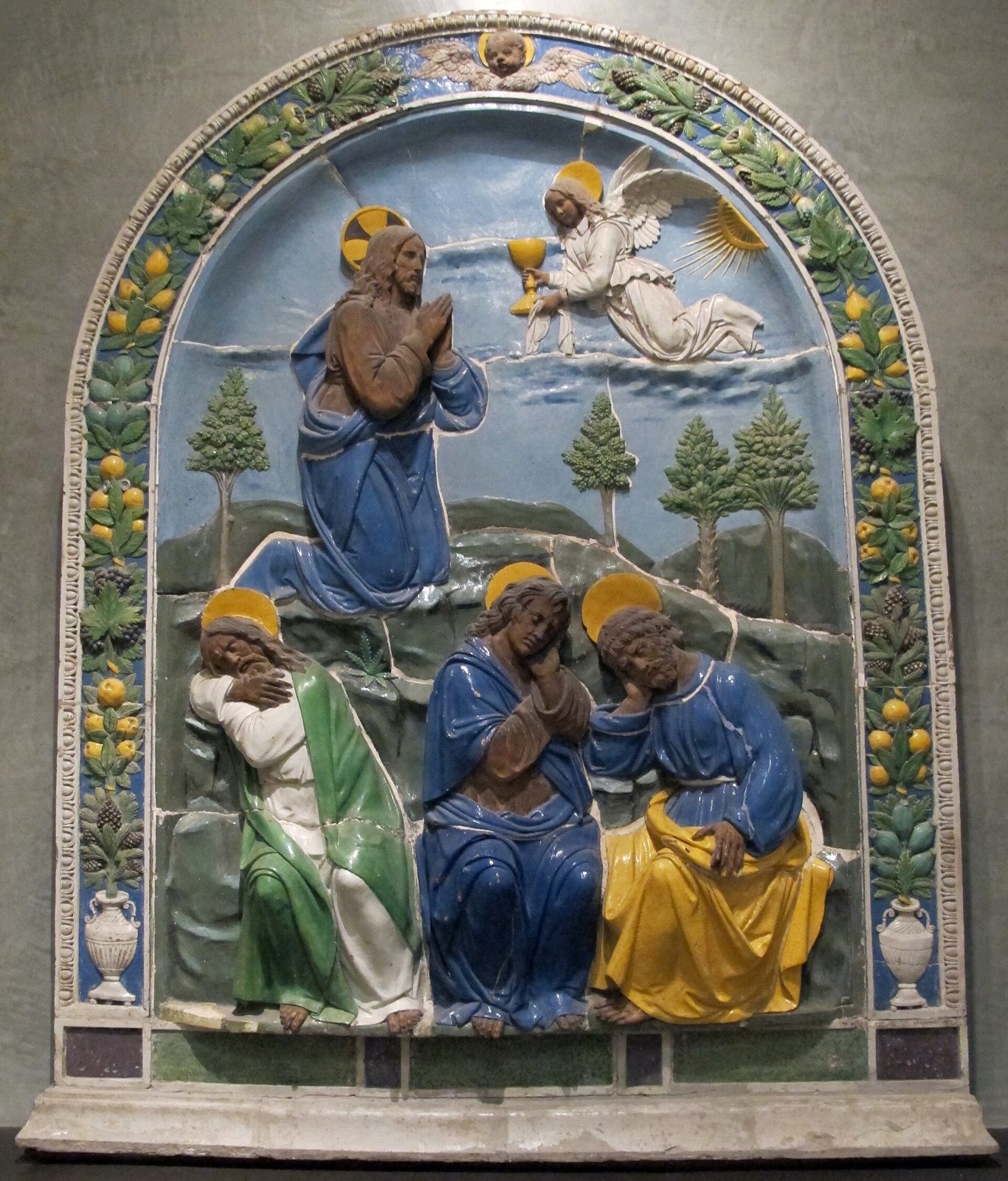
🎧 This work has audio narration — listen in the appThree sleeping figures sprawl across the foreground of this arched terracotta panel, heads propped on their hands, while a small kneeling man in a blue robe prays alone on a green rise above them. That contrast of sleep below and prayer above is the heart of the scene. Look at the angel on the right, floating on clouds and holding out a yellow chalice, and you will see the moment the story turns on: the one awake is not sharing the vigil, he is facing what is coming.
What you are seeing is glazed terracotta, a material the Della Robbia workshop made famous: clay modelled in relief, then coloured with a glossy glaze that gives the blue sky, the green hills and the yellow sunburst their lasting sheen. The garland framing the arch, with its lemons, grapes and pine cones, is set on blue, and it ends in white vases with a winged cherub at the top. The surface still shows cracks and old repaired joins, which tell you the panel has survived centuries of handling and moving.
Luca's story turns on a rivalry over the workshop's secret glazing methods. He left Italy for France in 1529, joining his younger brother Girolamo, who had been working for François I since 1517. He went partly to escape a plague that had killed his first wife, Agnoletta Falconieri, in 1527, and he took his second wife, Bartolomea Altoviti, with him. The dispute with Santi Buglioni, whose uncle had trained under Andrea, left the Buglioni family as the only holders of the workshop's techniques in Italy.
Luca della Robbia the Younger (c. 1475 – c. 1548) was one of the sons of Andrea della Robbia, and so belonged to the Italian family of artists whose workshop near Florence became famous in the Renaissance for brightly coloured relief sculptures in glazed terracotta. Together with his brothers Giovanni, Fra' Mattia, Girolamo and Fra' Ambrogio, he worked within the family enterprise, which turned out devotional reliefs that were admired for their clear, simple figures. His own compositions are described as favouring lucid forms and a plain, direct manner.
His life was shaped by upheaval. After the death of his first wife, Agnoletta Falconieri, in the plague of 1527, he married Bartolomea Altoviti and, in 1529, left Italy for France to avoid further contagion. He joined his younger brother Girolamo, who had been in the service of François I since 1517, and his brother Giovanni, who was already in France. The move also ended the family workshop's production, following a dispute with Santi Buglioni over the secret techniques of glazed terracotta. Those techniques, according to Vasari, had been obtained from the Della Robbia through a woman who frequented their household, and afterwards the Buglioni became the only holders of the process in Italy, turning them into rivals.
Luca's place in art history rests on his membership of a celebrated dynasty and on works such as the Nativity at the Dominican convent of Santa Maria Maddalena in Caldine, Florence, the Christ on the Mount of Olives in Rome, and Christ Consoling a Beggar in the Louvre. His career illustrates how closely the fortunes of Renaissance workshops depended on family ties, trade secrets and the disruptions of war and disease.
According to the material, the workshop stopped producing after a dispute with Santi Buglioni, which followed Luca's move to France in 1529.