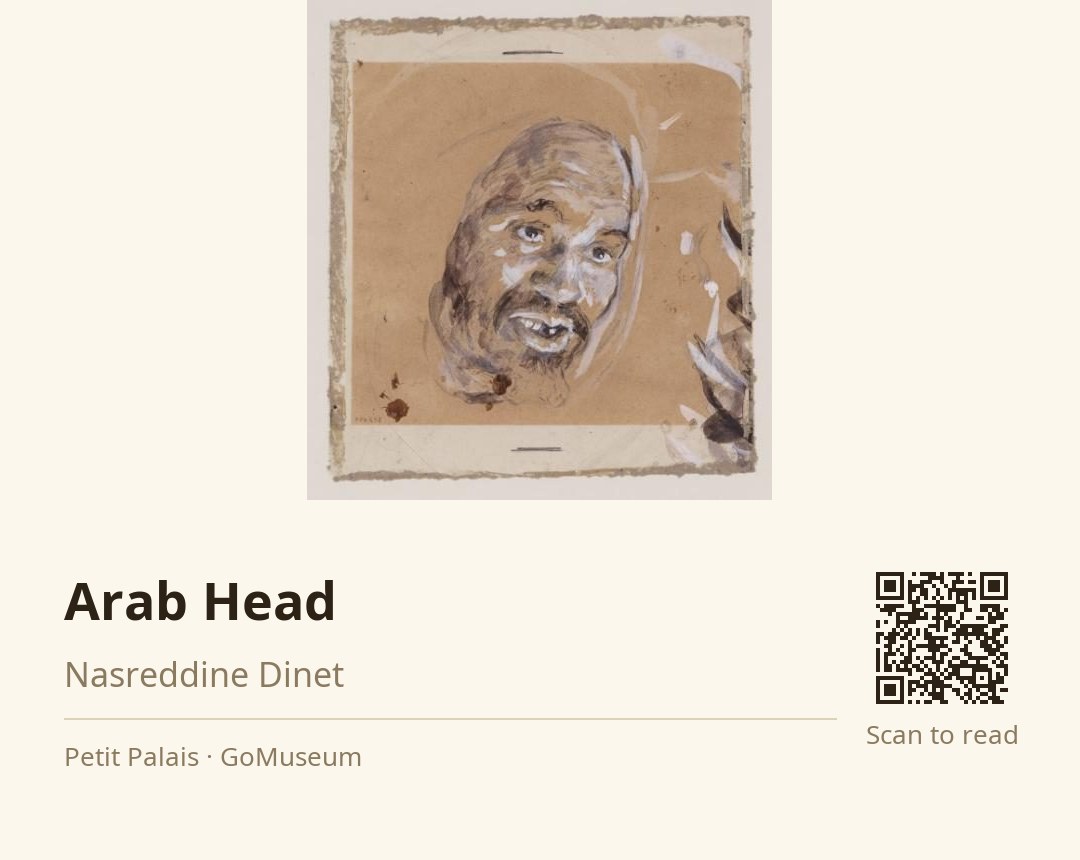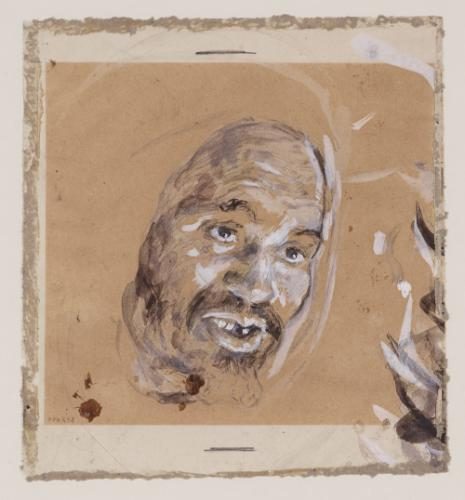
A bald, bearded man floats alone in the middle of a sheet of tan, kraft-brown paper, with no neck, no shoulders, no body beneath him. His eyes are wide and tilt up and to the side, and his mouth hangs open in what could be a grimace or a grin, with one dark gap showing among the teeth. The whole face is built from loose, wet strokes of white, grey and dark brown, and the paper itself shows through as the midtones, so the head seems to be made of the sheet rather than painted onto it.
Look at the highlights, the bright white marks along the brow, cheek and nose. They are the lightest things in the drawing, and they pull the face forward off the ground. The ragged, torn edges of the sheet and the short dark dashes at top and bottom remind us that this was a working piece of paper, not a finished presentation sheet.
The sheet was given to the city of Paris in 1907 and has since been held in the collections of the Petit Palais.
Dinet was a Paris-born painter who, after his first trips to Algeria in 1884 and 1885, kept returning to the region for two decades. He later converted to Islam, announcing it in a private letter in 1908 and formalising it in 1913, when he took the name Nasreddine. Those later decisions are part of his biography, but they are not recorded as bearing directly on this sheet.
Nasreddine Dinet, born Alphonse-Étienne Dinet in Paris on March 28, 1861, was a prominent French orientalist painter who dedicated much of his life to capturing the essence of Algeria and its culture. His artistic journey began at the École nationale supérieure des Beaux-Arts, where he trained under esteemed artists. Dinet's fascination with Algeria ignited during his travels there, leading him to convert to Islam and adopt the name Nasr ad-Din, meaning "defender of the faith." This transformation deepened his connection to the land and its people, allowing him to create works that were both ethnographic and deeply personal.
Dinet's paintings often depicted daily life in Algerian villages, religious themes, and landscapes, reflecting his immersion in the local culture. His ability to speak Arabic and understand Islamic traditions set him apart from many of his contemporaries. He was a founding member of the Société des Peintres Orientalistes Français and received accolades for his work, including a silver medal at the 1889 Exposition Universelle. His legacy endures, celebrated as a master of Algerian painting, and his life story continues to inspire discussions on orientalism and cultural exchange. Dinet passed away on December 24, 1929, leaving behind a rich body of work and a profound impact on the art world.
Materially, the sheet combines several media: graphite pencil, pen with brown ink, brown ink wash, white highlights, and gouache. Most of the head is built up in wash and gouache over the tan paper, with the pencil and ink lines sitting underneath or within those layers. The paper is a warm, tan kraft tone, and it is left visible as the modelling mid-tone. The sheet measures 18.9 cm high by 17.2 cm wide, so the head occupies a small, intimate scale. The torn, ragged edge and the small reddish-brown blotches near the lower left remain part of the surface as it survives today.
It is kept in the collections of the Petit Palais in Paris, which is also where it has been held since the city of Paris acquired it in 1907.
Yes, the sheet is linked to a painting called La Courtisane (The Courtesan), so it may be a study connected with that larger work.
Matisse also travelled to northern Africa in the first decade of the 20th century, but Dinet's works are described as far more conservative, closely observed and almost ethnographic, while Matisse was a modernist.