Portrait of Mme*** (Madame Durant)
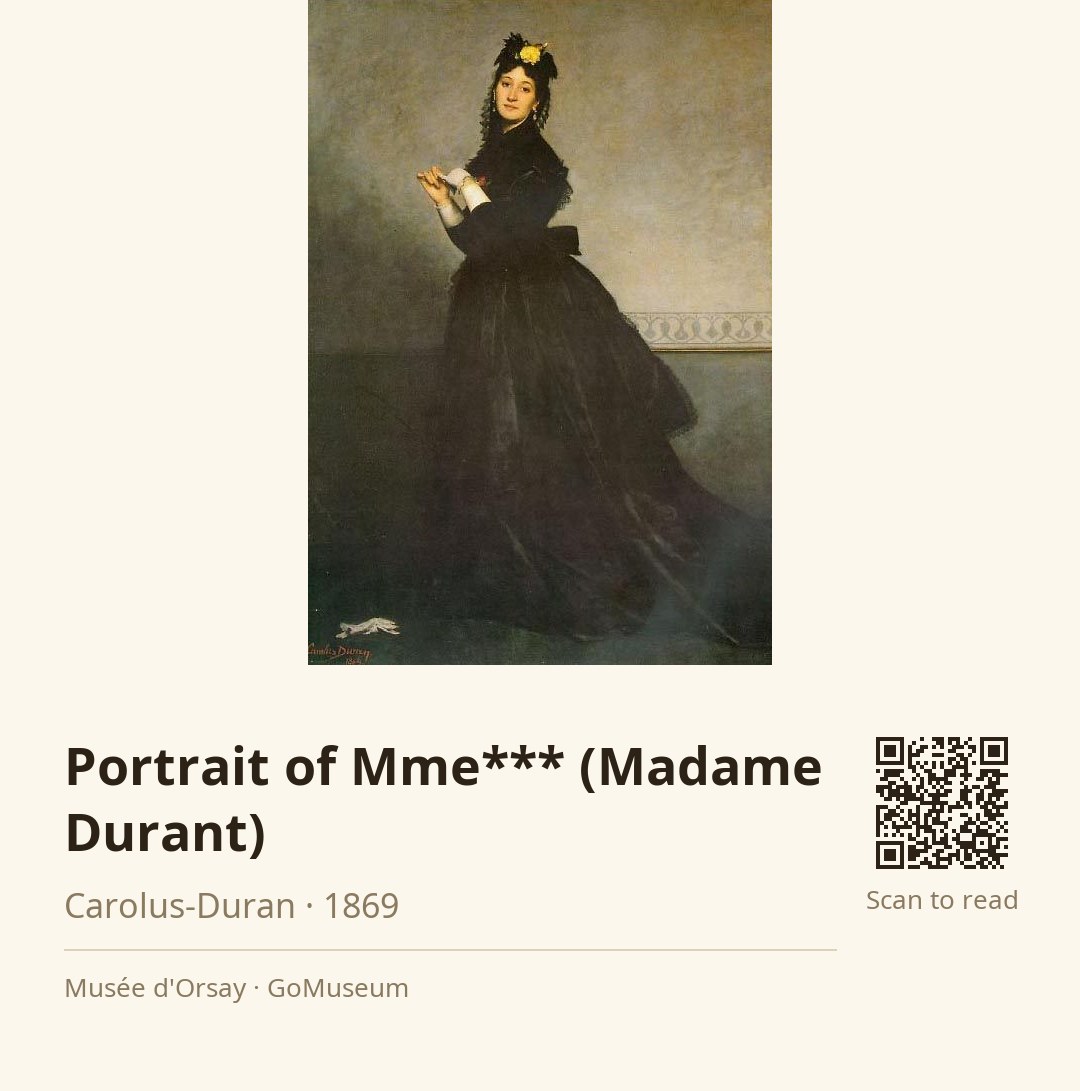
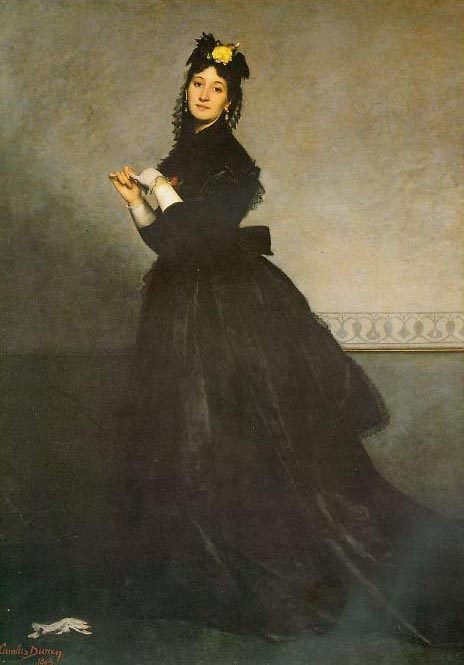
🎧 This work has audio narration — listen in the appThe woman in black is standing full-length, her body turned to the left while her face turns back toward you, and her hand is pulling a white glove off while the other glove already lies crumpled on the floor. That pause, caught mid-motion, is the whole idea of the picture. Pay close attention to the glove on the floor and the hat with its small yellow flowers, because the artist chose both to hold the eye.
The portrait is the work of Carolus-Duran, born Charles Auguste Émile Durand, who was a French painter of Paris high society during the Third Republic. The sitter was his wife, Pauline Croizette, whom he married in January 1868; she was a pastellist and miniaturist, and she posed for this canvas in 1869. The work was shown at the Salon in Paris in the year it was painted, where it won a medal. The state bought it in 1875 for the Musée du Luxembourg, it was shown at the Exposition universelle of 1878, and since 1982 it has been in the Musée d'Orsay.
Charles Auguste Émile Durand, known as Carolus-Duran, was a prominent French painter and art instructor born on July 4, 1837, in Lille. He emerged during the Belle Époque, celebrated for his elegant portraits of high society in Third Republic France. His artistic journey began with drawing lessons from a local sculptor, followed by formal studies in painting under François Souchon in Paris, where he adopted his pseudonym.
Durand's early work was influenced by Realism, particularly Gustave Courbet, but he later gravitated towards the style of Diego Velázquez after traveling to Rome and Spain. His breakthrough came with the painting "Murdered," which garnered significant acclaim. He became renowned for his portraiture, capturing the essence of his affluent subjects with a distinctive flair.
As an educator, Durand established a prominent atelier in Paris, mentoring many notable artists, including John Singer Sargent. His contributions to the art world were recognized with numerous honors, including multiple promotions within the Légion d'honneur. He played a crucial role in the art community, co-founding the Société Nationale des Beaux-Arts and serving on juries for major exhibitions.
Durand's legacy is marked by his ability to blend academic techniques with a modern sensibility, making him a key figure in the transition from traditional to contemporary portraiture. He passed away on February 17, 1917, leaving behind a rich artistic heritage that continues to influence artists today.
The painting was finished in 1869 and first shown at the Salon des artistes français in Paris that same year, catalogued under the title Portrait of Mme*** (Madame Durant). The state later acquired it for the Musée du Luxembourg, and it has been held at the Musée d'Orsay since 1982. The sitter, Pauline Croizette, was the artist's wife: the material notes that they married in January 1868, and that she posed for the picture in 1869, the year it was made.
Physically the canvas is tall and close to life size, measuring 228 by 164 centimetres, painted in oil on canvas. The woman stands in three-quarter view with her head turned toward us. Her gown is long and dark, with a fitted bodice and a voluminous skirt that spreads out across the floor into a train. A small dark hat trimmed with yellow flowers sits on her dark hair, and ringlets fall beside her ears. White cuffs show at the wrists. The background is a smoky, mottled grey-green field with no furniture or setting, and a pale decorative band runs down the right edge. The paint surface is smooth and softly blended, and the black fabric is built from subtle sheen rather than hard contrasts. The material describes the handling as smooth and blended; it does not say anything about visible brushwork or impasto.
Yes. Pauline Croizette, the painter's wife, was a pastellist and miniaturist, so she worked in art herself before posing for this portrait.