Saint Sebastian
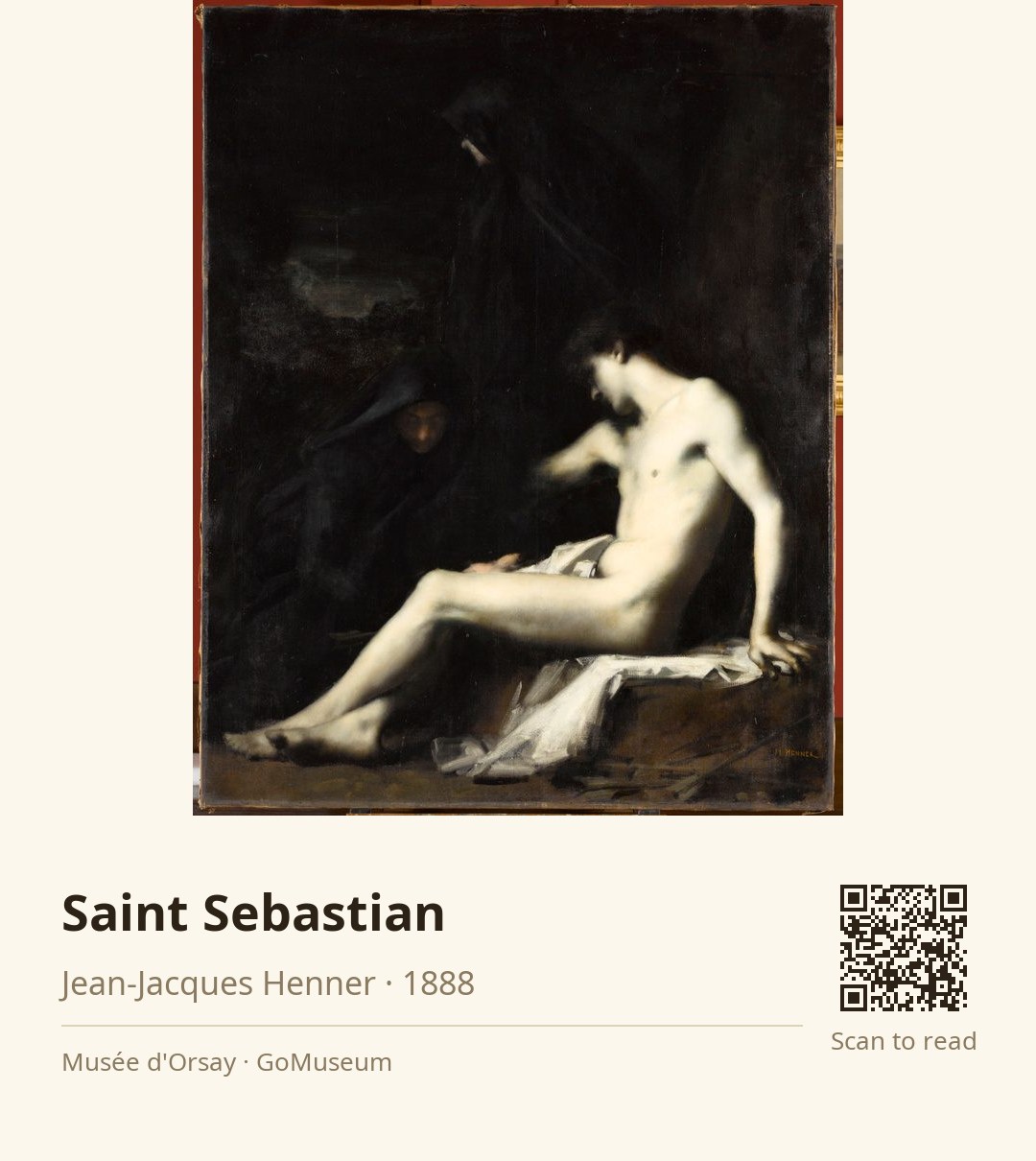
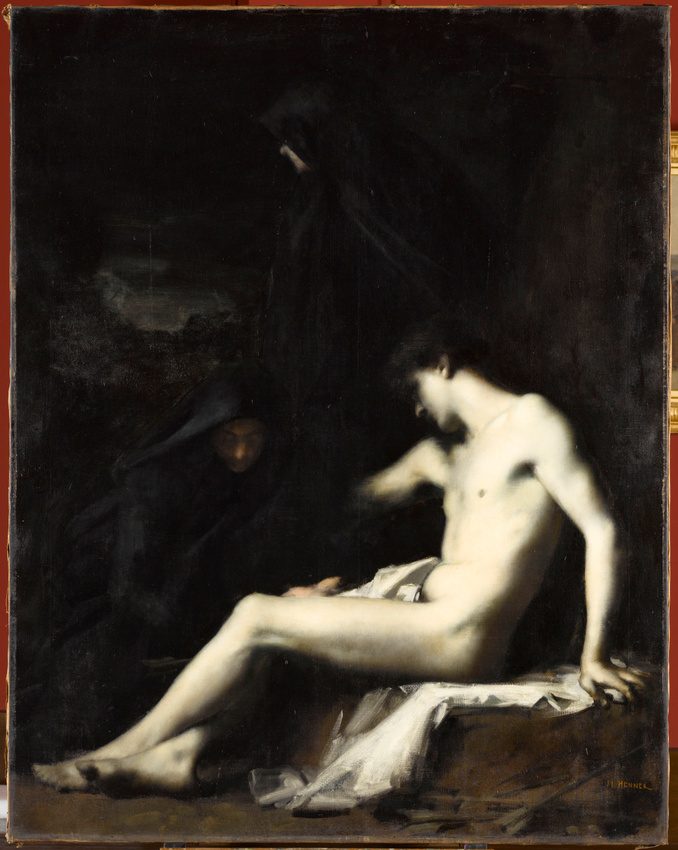
🎧 This work has audio narration — listen in the appHere a young man sits bare-skinned on the ground, bent forward with his head lowered, and the arrows lying beneath him tell you exactly what has happened to him. Look at the pale cloth that falls from his hips and pools across the earth, the soft, almost blurred edges of his arm, and the hooded figure at the left reaching toward his leg with a hand that seems to be tending a wound. Those things are what make this a scene of care rather than of violence: the painter has placed the martyr's body in a moment of attention, not in the moment of the shot. The soft handling of skin and linen, and the way the figures melt out of a near-black background, turn the grim subject into something quieter and more intimate.
The painting shows Saint Sebastian, the Christian martyr pierced by arrows, being tended by Roman women after the arrows struck him. The source names the women as Roman ladies and connects the scene to the figure of Saint Irene of Rome, who is recorded as caring for him. Henner painted it in 1888, and it was shown at the Salon des artistes français that year, where the French state bought it. It was then included in the Exposition universelle of 1889 in Paris. Henner, born in Alsace in 1829, was known for his pale nudes, his sfumato and chiaroscuro, and his religious subjects, and this work belongs to that devotional vein of his practice.
Henner was a student of Picot and won the Prix de Rome in 1858, which took him to the Villa Médicis, and his later career was built largely on Salon success, state purchases and commissions for portraits. The scene you see here, with its carefully shadowed ground and its tender tending of a wounded body, was made in the final quarter of a century of his career. Its acquisition by the state at the Salon of 1888 is the moment that brought it into public collections, and the painting has remained in the hands of French public museums ever since.
Jean-Jacques Henner was a prominent French painter born on March 5, 1829, in Bernwiller, Alsace. He studied under notable artists and won the Prix de Rome in 1858, which allowed him to refine his craft in Italy. Known for his mastery of sfumato and chiaroscuro, Henner became celebrated for his depictions of nudes, religious themes, and portraits, particularly his iconic painting of Saint Fabiola. His works often featured pale-skinned women with flowing red hair, embodying a dreamy, ethereal quality.
Henner's career flourished after his return to Paris, where he gained recognition at the Salon, particularly with his patriotic piece, "L'Alsace, elle attend," created in response to the Franco-Prussian War. He was a member of the Académie des beaux-arts and received numerous accolades, including the Legion of Honour. Despite his success, he remained somewhat detached from contemporary artistic movements. Henner passed away on July 23, 1905, leaving a legacy that continues to influence artists today, as seen in the extensive collection of copies of his works, particularly "Fabiola."
Look at the light falling on the body: the man's flesh and the pale cloth around his hips are the brightest things in the picture, while the background sinks into near-black. The figure at the lower right is turned away, head bowed toward the left, one arm stretched out behind him with the hand braced on the ground, the other arm softly blurred. His long legs run diagonally across the foreground, bare feet at the lower left, and the cloth spills over the brown earth beneath him where dark straight shafts lie. Up at the left, a hooded figure in dark robes leans in with a face that is only dimly lit. A second hooded shape hovers in the upper centre, almost swallowed by the shadows. Small details like that faint grey patch at the left edge, which breaks up the darkness just enough to hold the eye, are what keep the scene from collapsing into pure gloom. The work is painted in oil on canvas, and the material describes the flesh and cloth as smooth, soft-edged passages.
The French state bought the painting at the 1888 Salon, which is how it entered public collections.