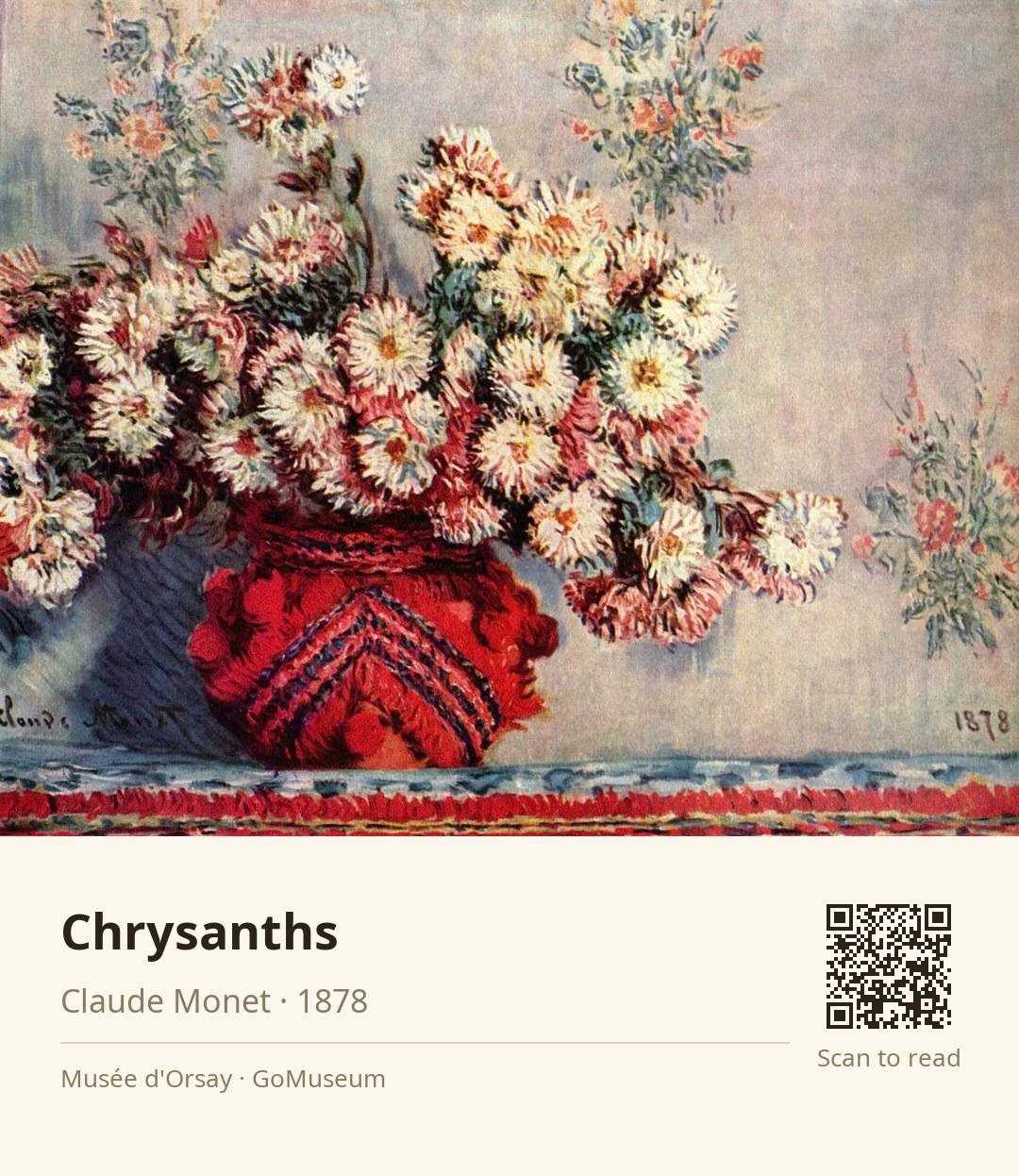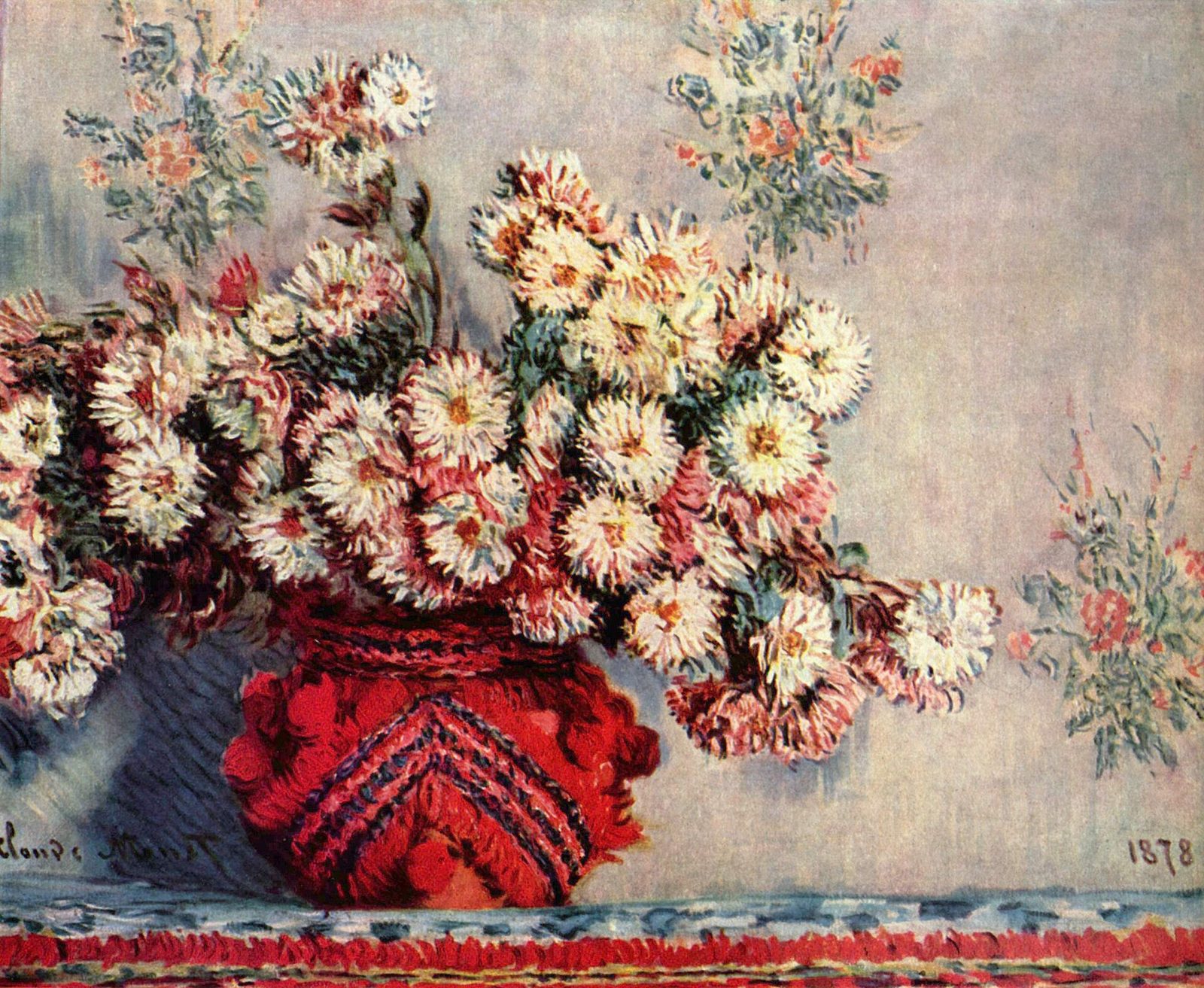
Look at the vessel first: a bright red, ruffled body banded with a chevron of blue, pink and dark strokes, set on a pale blue cloth with a red fringed edge. Above it, the chrysanthemums spill toward the left, shaggy white and pink heads with yellow-orange centres, their stems leaning hard to the right. Monet builds these blooms from short, thick, feathery dabs, so the petals seem to tremble on the surface rather than sit still.
What makes the picture work is that the paint is never smoothed into a finished skin. Each stroke stays visible as a stroke, and the eye does the blending from a distance. The grey-lilac wall behind carries small sprays of pink, orange and blue-green flowers, and a bluish shadow slides across its lower left, so the flowers feel placed in real light rather than arranged on a flat ground.
The material tells us this is an oil on canvas, measuring 54.5 by 65 centimetres, and that it dates to 1878, in the last quarter of the nineteenth century. It is a still life, a bouquet in a vase, and it sits within a body of work by Claude Monet, the painter who gave Impressionism its name. Its record shows that it passed to Dr Paul Gachet, who owned it from 1909, and then to his son, also named Paul.
Oscar-Claude Monet, born on November 14, 1840, in Paris, was a pioneering French painter and a founder of Impressionism, a movement that transformed the art world. Raised in Le Havre, he developed a passion for nature and painting early on, encouraged by his mother, while his father hoped he would pursue a business career. After his mother's death in 1857, Monet moved in with his aunt, who supported his artistic ambitions.
Monet's career began with caricatures, but he soon sought formal training, studying under Eugène Boudin, who introduced him to plein air painting. His breakthrough came in 1866 with "La Femme à la robe verte," which garnered attention at the Salon. The term "Impressionism" originated from his work "Impression, Sunrise," exhibited in 1874, marking a shift away from traditional art.
Throughout his life, Monet focused on capturing the essence of light and color in nature, creating series of paintings that depicted the same scenes under varying conditions, such as his famous haystacks and water lilies. He settled in Giverny in 1883, where he cultivated a beautiful garden that became his muse. Despite personal hardships, including the loss of loved ones and health issues, Monet's relentless dedication to his craft solidified his place in art history as a master of modernism, influencing countless artists and leaving a lasting legacy. He died on December 5, 1926, in Giverny, celebrated as one of the most significant figures in art.
The material gives us a few concrete facts about this canvas's history. It was made in 1878, in the last quarter of the nineteenth century. Its ownership is recorded from 1909, when it passed to Dr Paul Gachet. After him it went to his son, also named Paul Gachet. The catalogue numbering, RF 1951 36, tells you it entered the museum's collection under that inventory number. Beyond those dates and owners, the material does not say how or where it was first shown, so I won't guess at that for you.
The canvas is oil on canvas and measures 54.5 by 65 centimetres, which is a fairly modest size for a bouquet. The flowers are shaggy white and pink chrysanthemums with yellow-orange centres, and the grey-green foliage gives them a loose, tangled bulk. Their weight pulls everything to the right, so the whole arrangement feels like it is slowly spilling off the vessel toward the left edge. The vessel itself is a bright red, scalloped form with a chevron band of blue, pink and dark marks across its front. It rests on a pale blue patterned cloth that ends in a red fringed or striped border. Behind it, the grey-lilac wall is broken by three sprays of tiny pink, orange and blue-green blossoms, and a bluish shadow falls across its lower left. The paint is applied in short, thick, feathery dabs and dashes, and the material notes visible texture on both the petals and the red form, so the surface itself is physically raised and active.
The material only records that Dr Paul Gachet owned this canvas from 1909, and that it then passed to his son, also named Paul Gachet. It does not say more about him or his connection to Monet.