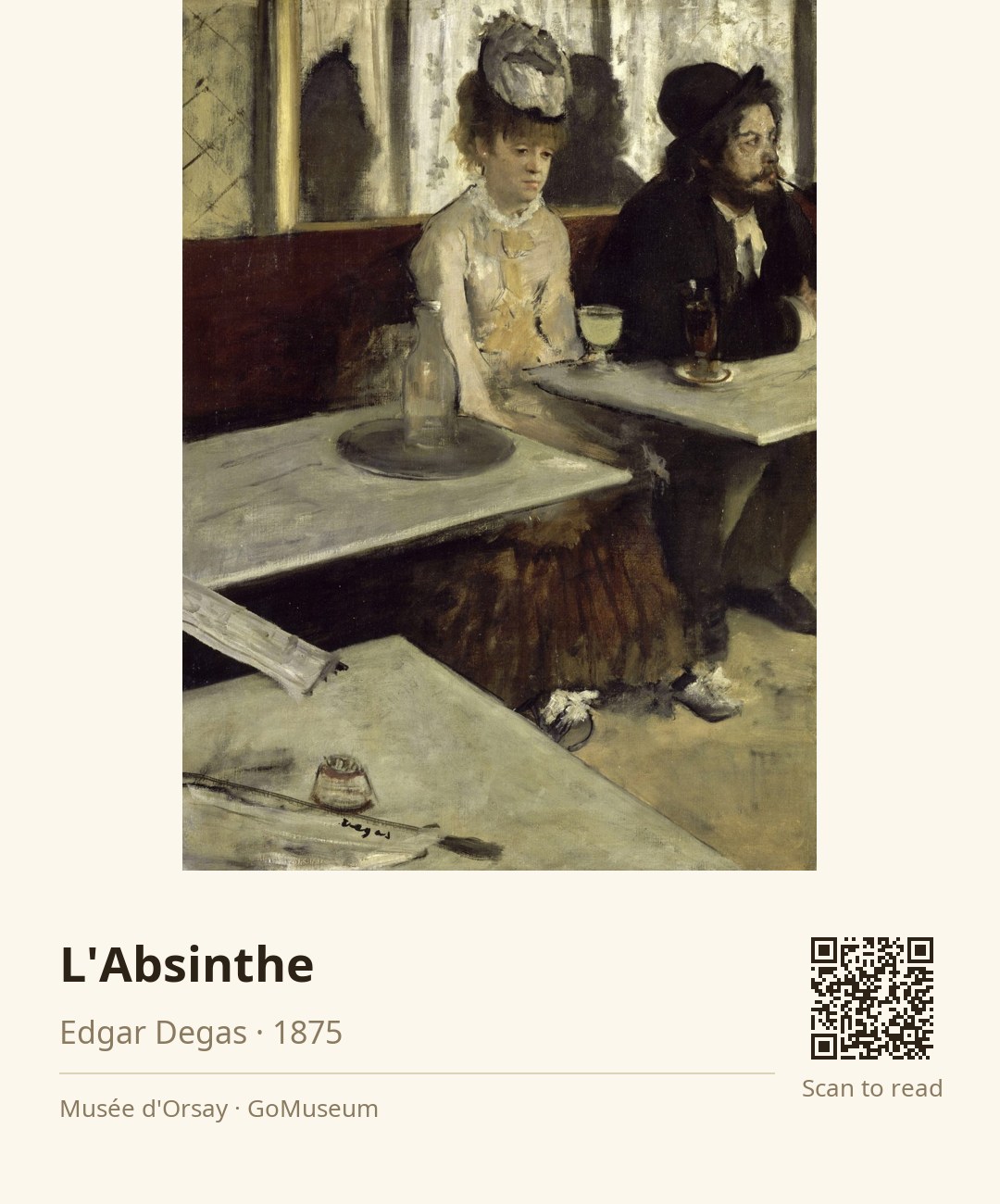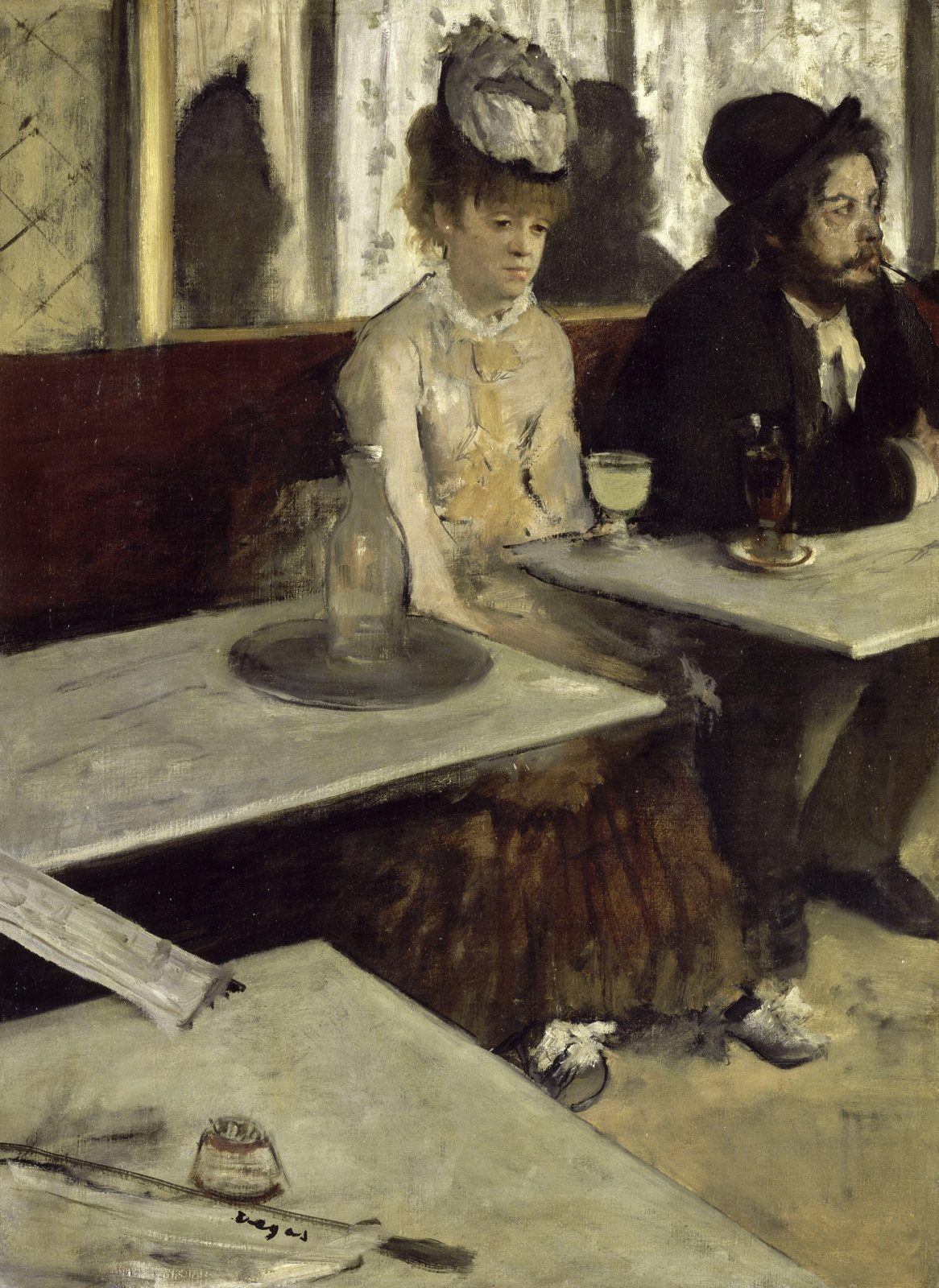
Take a moment to really look at Edgar Degas's "L'Absinthe." Notice how the woman’s gaze is cast downward, almost lost in thought, while the man beside her seems detached, staring off the canvas. This subtle interplay of isolation speaks volumes about their emotional state. The absinthe glass on the table isn’t just a drink; it symbolizes a deeper malaise. In the 19th century, absinthe was often associated with bohemian lifestyles and a sense of despair, reflecting the struggles of modern life. Degas captures this moment in a café, a social hub, yet the figures feel profoundly alone, embodying the loneliness that can exist even in crowded places. Created in 1875, "L'Absinthe" was initially titled "Dans un Café," and it stirred quite a controversy when first exhibited. Critics labeled it ugly and morally questionable, viewing it as a stark commentary on the degradation of society. But Degas wasn't merely painting a scene; he was exploring the human condition, the complexities of urban life, and the shadows lurking behind the glamour of Parisian cafés. As you stand here, think about the emotions that this painting evokes. What stories do you imagine these two characters carry with them? How does their solitude resonate with your own experiences?
Edgar Degas, born on July 19, 1834, in Paris, was a pivotal figure in the Impressionist movement, though he preferred to be labeled a realist. Known for his exceptional skill in drawing, Degas focused on capturing movement, particularly in his depictions of dancers, which constitute over half of his oeuvre. His works also include racehorses and portraits that reveal psychological depth and human isolation.
Degas came from a cultured, affluent family; his mother was a Creole from New Orleans, and his father was a banker. After his mother's death, he pursued art against his father's wishes, studying at the École des Beaux-Arts and drawing inspiration from classical masters during his time in Italy. His early ambition to be a history painter shifted as he embraced contemporary subjects, influenced by artists like Édouard Manet.
Despite being a founding member of the Impressionists, Degas's approach diverged from his peers, as he often worked in his studio rather than en plein air. His innovative techniques and themes sparked debate among critics and continue to influence art history today. Degas passed away on September 27, 1917, leaving behind a legacy that challenges traditional boundaries in art.
Edgar Degas's 'L'Absinthe' was painted between 1875 and 1876, originally titled 'Dans un Café.' This piece was a bold exploration of urban life, capturing a moment in the Café de la Nouvelle-Athènes in Paris. The painting first appeared at the second Impressionist exhibition in 1876, where it was met with harsh criticism, labeled as ugly and morally questionable. Critics were shocked by its portrayal of two figures lost in their own worlds, seemingly disconnected from the vibrant café scene around them. The painting was later exhibited in London in 1893, under its now-familiar title 'L'Absinthe,' igniting even more controversy. Critics in England viewed it as a stark commentary on the degradation of society, reflecting their deep-seated suspicions of French art. The painting changed hands several times, initially acquired by Captain Henry Hill in 1876, and later sold at auction in 1892 to Alexander Reid, who eventually sold it to a Paris dealer. It found a permanent home in the collection of the Musée d'Orsay, thanks to the Comte de Camondo, who held onto it until his death in 1911, after which it was bequeathed to the French state.
Degas employs a striking composition in 'L'Absinthe,' using an asymmetrical framing that accentuates the isolation of the figures. Notice how the woman's downward gaze contrasts sharply with the man's detached stare, both set against a backdrop of muted grays and browns. The brushwork is deliberate yet restless, creating a sense of unease that mirrors their emotional states. The glass of absinthe, with its luminous green hue, draws the eye and serves as a focal point, symbolizing the malaise of modern life. Degas's choice of colors—grays for the café's marble tables and the somber attire of the characters—contributes to the overall atmosphere of desolation. The way he captures light, filtering through the smoky air of the café, adds depth and a sense of realism, making you feel as though you are witnessing a fleeting moment in time. This technique of capturing the ordinary yet profound is what makes Degas's work resonate so deeply.
Painted in 1875, it captures a moment of urban isolation, showcasing a woman and a man in a café, both seemingly lost in their own worlds. Critics initially panned it, calling it ugly and immoral, reflecting the societal tensions of the Victorian era regarding absinthe and its connotations. Yet, this very controversy helped cement its legacy, as it forced viewers to confront uncomfortable truths about modern life and addiction. Degas's innovative composition, with its asymmetrical framing and psychological depth, paved the way for future artists, including Pablo Picasso, who paid homage to it in his own work. Remember, 'L'Absinthe' isn't just a painting; it's a conversation starter about the complexities of human experience and the evolving role of art in society.
One surprising fact about 'L'Absinthe' is the initial reaction it received when it was first exhibited. Critics were so appalled by the painting that they labeled it 'ugly' and 'disgusting.' This visceral response underscores the cultural tensions of the time, particularly in Victorian England, where the subject of absinthe and the portrayal of urban life were seen as morally questionable. The painting's original title, 'Dans un Café,' was also a point of contention, as many felt it trivialized the serious nature of art. It wasn't until it was re-titled 'L'Absinthe' for its 1893 exhibition in London that it sparked even greater controversy, with critics viewing it as a stark warning against the dangers of absinthe and the perceived moral decay of French society.
Ellen Andrée, the actress depicted in the painting, was reportedly displeased with how she and Marcellin Desboutin were represented, feeling they looked like 'two fools' and were shocked by the inclusion of absinthe, which Desboutin did not even drink.
Initially titled 'Dans un Café,' the painting underwent several name changes before being exhibited in London in 1893, where it was renamed 'L'Absinthe,' a title that has since become widely recognized.
Degas employs an asymmetrical framing that emphasizes the isolation of the figures, cutting off parts of their bodies and creating a sense of disconnection, a hallmark of his innovative approach to composition.