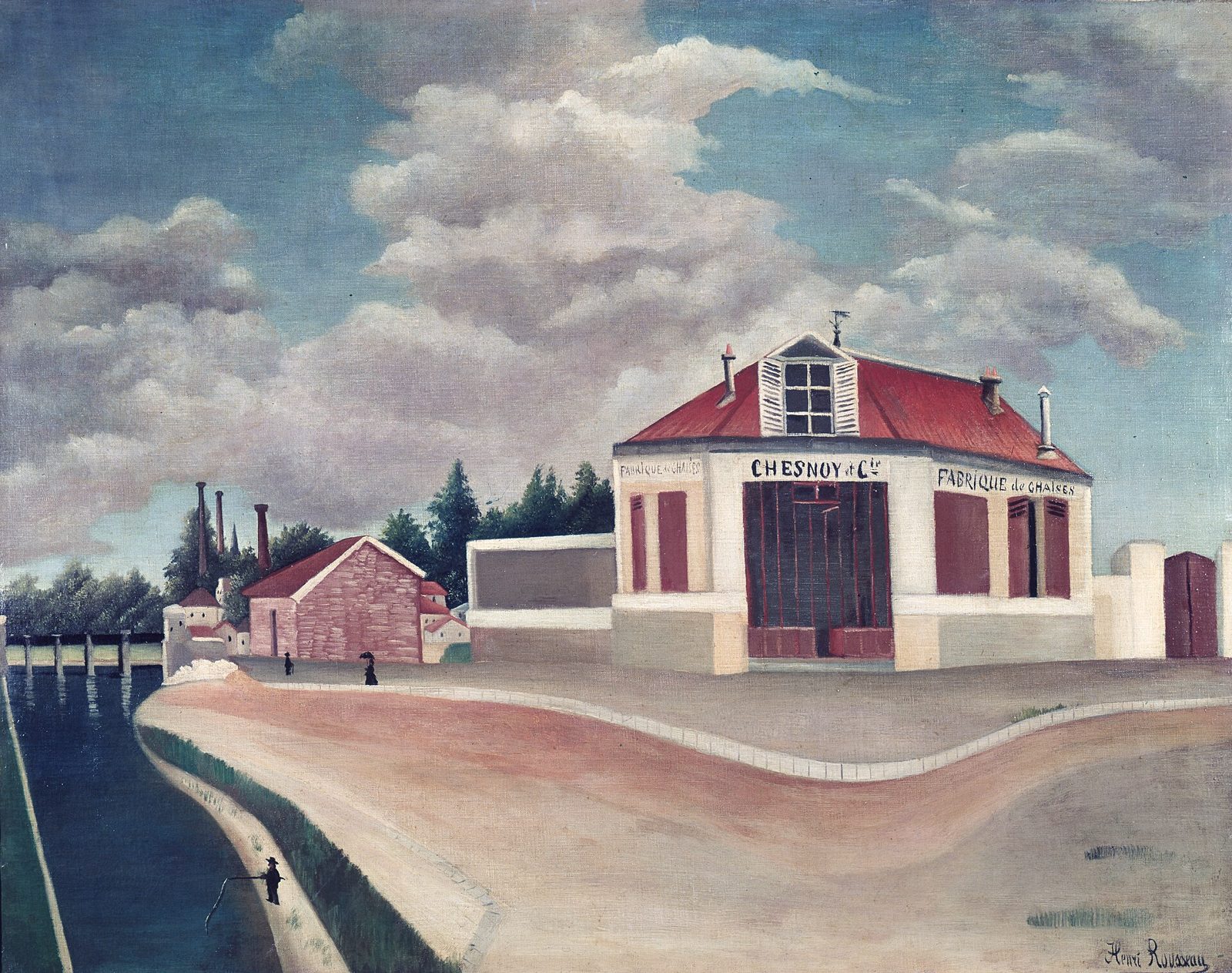
La fabrique de chaises à Alforville
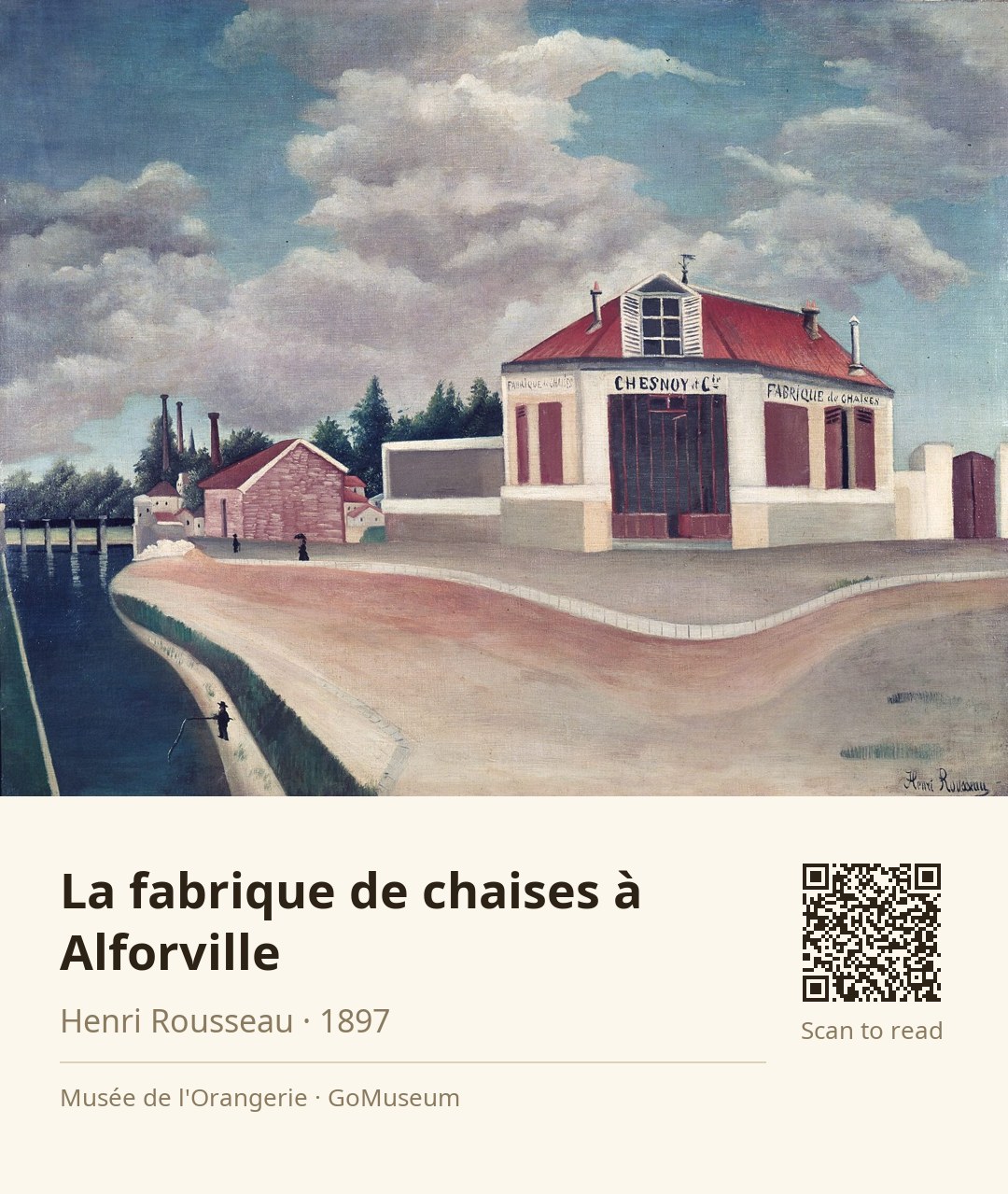
🎧 This work has audio narration — listen in the appAlfortville, on the outskirts of Paris, is where this painting takes us, and the sign on the white wall tells you exactly what happens inside: "Fabrique de chaises," a chair factory, run under the name "Chesnoy et Cie." Rousseau paints it in flat, even colour, the way a sign-painter might, and the lettering is as much a part of the picture as the road curving toward you.
Look at the building on the right. These are the things the picture gives you: a working district beside the Seine, where the factory is one ordinary feature among the trees, the chimneys and the quiet riverbank. Rousseau did not make the factory grand or the workers heroic. He set them down with the same care he gave the grass and the clouds, which is part of what makes the scene feel so unusual for its time.
Rousseau was a customs officer, a clerk for the Paris octroi, the city's tax office that collected duties on goods entering the capital. That job earned him the nickname "Le Douanier," and it is the name that stayed with him. He taught himself to paint, and he did so in his forties, after years of work in offices and in the army.
This canvas, dated 1897, belongs to the same years in which he was still treated with suspicion by critics who saw his work as the clumsy effort of a Sunday painter.
Henri Rousseau, born on May 21, 1844, in Laval, France, was a self-taught painter who became a pivotal figure in the Naïve art movement. Known as "Le Douanier" due to his job as a customs officer, he began painting seriously in his forties after a modest life marked by early hardship and family responsibilities. Despite facing ridicule from critics during his lifetime, Rousseau's unique style, characterized by vivid colors and dreamlike jungle scenes, garnered a devoted following.
His works, inspired by visits to the Natural History Museum and botanical gardens in Paris, often depicted fantastical landscapes, despite his never having traveled outside France. He exhibited regularly at the Salon des indépendants, where his painting "Surprised!" received acclaim from fellow artists, including Félix Vallotton. By the end of his life, Rousseau was celebrated by avant-garde figures like Pablo Picasso, who recognized his genius and honored him with a banquet in 1908.
Rousseau's influence on modern art is profound, impacting generations of artists, including the Surrealists and the Fauves. His legacy endures as a testament to the power of imagination and the beauty of simplicity in art. He passed away on September 2, 1910, in Paris, leaving behind a body of work that continues to inspire and captivate audiences worldwide.
This one has a clear paper trail. It is dated 1897, and the material records that it passed to Guillaume Paul, who owned it in 1931. After that it moved through Mme Vve Jean Walter's hands. It was shown in a long run of exhibitions: first at the Marie Harriman gallery in New York in 1931, then at the Kunsthalle in Basel in 1933, the Gazette des beaux-arts show in Paris in 1935, the Paul Rosenberg gallery in Paris in 1937, the Kunsthaus in Zurich the same year, the Charpentier gallery in 1950, and the Charpentier gallery again in 1961. The painting is about 73 by 92 centimetres.
Rousseau's own working life overlapped with this picture. The material says he was appointed a collector of the Paris octroi, the city tax office that charged on goods coming into the capital, in 1871, and that he retired from it in 1893 to paint full-time.