The clouds
🎧 Free preview: one of 5 works you can listen to here in full.
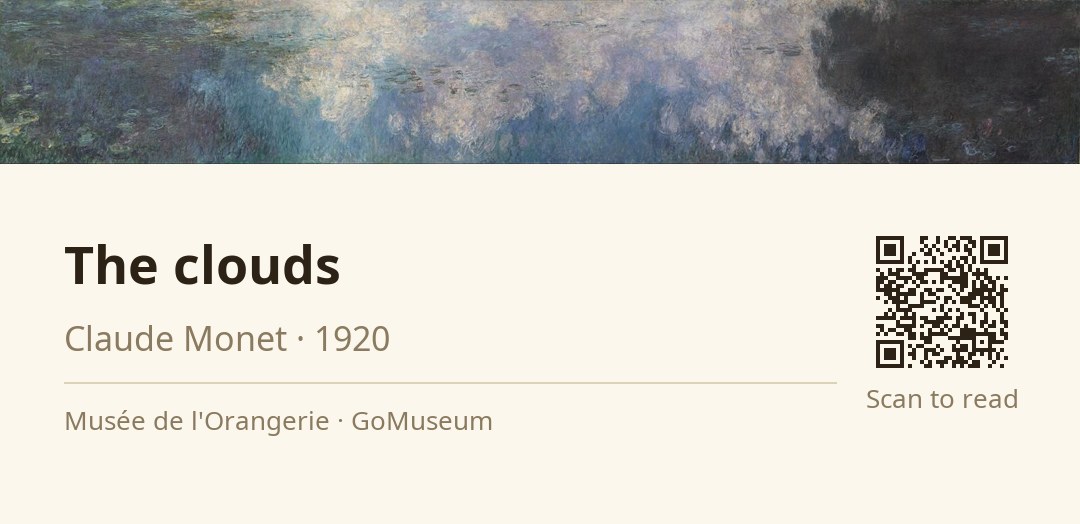
Take a moment to really look at "The Clouds" by Claude Monet. Notice how the soft, billowing forms seem to dance across the canvas, almost as if they’re alive. The way the light filters through those clouds creates a stunning interplay of colors—pinks, blues, and whites that blend seamlessly together.
These details matter because they capture Monet's fascination with light and atmosphere, a hallmark of his Impressionist style. He wasn’t just painting clouds; he was expressing a fleeting moment in time, the essence of nature as he perceived it. Monet believed that the beauty of the world was found in its transience, and here, he invites you to experience that ephemeral quality.
Created in 1920, this work reflects Monet's later years, a time when he was deeply immersed in exploring the effects of light and color. Living in Giverny, he often painted en plein air, capturing the changing skies above his beloved gardens.
So, as you stand here, think about the clouds above you right now. How do they compare to Monet's vision? What feelings do they evoke in you? Let that connection linger as you continue your journey through this incredible collection.
Oscar-Claude Monet, born on November 14, 1840, in Paris, was a pioneering French painter and a founder of Impressionism, a movement that transformed the art world. Raised in Le Havre, he developed a passion for nature and painting early on, encouraged by his mother, while his father hoped he would pursue a business career. After his mother's death in 1857, Monet moved in with his aunt, who supported his artistic ambitions.
Monet's career began with caricatures, but he soon sought formal training, studying under Eugène Boudin, who introduced him to plein air painting. His breakthrough came in 1866 with "La Femme à la robe verte," which garnered attention at the Salon. The term "Impressionism" originated from his work "Impression, Sunrise," exhibited in 1874, marking a shift away from traditional art.
Throughout his life, Monet focused on capturing the essence of light and color in nature, creating series of paintings that depicted the same scenes under varying conditions, such as his famous haystacks and water lilies. He settled in Giverny in 1883, where he cultivated a beautiful garden that became his muse. Despite personal hardships, including the loss of loved ones and health issues, Monet's relentless dedication to his craft solidified his place in art history as a master of modernism, influencing countless artists and leaving a lasting legacy. He died on December 5, 1926, in Giverny, celebrated as one of the most significant figures in art.
In 1920, Claude Monet painted 'The Clouds' during a period when he was deeply engaged in exploring light and color. This work was created in Giverny, where Monet had established a beautiful garden and a water-lily pond that became central to his later works. The painting reflects his ongoing fascination with the ephemeral qualities of nature. Monet's later years were marked by a struggle with cataracts, which affected his vision and ultimately his work. Despite this, he continued to paint, capturing the essence of the world around him.
Take a closer look at how Monet's brushwork in 'The Clouds' creates a sense of movement and fluidity. The strokes are loose and expressive, allowing the colors to blend and swirl together, mimicking the natural flow of the sky. Notice how he uses a lighter palette, with soft pinks and blues that evoke a serene atmosphere. The composition is open and airy, drawing your eye across the canvas and inviting you to linger on the subtle transitions of light. Monet's technique of layering paint creates depth, making the clouds appear almost three-dimensional. This approach not only captures the moment but also invites you to feel the changing light, as if you are standing beneath the very sky he painted. It's a testament to his dedication to plein air painting, where he sought to encapsulate the fleeting beauty of nature in real-time.
Did you know that Monet's fascination with clouds was so intense that he often painted the same scene multiple times just to capture their ever-changing forms? This relentless pursuit of light and atmosphere led him to create a series of cloud studies, showcasing his unique ability to convey the ephemeral nature of the sky. It's a testament to how deeply he engaged with the world around him, turning something as simple as clouds into a profound exploration of perception and beauty.