The Water Lilies - Tree Reflections
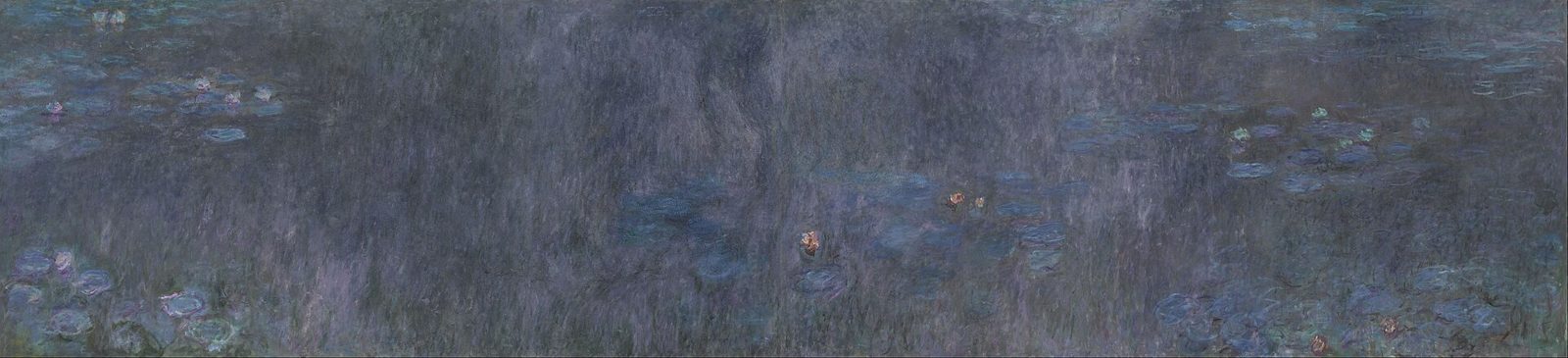
🎧 This work has audio narration — listen in the appTake a moment to really absorb the scene before you in Monet's "The Water Lilies - Tree Reflections." Notice how the water's surface shimmers with dappled light, almost as if it's alive. Look closely at the way the trees are mirrored in the pond, their branches stretching out like fingers reaching for the sky.
These reflections are not just pretty details; they capture Monet's fascination with light and its ability to transform the ordinary into something extraordinary. This painting, created in 1920, is a testament to his lifelong pursuit of depicting nature as he experienced it, where every ripple and shadow tells a story of the moment.
Monet spent the last two decades of his life in Giverny, where he cultivated his garden and created this series of water lily paintings. They represent not only his artistic evolution but also his deep connection to the landscape around him.
As you stand here, think about how Monet's work invites you to see the world through his eyes. What feelings or memories does this tranquil scene evoke for you?
Oscar-Claude Monet, born on November 14, 1840, in Paris, was a pioneering French painter and a founder of Impressionism, a movement that transformed the art world. Raised in Le Havre, he developed a passion for nature and painting early on, encouraged by his mother, while his father hoped he would pursue a business career. After his mother's death in 1857, Monet moved in with his aunt, who supported his artistic ambitions.
Monet's career began with caricatures, but he soon sought formal training, studying under Eugène Boudin, who introduced him to plein air painting. His breakthrough came in 1866 with "La Femme à la robe verte," which garnered attention at the Salon. The term "Impressionism" originated from his work "Impression, Sunrise," exhibited in 1874, marking a shift away from traditional art.
Throughout his life, Monet focused on capturing the essence of light and color in nature, creating series of paintings that depicted the same scenes under varying conditions, such as his famous haystacks and water lilies. He settled in Giverny in 1883, where he cultivated a beautiful garden that became his muse. Despite personal hardships, including the loss of loved ones and health issues, Monet's relentless dedication to his craft solidified his place in art history as a master of modernism, influencing countless artists and leaving a lasting legacy. He died on December 5, 1926, in Giverny, celebrated as one of the most significant figures in art.
Monet's "The Water Lilies - Tree Reflections" was created in 1920, during the final years of his life. This period was marked by both personal and artistic challenges, as Monet struggled with deteriorating eyesight due to cataracts. Despite this, he continued to paint, driven by his passion for capturing the beauty of his garden in Giverny. The painting was part of a series that Monet dedicated to the water lilies, a subject he had explored extensively. The work reflects his deep connection to the landscape he cultivated and loved. Monet's garden was not just a backdrop; it was a living canvas that inspired him daily. The painting was likely shown in various exhibitions during his lifetime, garnering admiration for its innovative approach to light and color. Monet's work was well-received, and he became a celebrated figure in the art world, influencing countless artists who followed in his footsteps. The provenance of this piece remains closely tied to Monet himself, as he was deeply involved in its creation and presentation.
As you gaze at "The Water Lilies - Tree Reflections," pay attention to the way Monet employs color and light to create a sense of movement and depth. The brushwork is both loose and deliberate, with quick strokes that seem to dance across the canvas. This technique captures the fleeting quality of light as it reflects off the water's surface. Notice how the vibrant greens and blues intermingle, creating a shimmering effect that draws your eye across the painting. The composition is carefully structured; the trees are positioned to frame the water, guiding your gaze to the reflections below. Monet's choice of scale, with the expansive dimensions of the canvas, invites you to immerse yourself in the scene, almost as if you are standing at the edge of the pond. This approach not only showcases his mastery of color but also his desire to evoke an emotional response, making the viewer feel the tranquility and beauty of nature.
Did you know that Monet's fascination with water lilies wasn't just about their beauty? This painting, 'The Water Lilies - Tree Reflections,' is one of the many he produced during his later years, where he experimented with light and reflection, capturing the essence of nature as he saw it. It’s a testament to his relentless pursuit of capturing the fleeting moments of beauty in the world around him.
Monet's brushwork in 'The Water Lilies - Tree Reflections' is characterized by quick, loose strokes that create a sense of movement and capture the fleeting quality of light on the water's surface.
Monet's garden in Giverny was not just a setting; it was a living canvas that he meticulously cultivated, providing endless inspiration and serving as the primary subject for many of his most famous works, including the water lily series.