 Image: Deror avi
Pommes et poires
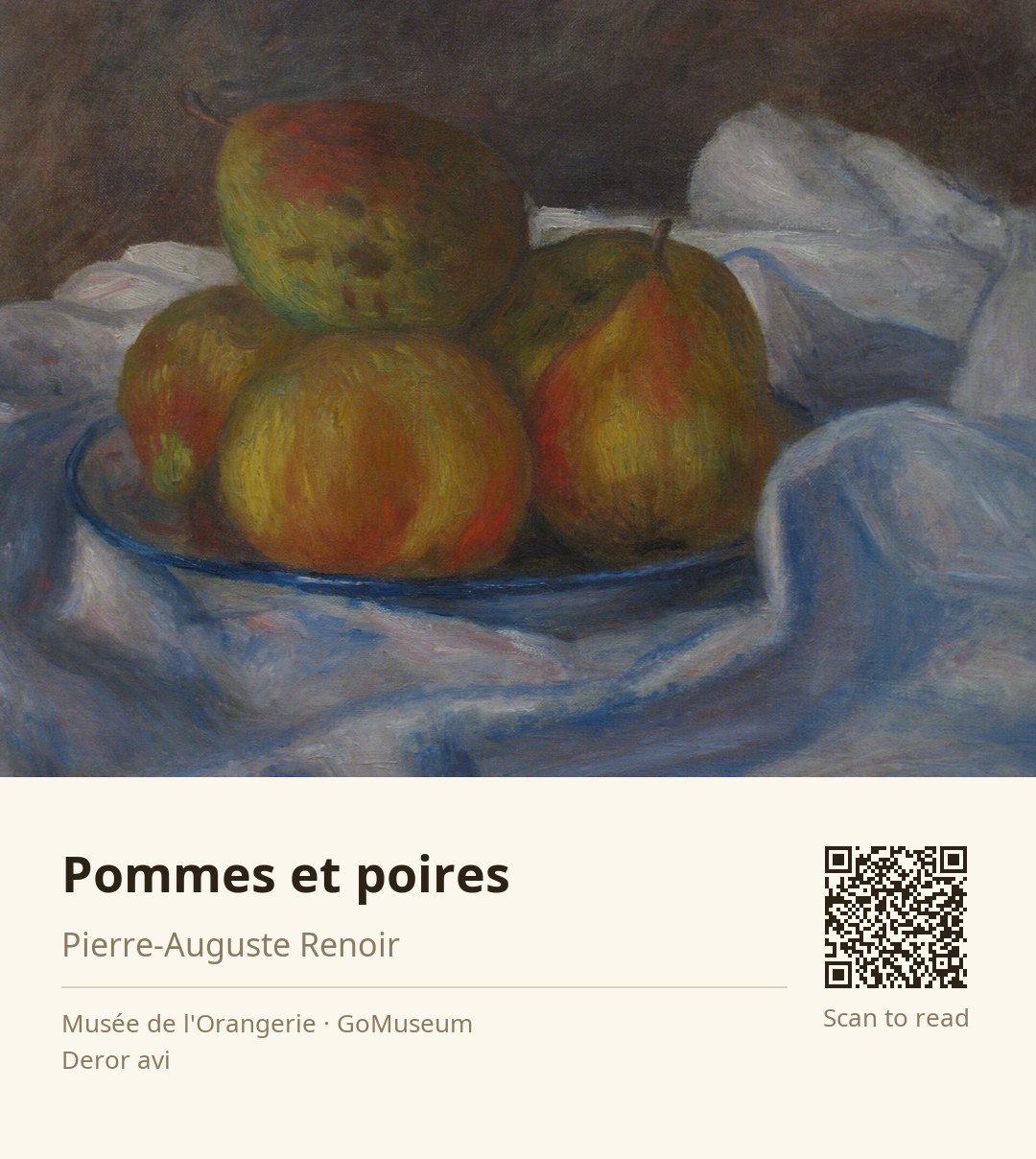
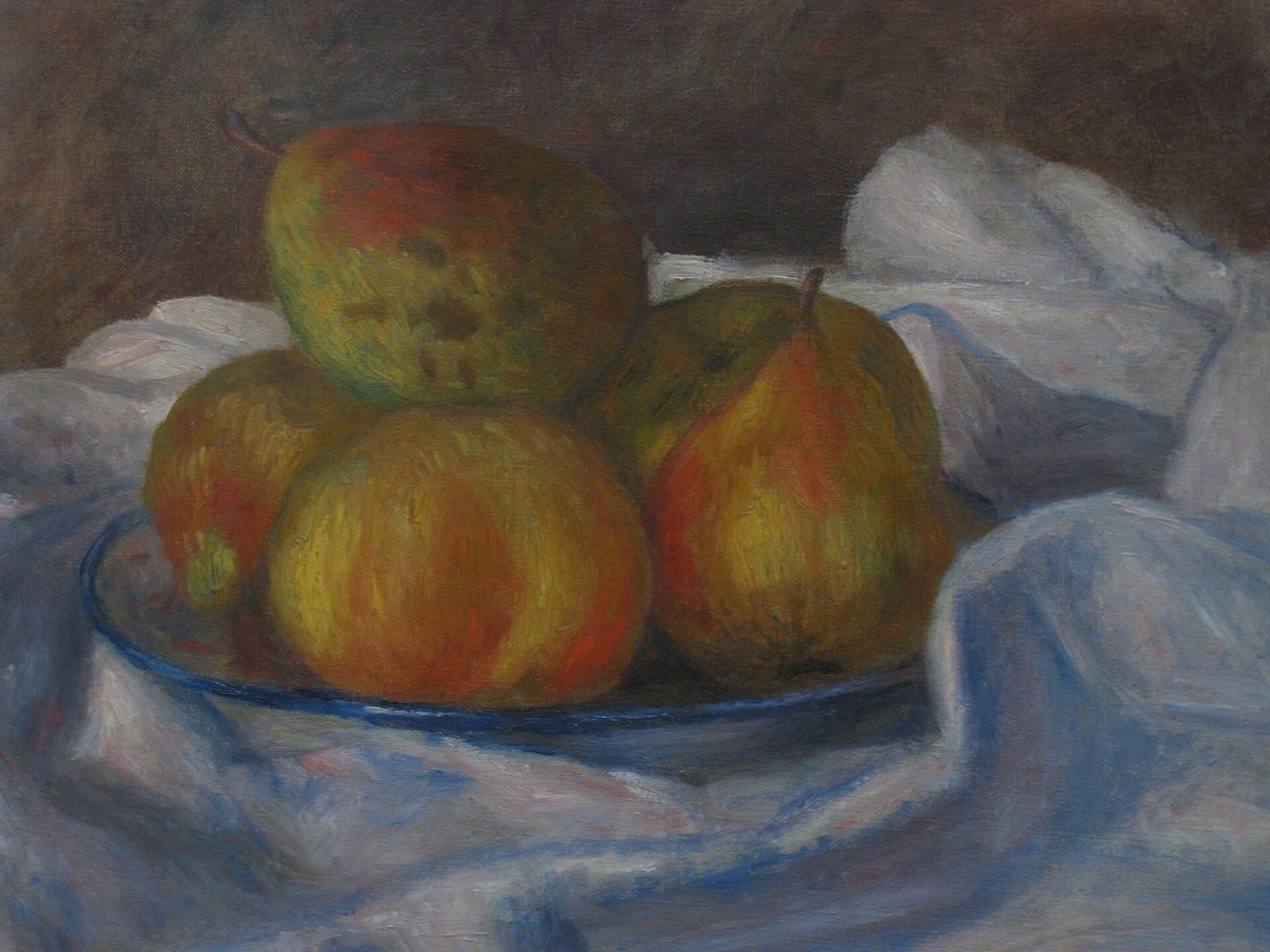
🎧 This work has audio narration — listen in the appHeaped on a shallow plate with a thin blue rim sits a tumble of apples and pears, and the whole pile seems to lean toward you. At the top, a large pear with a curved stem catches the light, its yellow-green skin flushed with red and speckled with dark brown spots. Two apples sit below it, and at the right a smaller pear stands upright on its stem, its colors a mix of yellow, olive and orange with patches of red.
Look at what the fruit rests on: a heavily folded white cloth, painted in blues, lavenders and soft pinks, its folds rising into soft mounds on the right. Those folds do a lot of work. Renoir has let them fill the foreground and sides of the canvas, so the fruit seems to sit in a nest of fabric rather than on a bare table, and the cloth's cool tones make the warm fruit glow. Notice too that the paint itself is applied in short, visible strokes, thicker on the fruit and cloth, while the weave of the canvas shows through the dark brown background. The surface is alive with brushwork, and the effect is less a polished illusion than a record of the hand that made it.
The painting is a still life, a subject Renoir treated far less often than the portraits and figures for which he became famous, and it belongs to the last quarter of the nineteenth century. It passed through the artist's own collection, and by 1919, the year of his death, it was in the hands of the dealer Ambroise Vollard, who handled many of Renoir's works. Later owners included Paul Guillaume and, finally, Madame Veuve Jean Walter. The painting entered the museum's collection under the inventory number RF 1963-19, and it appears in the 1990 catalogue raisonné of Renoir's work by Hoog.
Pierre-Auguste Renoir, born on February 25, 1841, in Limoges, France, emerged as a pivotal figure in the Impressionist movement. His early life in a modest family led him to Paris, where he honed his artistic skills amidst the masterpieces of the Louvre. Initially apprenticed in a porcelain factory, Renoir's passion for painting flourished, particularly after studying under Charles Gleyre, where he befriended fellow artists like Monet and Sisley.
Renoir's work celebrated feminine beauty and vibrant social scenes, exemplified in iconic pieces like "Dance at Le Moulin de la Galette." Despite facing criticism early on, he gained recognition, especially after participating in the first Impressionist exhibition in 1874. His style evolved over the years, transitioning towards realism influenced by classical masters like Raphael.
Throughout his life, Renoir balanced personal struggles, including health issues, with a prolific output, reportedly creating around four thousand works. He became a beloved figure in art history, known for his warm palette and expressive brushwork. Renoir passed away on December 3, 1919, leaving a legacy that continues to inspire artists and art lovers alike.
The canvas is an oil on canvas, and the record gives its size as 32 by 41 (centimetres). The fruit is grouped at the centre, with the white cloth taking up the foreground and both sides, so the pile sits on fabric rather than bare wood. Behind the cloth the ground is a dark, muted brown, and the canvas weave shows through there, which makes that dark area feel thinner and more open than the thick paint on the fruit. Paint is laid on in short, visible strokes, heavier on the fruit and the cloth, so the surface reads as worked rather than smooth.
The record notes that the work came to the museum with the inventory number RF 1963-19, and that it appears in the 1990 catalogue raisonné of Renoir's work by Hoog as number 86. The painting's chain of ownership begins with the artist himself, who held it in his own collection by 1919.