 Image: Marie-Lan Nguyen
Panathenaic Amphora
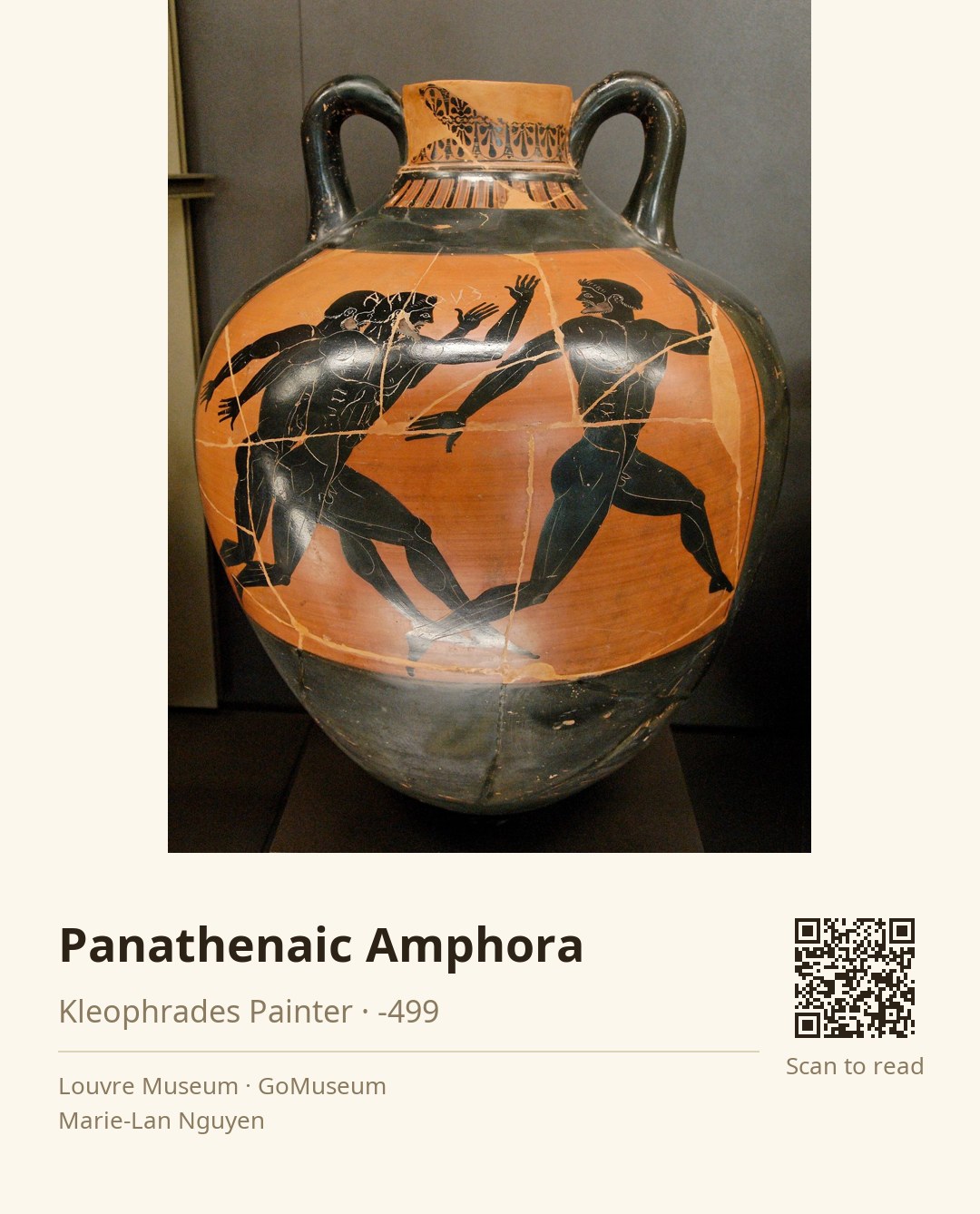
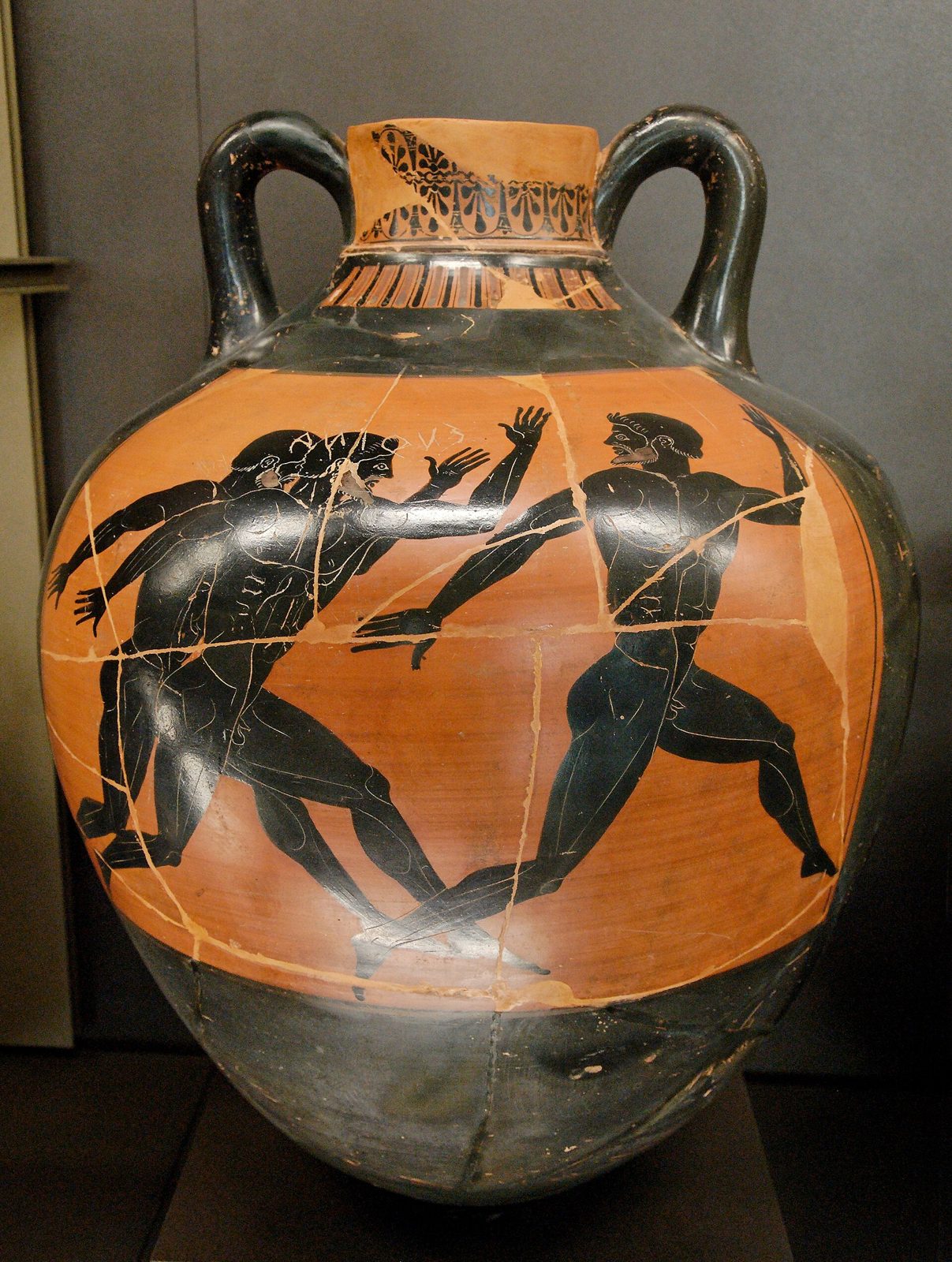
Three naked runners stream left across an orange-red panel on this jar, their bodies cut in dark silhouette, with the lines of their muscles and beards scratched into the black with a point. Look closely at the figure at right: his legs cross as he strides, and one arm reaches forward with the hand held open. Those incised lines and that open hand are the painter's signature touches, the way he turns a simple outline into a body in motion.
The shoulder, handles and lower body stay glossy black, while the neck carries a band of palmettes and lotus-like ornament set on orange. Its surface now shows thin cracks and scattered losses, because the vessel was reconstructed from fragments.
The painter behind this work is known today only as the Kleophrades Painter, a name given by the scholar John Beazley in 1910 after an inscription on a cup in Paris. A later pelike bearing the name Epiktetos led scholars to rename him Epiktetos II, but in 1981 John Boardman showed that the signature on that cup was a modern forgery, and the painter returned to anonymity. Working in Athens around 510 to 470 BC, he is thought to have trained under the painter Euthymides and to have been the son of the potter Amasis. Beazley's catalogue counts about 113 vases attributed to him directly, and many of his large vessels were found in Italy, especially at Vulci, suggesting they were made for export.
The Kleophrades Painter was an anonymous Athenian vase painter, active roughly between 510 and 470 BC, whose work is regarded as among the finest of the red-figure tradition. The name was coined in 1910 by the classicist John Beazley, taken from a potter's inscription "Kleophrades" on a cup now in Paris. Later a pelike in Berlin bore the signature of the painter Epiktetos, and for a time he was called Epiktetos II, but in 1981 John Boardman showed that this signature was a modern forgery, so the painter returned to anonymity. Scholars think he was the son of the potter Amasis and a pupil of Euthymides, since his earliest works closely resemble his master's. He in turn trained pupils, among them the Berlin Painter and the Boot Painter.
His craft was marked by strong draughtsmanship and vigorous, well-proportioned figures. He worked mainly on large vessels, especially calyx kraters, hydriai, Panathenaic amphorae, and neck amphorae, and most of his surviving pots were found in Italy, particularly at Vulci in Etruria, suggesting that many were made for export. His early pieces still show black-figure borders and patterns, which gradually gave way to red-figure decoration until his later work was fully red-figure. He is recognized above all through his faces, with long, slender eyes, strong chins, and a distinctive rendering of the inner ear. His Panathenaic amphorae, some of which served as prizes, can be identified by features such as Pegasus on Athena's shield and the placement of her spear. Through the Boot Painter and the Troilos Painter, his influence reached well beyond his own workshop, securing his place among the great pot painters of late Archaic Athens.
Yes, he sometimes used white ground, but only as a secondary technique within his black-figure work.