 Image: Manner of the Antiphon Painter
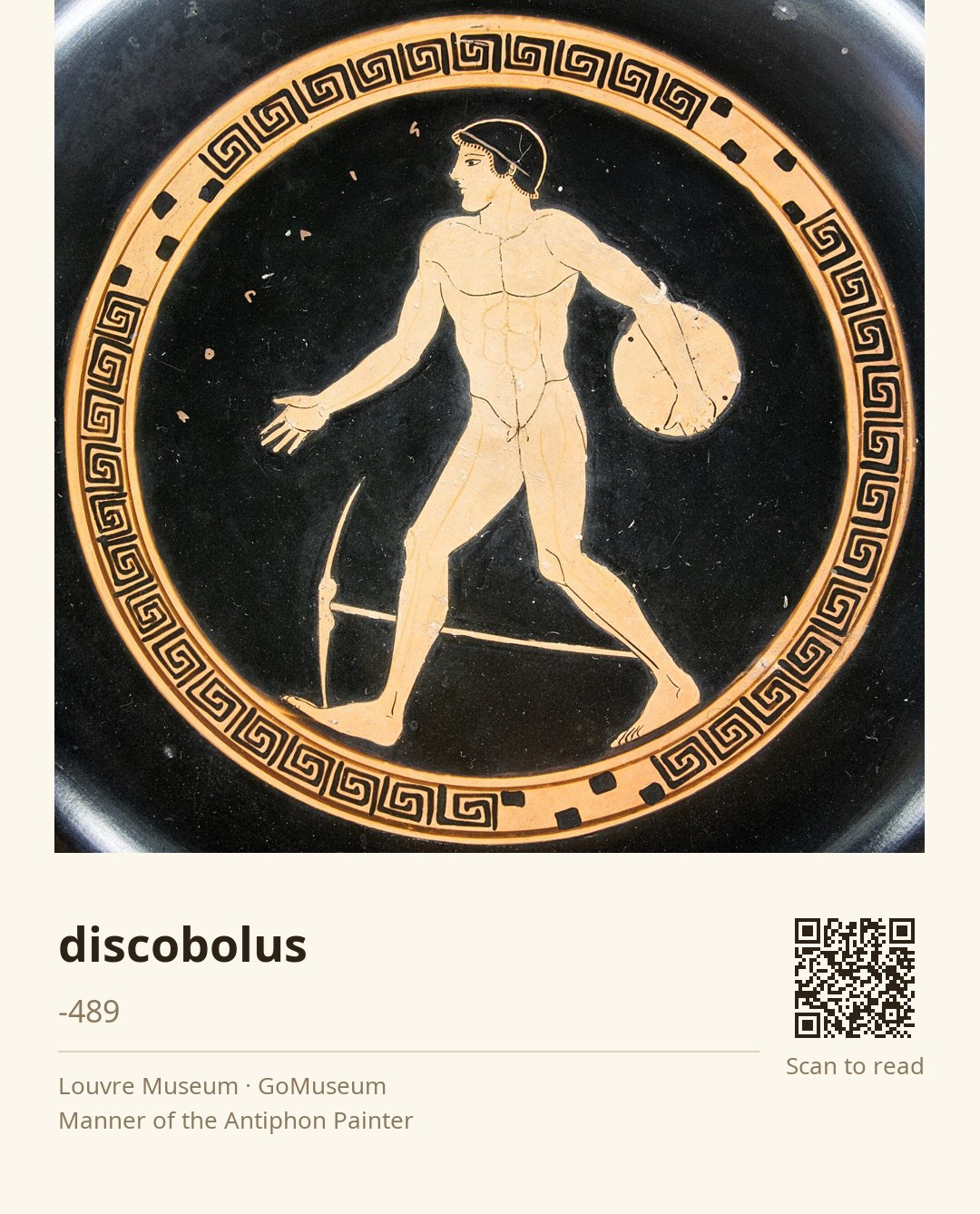
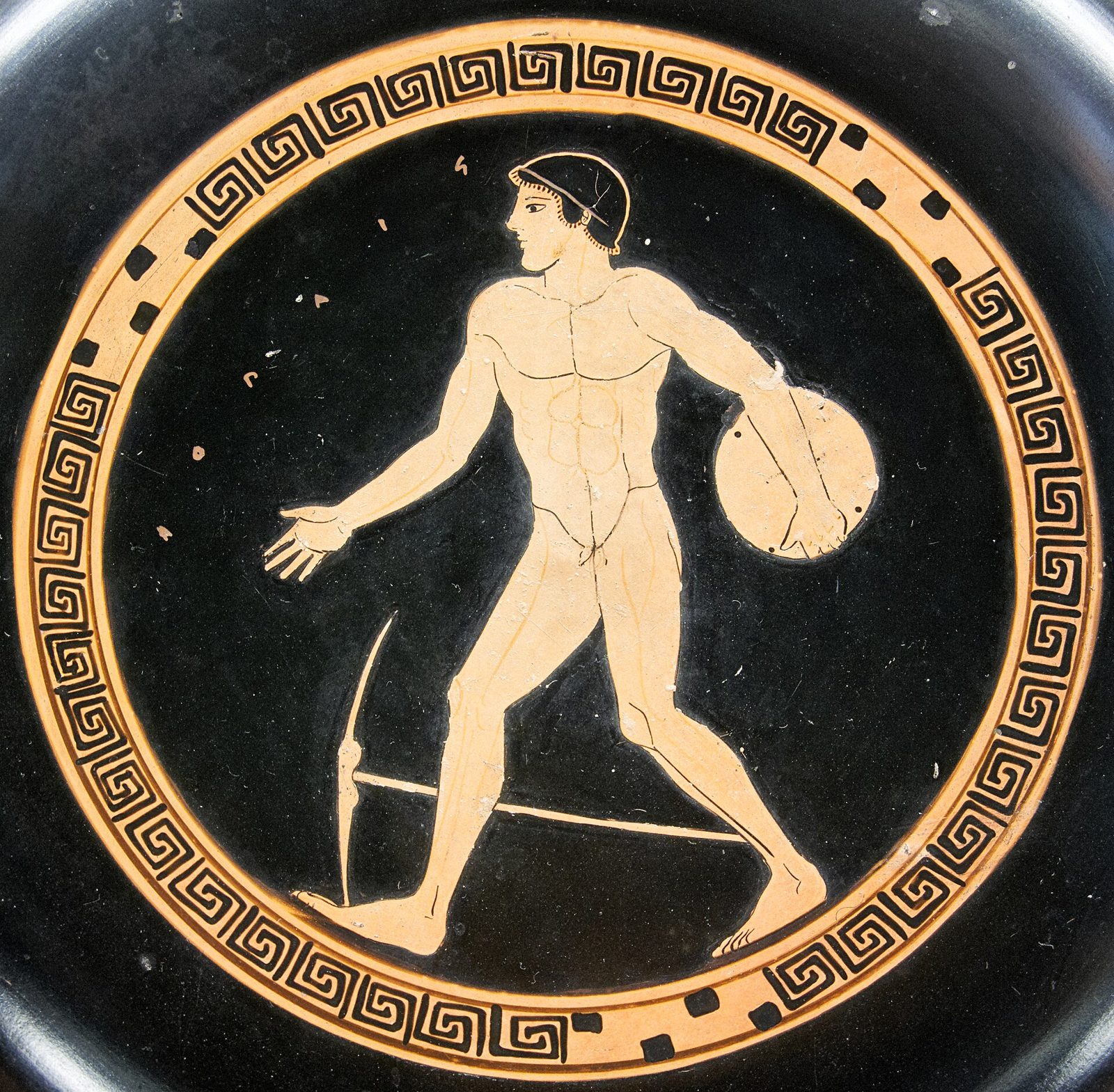
A young man, nude and in profile, strides across the inside of this shallow bowl with a flat disc pressed against his hip, his open left palm stretched out in front of him.
Look closely at the small things. The fine incised lines that map his chest, belly and legs are drawn directly into the surface, and a close-fitting dark cap sits on his head, held in place by a thin band. Along the lower left, a slender pole or bow-like shape runs beneath his feet beside a curved upright stroke, and a ring of meander pattern frames the whole picture, with a few black dots breaking its rhythm at the upper left and lower right. Near his head there are a handful of tiny marks that may be letters, though they are too faint to read.
What the material offers is a clear picture of how this bowl was made rather than a full story of its maker or first owners. It is a red-figure piece from around 489 BCE, and the decorative arts category places it among objects meant for use and display. The figure's pose, with the weight carried through the legs and the arm reaching out, shows how precisely the painter drew the human form using thin lines and the contrast of clay against slip.
Here's the thing about this bowl: the man is the color of the clay itself, left bare, while everything around him has been covered in glossy black. The lines that map his chest, belly and legs are fine and drawn into the surface, and the painter used thinned glaze lines to pick out the body. So what you're really looking at is the bare clay, shaped by a line, with the dark ground pressed around him like a shadow.
The material notes that the figure is rendered in the orange-tan colour of the clay against a glossy black ground, so the body stands out as unpainted clay. The source does not give a reason for this choice.
The marks may be letters, but they are too faint to read, so their meaning is unknown from the material available.
The material describes them only as a slender pole or bow-like shape and a curved vertical stroke, without identifying what they represent.