Joan of Arc at the Coronation of Charles VII
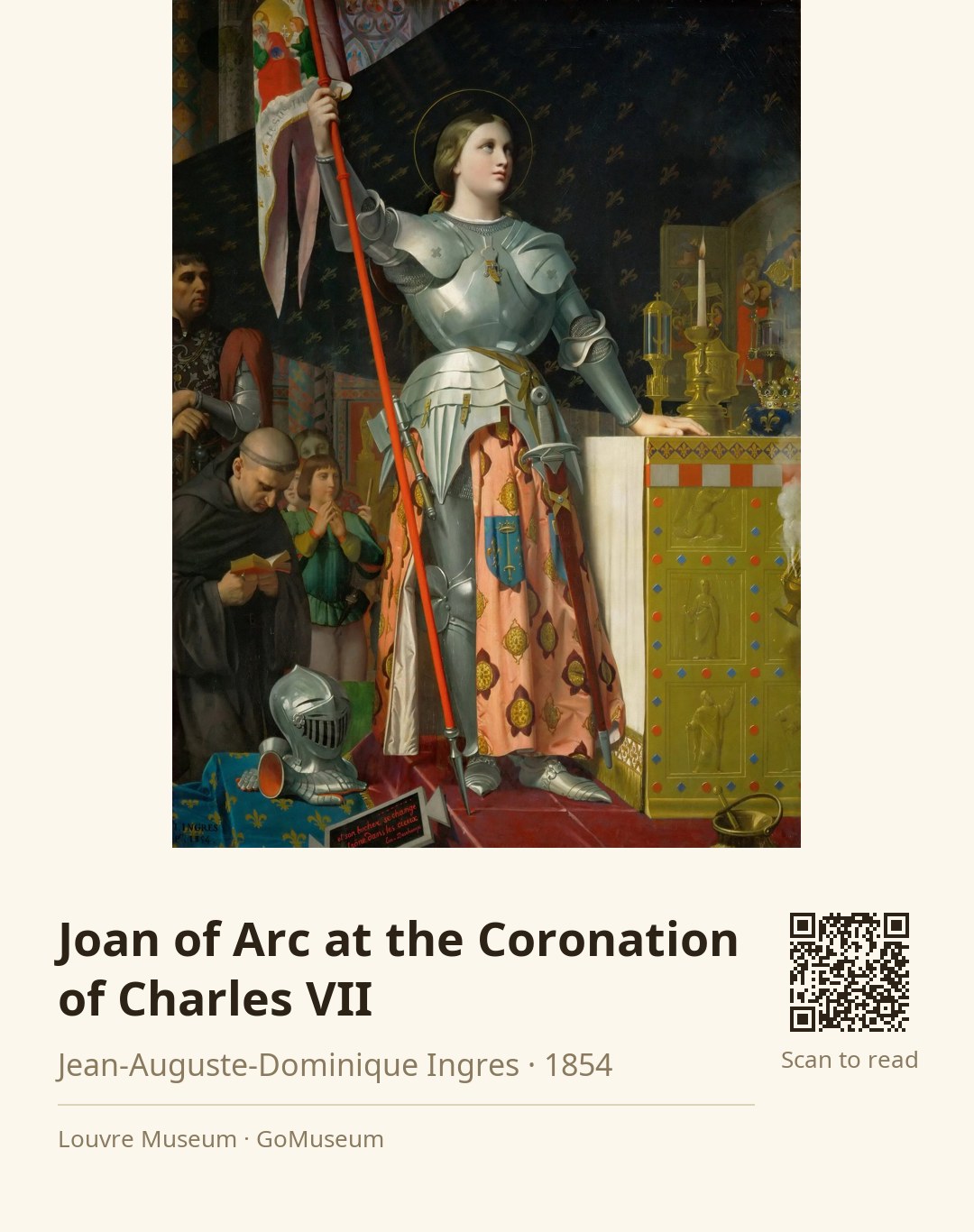
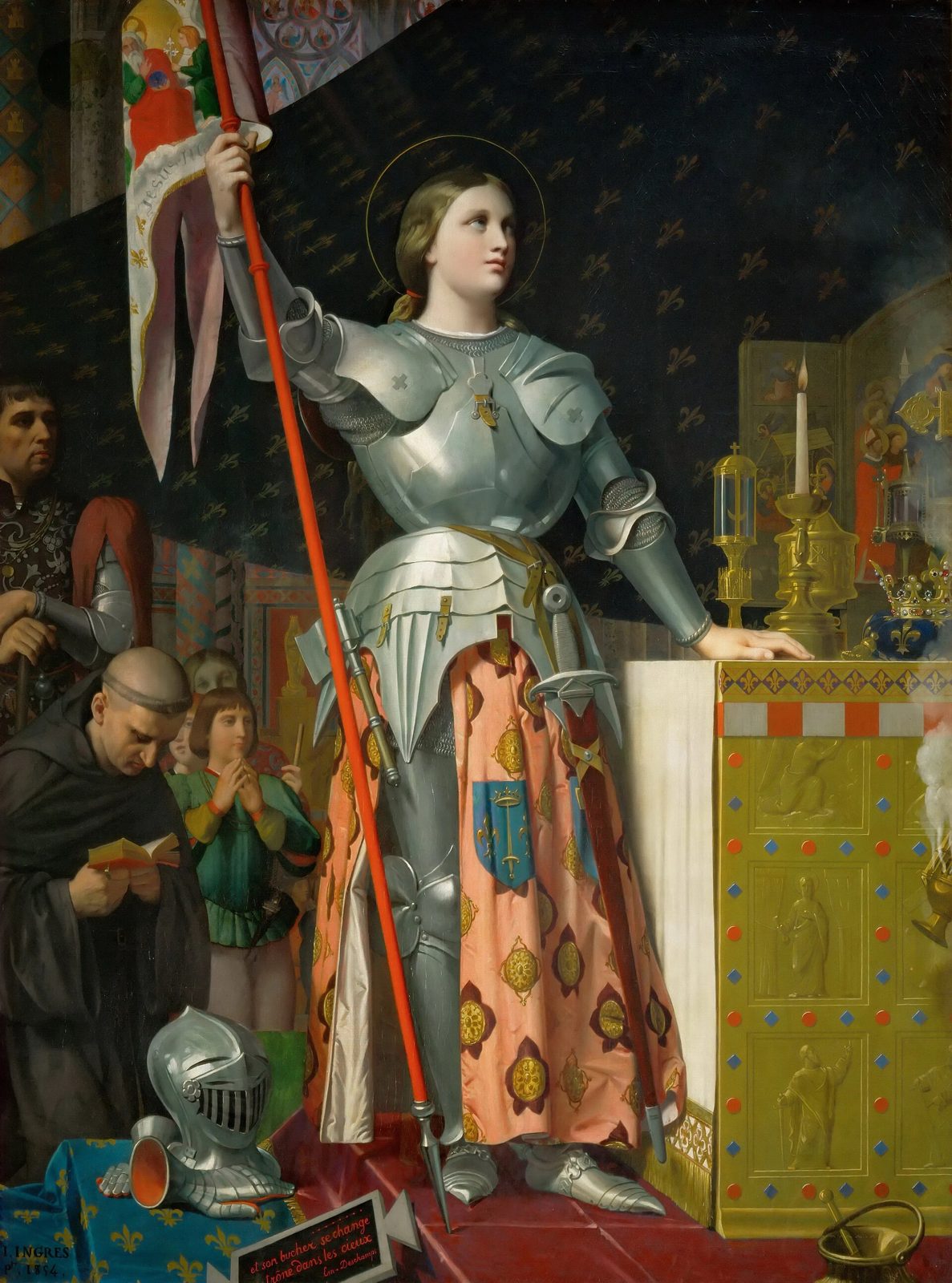
🎧 This work has audio narration — listen in the appTake a moment to really soak in the scene before you. Here stands Joan of Arc, her gaze lifted toward the heavens, embodying a moment of triumph at the coronation of Charles VII. Notice the intricate details of her armor, the way it glimmers under the ambient light, and the rich colors that seem to pulse with life.
These elements aren’t just for show; they symbolize her strength and divine mission. Ingres, the artist, was deeply influenced by the Neoclassical style, and here, he merges that with a troubadour flair, creating a visual narrative that speaks to both history and emotion. Joan’s victorious expression captures the spirit of a nation reborn, a powerful reminder of her role in uniting France during a tumultuous time.
Created in 1854, this painting was commissioned to celebrate Joan’s legacy, reflecting the 19th-century fascination with national heroes. Ingres, who had a penchant for historical subjects, chose this moment to highlight the intersection of faith and patriotism, a theme that resonated deeply in post-revolutionary France.
As you stand here, consider what Joan represents to you. Is it courage, faith, or perhaps the idea of fighting for a cause greater than oneself? Let her story linger in your mind as you move through the museum.
Jean-Auguste-Dominique Ingres was a pivotal figure in French Neoclassicism, born on August 29, 1780, in Montauban. He was the son of a versatile artist, which nurtured his early artistic inclinations. Ingres studied under Jacques-Louis David in Paris, where he developed a commitment to academic traditions, aspiring to elevate history painting above all genres. His early career was marked by struggles, as critics dismissed his style as archaic, yet he persevered, achieving recognition with works like "The Vow of Louis XIII" in 1824.
His portraits, characterized by expressive distortions, became his most celebrated contributions, influencing modern artists such as Matisse and Picasso. Ingres's time in Italy, from 1806 to 1824, was crucial; he immersed himself in the study of Renaissance masters, which shaped his distinctive style. Despite facing criticism for his meticulous approach, he remained steadfast in his vision of beauty, emphasizing drawing over color.
Later in life, he returned to Paris, where he continued to create significant works, including "The Turkish Bath." Ingres's legacy endures as a bridge between classical traditions and modern art, embodying the tension between adherence to established norms and the evolving landscape of artistic expression. He passed away on January 14, 1867, leaving behind a profound impact on the art world.
In 1851, the French state commissioned Jean-Auguste-Dominique Ingres to create a painting celebrating Joan of Arc, offering him a substantial sum of 20,000 francs. Instead of starting anew, Ingres opted to complete two existing works, one of which was this very painting. His earlier engagement with Joan's image dates back to the 1840s when he created a wash drawing that served as a model for an engraving. The final piece, completed in 1854, depicts Joan at the coronation of Charles VII in Reims Cathedral, a moment she believed was divinely ordained. The painting was first shown at the 1855 Exposition Universelle, gaining recognition and later moving through prestigious locations like the Palace of Versailles and the Musée du Luxembourg before finding its permanent home in the Louvre. Ingres even included a self-portrait as a servant in the scene, adding a personal touch to this historical narrative.
As you gaze at this painting, notice how Ingres masterfully blends light and color to create a sense of divine illumination surrounding Joan. The ambient light bathes her in a soft glow, enhancing her victorious expression and the intricate details of her armor. Ingres employed a technique of layering colors, allowing the rich hues to resonate with life. The composition is carefully structured, with Joan centrally positioned, drawing your eye upward to her gaze toward the heavens. The figures surrounding her, including the monk and pages, are arranged to create a sense of depth and reverence, guiding your focus back to her. The brushwork feels both precise and fluid, reflecting the Neoclassical influence of his mentor, Jacques-Louis David, while also infusing a troubadour flair that adds emotional weight to the scene.
Interestingly, Ingres' painting inspired a modern caricature by Michael Leonard in 1980, which depicted Margaret Thatcher as Joan of Arc. This playful reinterpretation highlights how Ingres' work continues to resonate in contemporary culture, bridging historical art with modern political commentary.
Ingres included a self-portrait as a servant in the scene, which adds a unique personal touch to the historical narrative. This choice reflects his desire to connect himself with the momentous event he was depicting.