Landscape with a Traveler
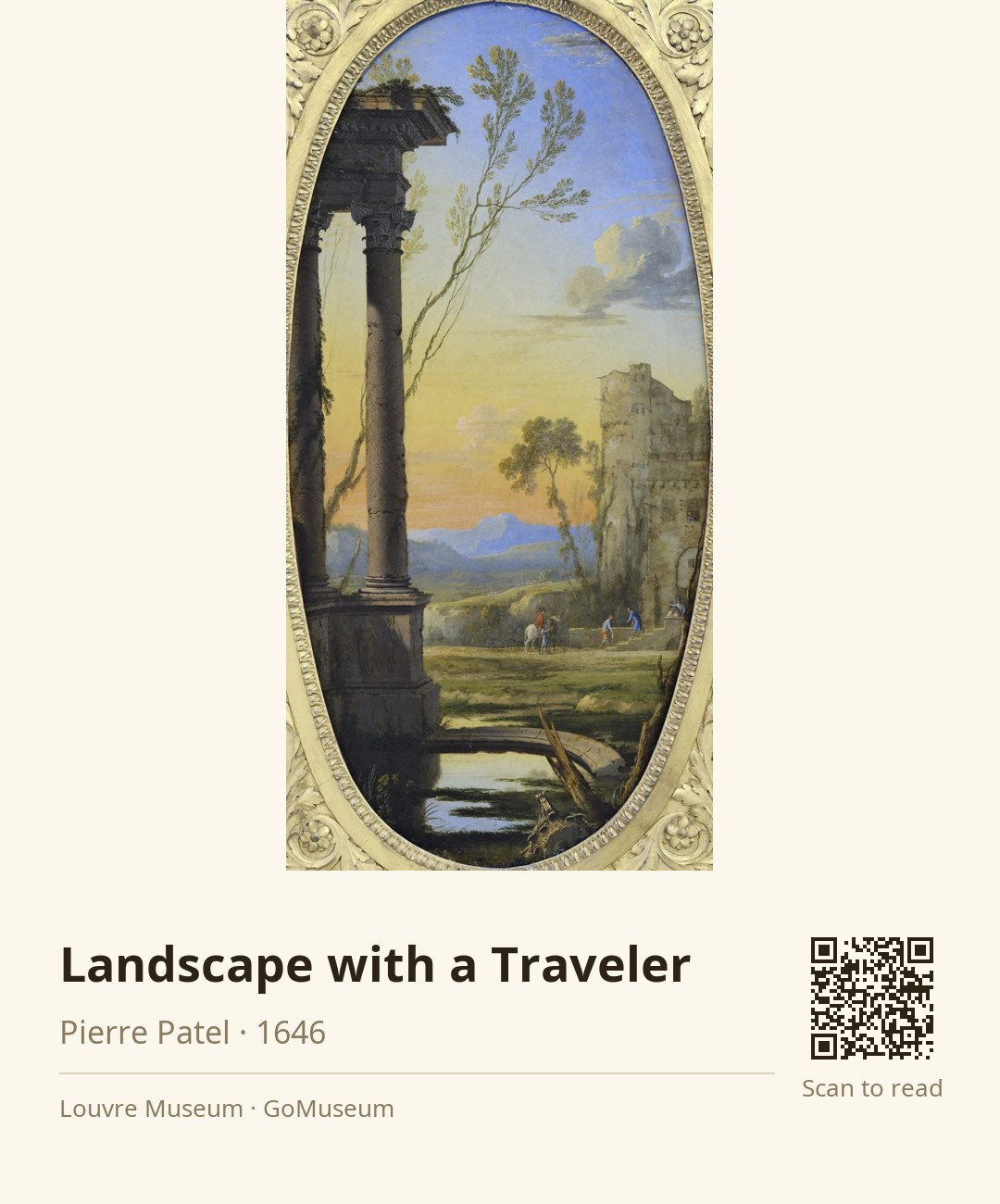
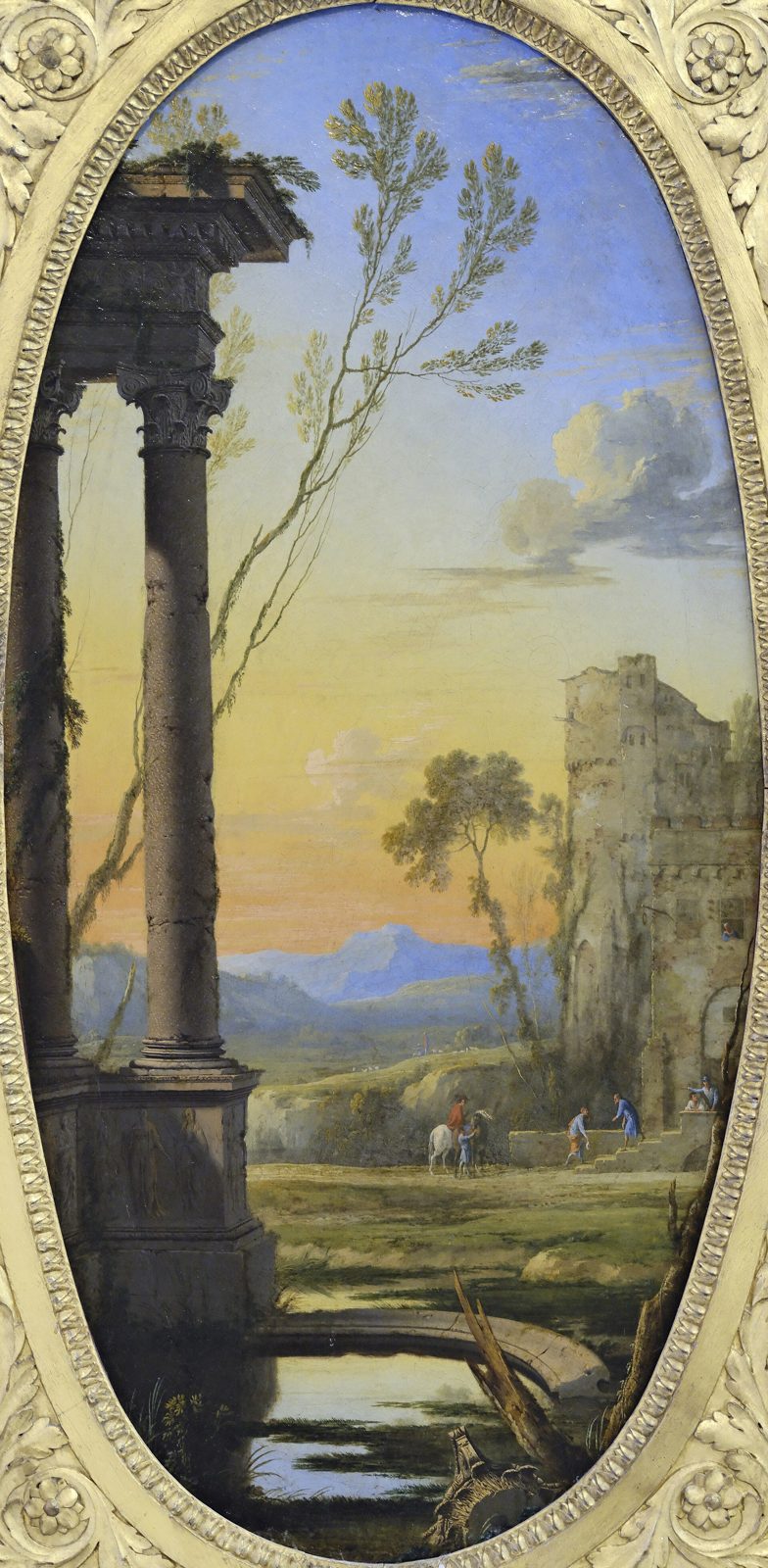
🎧 This work has audio narration — listen in the appTwo tall fluted columns rise on the left, their carved capitals almost lost against the sky, and a pedestal beneath them is decorated with tiny figures in low relief. Down in the foreground, a still pool holds a patch of blue sky, and a low arched stone bridge spans it. These are the things that tell you what kind of picture this is: a landscape built out of ruins, where the architecture has been left half standing and the grass has moved in.
The catalogue for the museum records it as a composed landscape under the French title "Paysage composé, le voyageur," and it describes the scene as a town gate, a traveler, ruins and a basin of water. Its earlier history is documented: it passed through the hands of a collector named Marin de la Haye in 1776, then belonged to Louis XVI, and finally became property of the French Crown. He worked on the decoration of the Cabinet de l'Amour at the Hôtel Lambert in Paris, alongside Simon Vouet and Eustache Le Sueur, and the works from that cabinet were later acquired by Louis XVI and are now in the Louvre. The sources describe this kind of painting as built for decoration, with clear compositions and soft pastel colors, and they say Patel was strongly influenced by Claude Lorrain.
Pierre Patel was a French painter of the seventeenth century, best known for his landscapes. Sources differ on his birth year and place: the English-language material gives 1605 and Picardy, while the French material places his birth at Chauny in 1604. Both agree that he died in Paris in 1676. He was admitted to the Guild of Saint-Germain-des-Prés in 1633 and to the Académie de Saint-Luc in 1635, marking his entry into the professional artistic life of the capital.
Patel's reputation rested on his skill with the landscape genre, and the French account describes him as one of the most gifted landscapists of his generation. He took part in major decorative commissions, including the "Cabinet de l'Amour" at the Hôtel Lambert in Paris, working alongside Simon Vouet and Eustache Le Sueur. Such projects suggest a painter trusted within the period's ambitious interior decoration.
His work was strongly shaped by the classical landscape tradition of Claude Lorrain. Patel developed a specialty in paintings of ruins, rendered in soft, pastel colours and with compositions designed to be clear and easily read, since they were intended above all for decoration. Within this consistent output he nonetheless found variety. He had a son, Pierre-Antoine Patel, born in 1648, who became a painter and was later celebrated for his ruin scenes, carrying the family's artistic legacy forward.
The material gives us a few concrete points. The painting was made in 1646 by Pierre Patel, and it is oil on canvas. Its recorded provenance runs through a collector named Marin de la Haye, who appears in 1776; then Louis XVI; and finally the French Crown. The catalogue title is 'Paysage composé, le voyageur', and the museum's inventory number is INV 7129. The material does not say who commissioned the picture or where it was first shown, so I won't guess at either.
Look at the scale first: this is a fairly tall, narrow canvas, about 78 by 38 units. The palette is soft and pastel, with a blue sky held in the still water of the pool, and the far hills fade toward an orange-yellow horizon. Two rider-and-walker figures stand together on the green path, and two more climb stone steps toward a ruined tower on the right. Small figures also show up in an opening high above. The lower right is given to a broken tree trunk and scattered debris, which gives the eye a rough, weathered place to land. The painted surface is described as smooth and finely detailed, with no visible signature or inscription.
Yes, his son and pupil Pierre-Antoine Patel became a well-regarded painter of ruins.