 Image: Shonagon
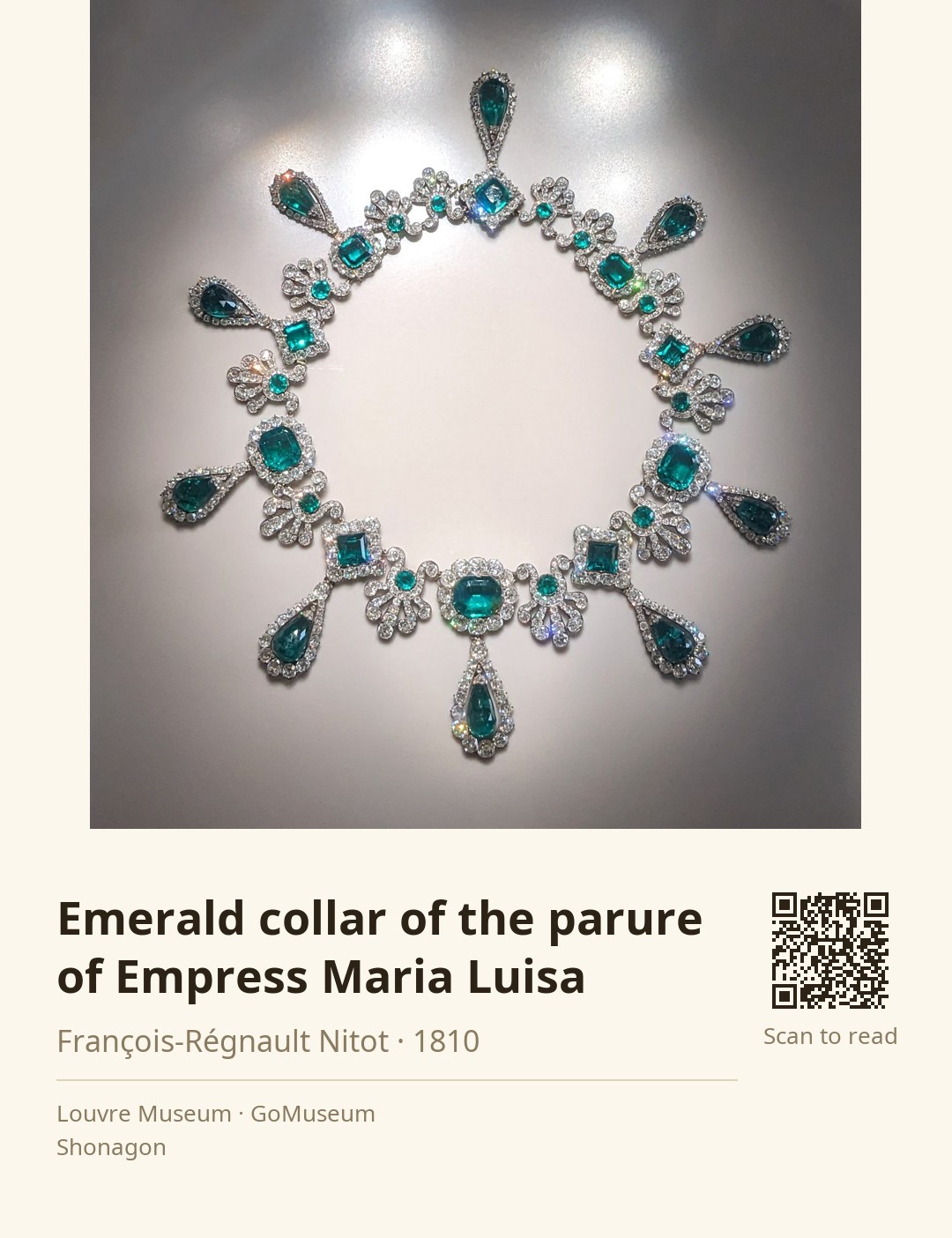
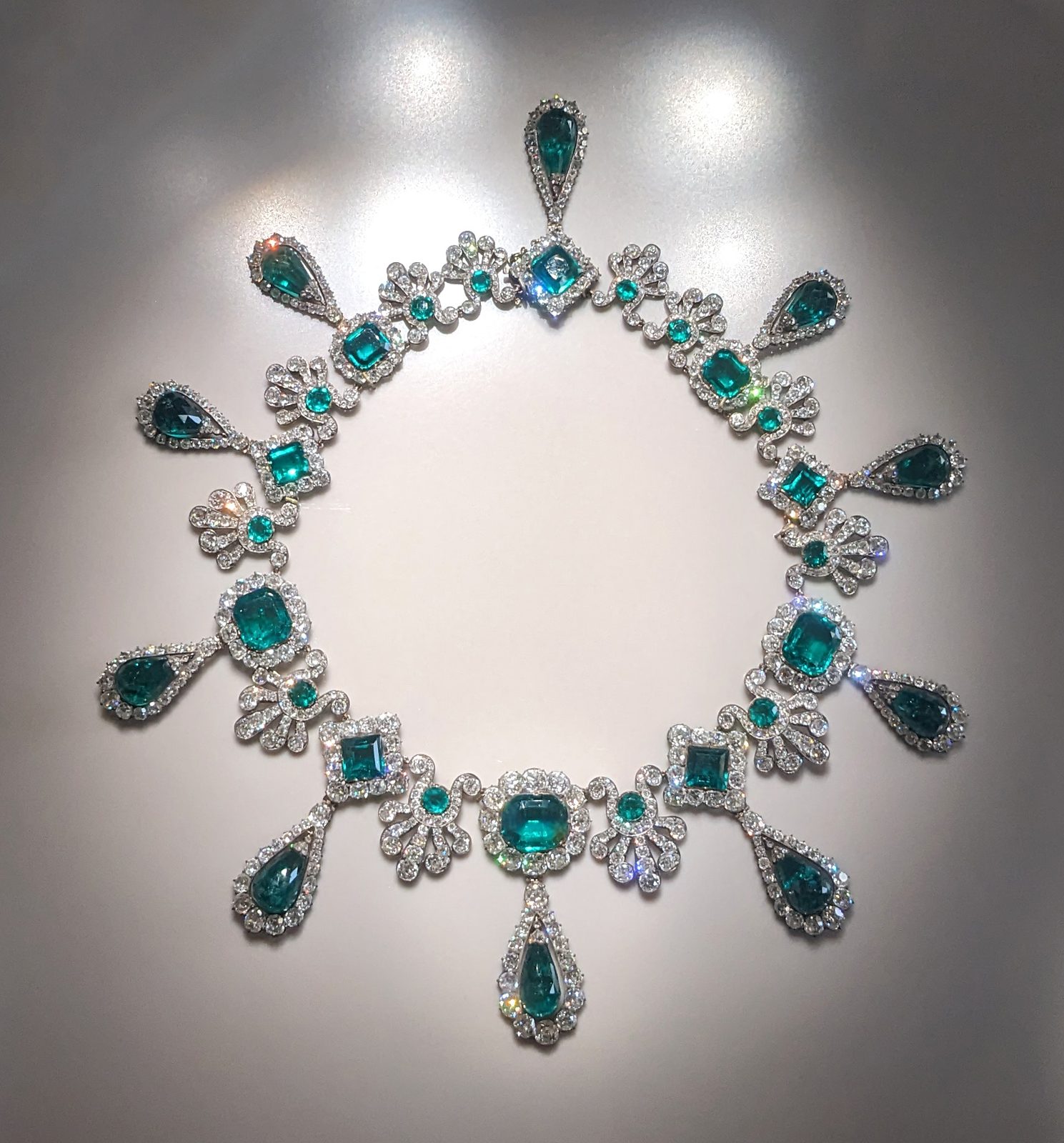
Emerald collar of the parure of Empress Maria Luisa
Ten emeralds, cut into tear-drops, hang from this circle of green like a row of pendants that never quite touch the ground. Look for the largest drop at the bottom center, ringed in small white stones, and the square link near the top where a green stone sits in its own setting above another drop. Each of the larger green stones is framed by a border of colorless gems, and between them the openwork fans, centered on small round emeralds, pick up the same rhythm.
The collar was made in 1810 by François-Régnault Nitot, who ran the Nitot house and served as official jeweler to Napoleon. It was part of a set given by Napoleon to Marie-Louise of Austria for their wedding, which took place on 2 April 1810, and the jewels were delivered at the end of March that year. The parure also included a diadem, a pair of earrings and a comb, and a belt buckle was added in August 1811. Because these were personal possessions of the empress rather than part of the Crown Jewels, she kept them when she left France in March 1814, and they passed down through several members of the Habsburg family. In 1953 the set was sold to the jeweler Van Cleef & Arpels, and after that the diadem was taken apart and its emeralds sold separately.
François-Régnault Nitot was a French jeweller, born in Paris on 25 February 1779, who became the official jeweller of Napoleon I. He was the son of the jeweller Marie-Étienne Nitot, and he took over the family house, the Maison Nitot, after his father. In 1809 he married Marie Jeanne Agathe Irisson, a Parisian, and their son, General Ferdinand Nitot, would later carry the family name into a military career. Nitot served the Emperor through the years of the empire, but when Napoleon fell in 1815 and went into exile, Nitot, who was a royalist, chose to withdraw from the jewellery trade. He handed the business to his workshop head, Jean-Baptiste Fossin. Alongside his craft, he was also mayor of Écharcon from 1817 to 1852, and he was buried there. He died on 19 January 1853 at his home on the Place Vendôme in Paris, outliving his wife. Among the works attributed to him is a necklace and pair of earrings made for Empress Marie-Louise in 1810, now held by the Louvre. The material says little about his personal temperament, so his character must be inferred mainly from his loyalty to the monarchy and his decision to leave his trade rather than continue under a new regime.
The necklace and earrings were acquired by Baroness Élie de Rothschild and kept as they were made, unlike other parts of the set, which were changed during the 20th century.
Yes. In 2015 it slipped from its stand inside its display case in the Galerie d'Apollon, before the cases were replaced in 2019.