Lamartine in front of the Town Hall of Paris rejects the red flag
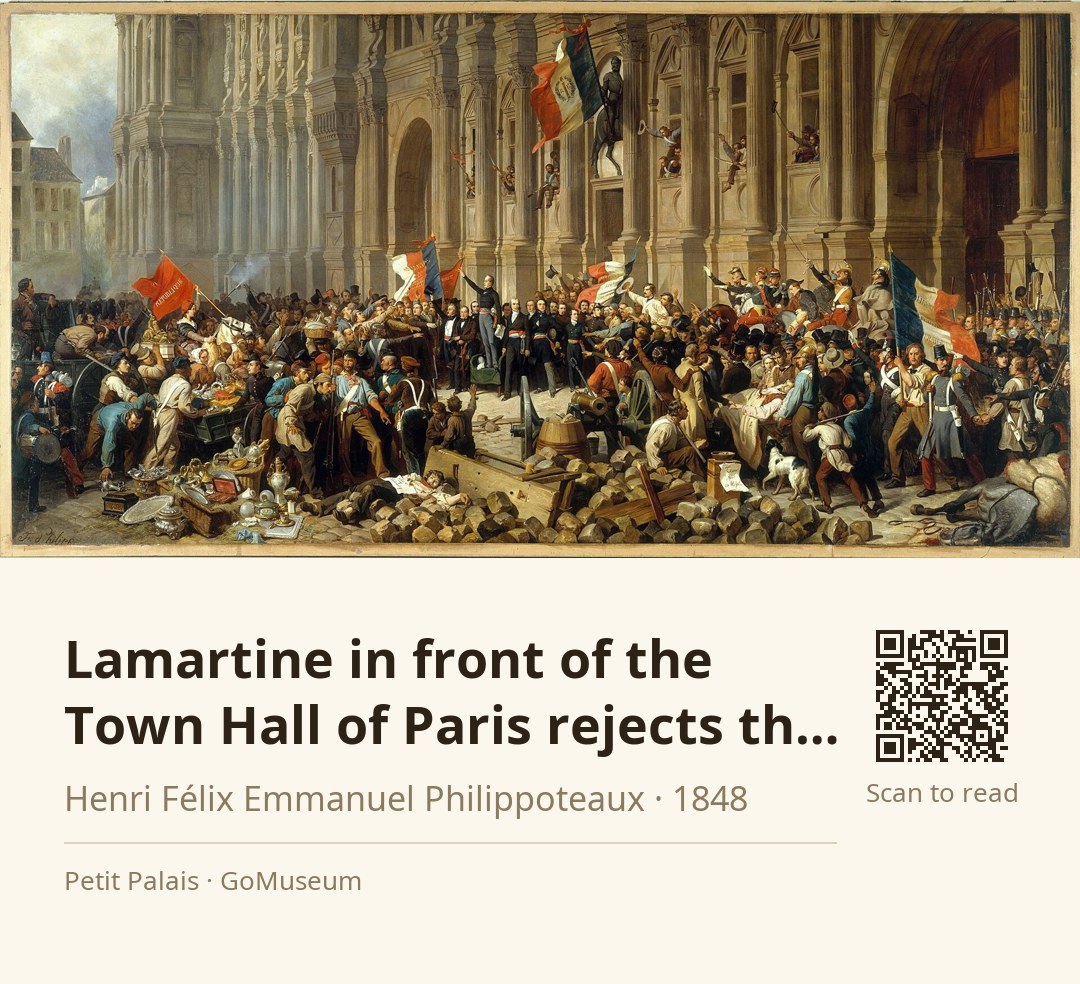
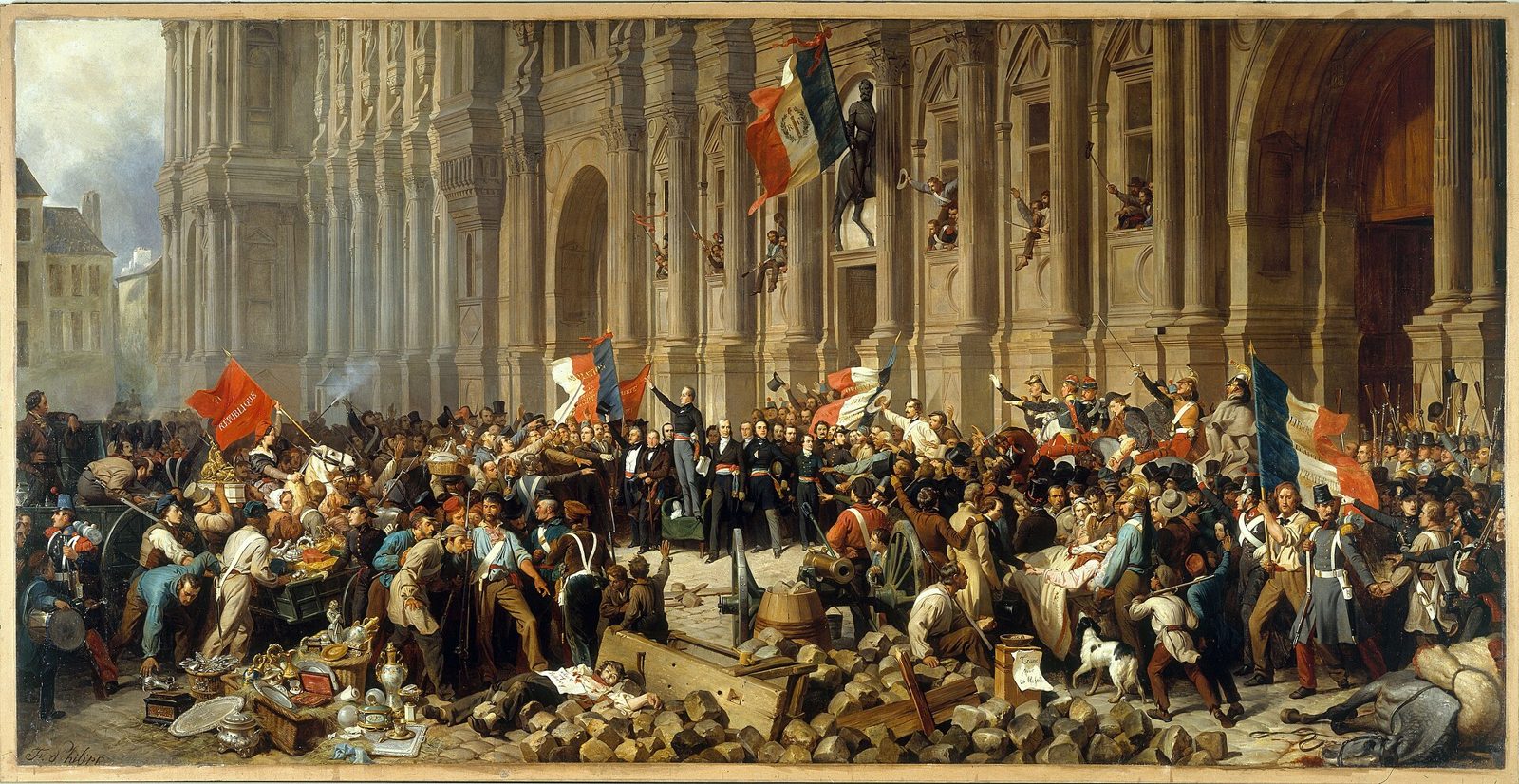
🎧 This work has audio narration — listen in the appA dense crowd presses into a cobbled square in front of a tall stone facade, and at its centre a man in a dark coat and sash stands raised on a chair, one arm flung out over the throng. Look at the red banner at the left, lettered "REPUBLIQUE," and then at the tricolour flags rising in the centre and on the right: the painting is staging a choice between two flags, and the outstretched arm is the moment of decision.
What makes the scene readable is the mix of the ordinary and the violent packed into the foreground. A cart and spilled silver lie at the left, while lower down a bloodied figure is stretched out on the paving stones, a small dog nearby, and a cannon and a wooden crate sit among the debris. On the right a wounded man is carried on a stretcher and a horse lies fallen beside the soldiers in their helmets and shakos. Fighting has just ended in this square, and the crowd has come to see who will shape what follows.
The man on the chair is Alphonse de Lamartine, the Romantic writer and politician who was a leading figure in the provisional government that gathered at the City Hall of Paris after the July Monarchy of Louis Philippe I fell in 1848. Lamartine rejected it in favour of the traditional tricolour, which remained the national flag during the Second Republic, and this painting commemorates that refusal. The proffered red flag is carried in the scene by an allegorical woman on horseback in a Phrygian cap, a figure who sits outside the crowd's ordinary world, marking the banner as an ideal being turned away.
Henri Félix Emmanuel Philippoteaux, known as Félix Philippoteaux, was born in Paris on 3 April 1815 and died in the same city on 8 November 1884. He trained under the painter Léon Cogniet and made his debut at the Paris Salon of 1833, quickly establishing himself as a painter of historical subjects, and above all as a specialist in battle scenes. His output included a portrait of Napoleon in regimental uniform and a series of canvases celebrating French victories in the Napoleonic Wars, reflecting a lasting fascination with the emperor's campaigns. He also painted subjects in an Orientalist vein. In 1846 he was made a Knight of the Légion d'honneur, a recognition of his standing among his contemporaries.
His fame, however, rests largely on the cyclorama, a vast circular painting designed to surround the viewer with a continuous 360-degree scene. Working with his son Paul Philippoteaux, who was also his pupil, he produced panoramas including a depiction of the Siege of Paris during the Franco-Prussian War, the Defence of the Fort d'Issy in 1871, and the Battle of Gettysburg, painted in 1882–83. The Gettysburg work proved remarkably popular in the United States, drawing about half a million visitors within a year and reviving public interest in the form for a further decade. To heighten the illusion, father and son added three-dimensional elements in front of the canvas, such as diorama features and real battlefield objects, blending them seamlessly into the painted scene.
Philippoteaux's work reflects a dedication to immersive spectacle and to the memory of French military history, from Napoleon's triumphs to the trauma of 1870–71. His collaboration with his son linked two generations of artists in a shared enterprise. His paintings are held in public collections, including the Versailles Museum of French History and the Victoria and Albert Museum in London. He died in Paris in 1884, and his obituary appeared in the New York Times that November.
Here is the story behind the canvas. In 1848 the July Monarchy of Louis Philippe I fell, and a provisional government gathered at the City Hall of Paris. Alphonse de Lamartine, the Romantic writer and politician, was a key figure in that government and formally proclaimed the French Second Republic. The painting, by Henri Félix Emmanuel Philippoteaux, is dated to around 1848 and is held at the Musée Carnavalet in Paris, where it was acquired in 1901.
The canvas is a large oil painting, roughly three metres high and six metres long, so it fills a wall and asks you to stand back. The palette is mostly warm greys and ochres, which makes the stone facade and the paving feel dusty and worn, with reds, blues and white picked out in the flags, the uniforms and the banner at left. Lamartine stands raised on a chair at the centre with one arm flung out, ringed by men in sashes, while the crowd packs the cobbled square and waving figures fill the windows above. The foreground is crowded with debris: a cart and spilled silver, vases and baskets, a wooden crate, a barrel, a cannon, and a small dog among the stones. On the right, a wounded person is carried on a stretcher beside soldiers in helmets and shakos and a fallen horse.
The painting shows an allegorical woman on horseback in a Phrygian cap carrying the red flag that the insurgents wanted adopted, which places an ideal figure outside the ordinary crowd, and Lamartine's rejection of that flag in favour of the tricolour is what the scene commemorates.
Yes, the painter, Henri Félix Emmanuel Philippoteaux, produced many works chronicling Napoleon's rise and victories, including a portrait of Napoleon in his regimental uniform.
Yes, Paul Philippoteaux was also an artist, and the two were known together for producing cycloramas, including one of the Battle of Gettysburg that became popular in the United States.